
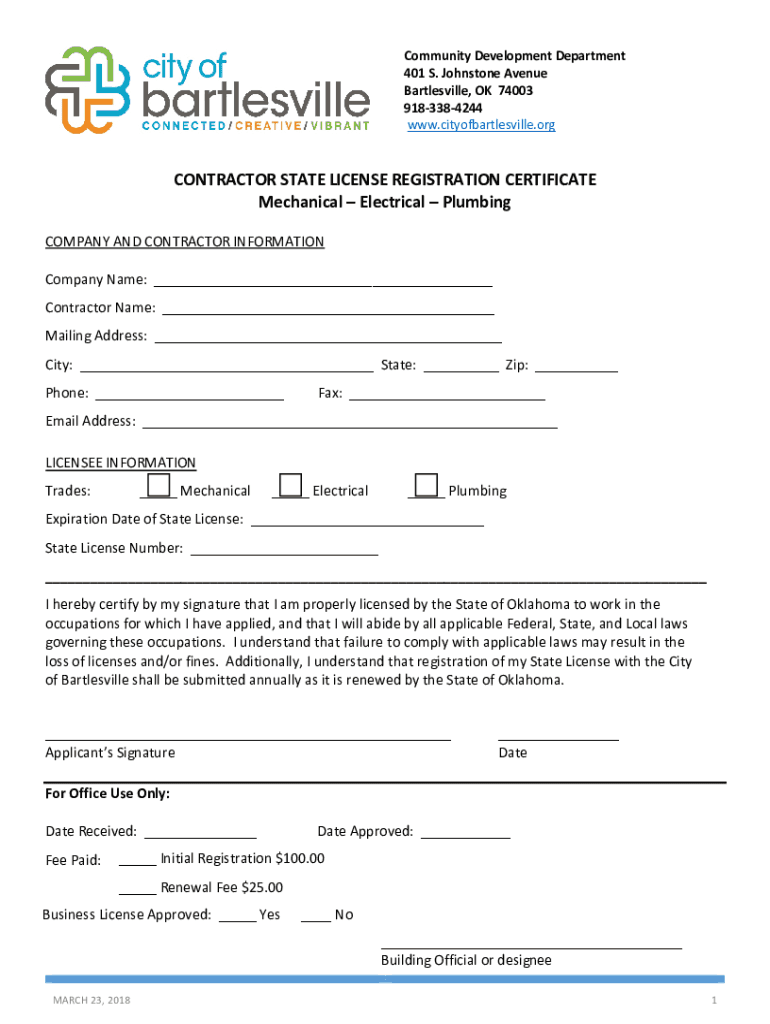







Definition and Purpose of the Contractor State License Registration Certificate
The Contractor State License Registration Certificate is a crucial document issued by the Community Development Department of Bartlesville, Oklahoma. It serves as an official record that mechanical, electrical, and plumbing contractors have met state licensing requirements to operate within the city. This form ensures compliance with local regulations and helps maintain high standards of safety and professionalism in the contracting industry. By registering their state licenses with the city, contractors affirm their commitment to adhere to relevant laws and guidelines, fostering trust with clients and regulators alike.
Importance for the Contracting Industry
- Maintains Compliance: Ensures adherence to state and city-specific regulations.
- Builds Trust: Establishes contractors as legitimate and reliable professionals.
- Facilitates Safety: Promotes adherence to safety standards in construction and maintenance.
How to Use the Contractor State License Registration Certificate
The certificate is utilized primarily by contractors to demonstrate their eligibility to perform work within the city legally. Contractors must provide accurate and up-to-date information about their business and professional credentials.
Key Steps for Utilization
- Complete the Certificate Form: Fill in all necessary details including company and contractor information.
- Attach Required Documents: Ensure that all supporting documents, such as copies of state licenses, are included.
- Submit to the Department: Deliver the completed form to the Community Development Department either online or in-person.
- Await Approval: After submission, the department reviews the application for completeness and compliance.
Business Benefits
- Streamlined Approval: Simplified process for local work authorization.
- Enhanced Credibility: Official recognition by local authorities boosts contractor credibility.
Steps to Obtain the Contractor State License Registration Certificate
Acquiring the certificate involves several structured steps to ensure compliance with both state and local standards.
Procedure Breakdown
- Verification of State Licensing: Contractors must first ensure that their state licensing is in order, as this is a prerequisite.
- Form Procurement: Obtain the registration certificate form from the Community Development Department in Bartlesville.
- Accurate Completion of the Form: Carefully fill out the form, ensuring all information is correct and complete.
- Documentation Submission: Gathering necessary supporting documents such as proof of insurance, tax ID numbers, and any other required paperwork.
- Form Submission: Choose the preferred method of submission—online, by mail, or in-person.
Processing Time and Approval
- Time Frame: The approval process typically takes a few weeks, depending on the department’s workload and verification processes.
- Notification: Applicants are notified once their certificate is approved or if additional information is required.
Key Elements of the Contractor State License Registration Certificate
The form consists of several critical sections that need to be completed accurately to ensure successful registration.
Essential Sections
- Company Information: Includes the business name, address, and contact details.
- Contractor Details: Personal and licensing information of the primary contractor.
- License Specifications: State license numbers and expiry dates.
- Certification of Compliance: A declaration by the applicant affirming adherence to local laws and standards.
Each section requires careful attention to detail to avoid potential delays or rejections.
State-Specific Rules for Contractor State License Registration
The requirements for obtaining and maintaining the Contractor State License Registration Certificate may vary based on state and local regulations.
Unique Considerations in Oklahoma
- Professional Standards: Oklahoma mandates specific qualifications for contracting trades such as electrical, plumbing, and mechanical work.
- Fee Structure: There are distinct fees for initial registration and renewals, subject to change by the Community Development Department.
- Renewal Requirements: Contractors must ensure timely renewals to avoid lapses that could affect their ability to work legally within the city.
Implications for Multi-State Contractors
Contractors operating in multiple states need to be aware of differing regulations and ensure that they hold the necessary certifications for each locality to avoid compliance issues.
Examples of Using the Contractor State License Registration Certificate
Understanding practical usages of the certificate can provide insights into its real-world applications.
Practical Scenarios
- New Construction Projects: Before initiating major construction projects, contractors must present their registration certificate to obtain necessary building permits.
- Service and Maintenance Work: Companies engaged in ongoing contracts for maintenance services need to renew their license registration to guarantee uninterrupted service capabilities.
- Bidding for Government Contracts: Contractors seeking public sector projects use the certificate as part of the qualification documents required during the bidding process.
These scenarios underline the certificate's significance in ensuring legal compliance and facilitating business operations.
Penalties for Non-Compliance
Failing to register or properly renew the Contractor State License Registration Certificate can result in severe consequences.
Potential Repercussions
- Fines and Penalties: Financial penalties imposed for lack of proper registration.
- Suspension of Work Authorization: Temporary cessation of work activities until compliance is achieved.
- Legal Action: Possible legal proceedings initiated by the local authorities, leading to further business disruptions.
Understanding these risks underscores the importance of maintaining current and complete documentation in adherence with local regulations.
Form Submission Methods
Contractors have multiple submission avenues for the registration process, offering flexibility based on their preferences and resources.
Available Submission Channels
- Online Submission: Convenient electronic form submission via the Community Development Department’s website.
- Mail Submission: Traditional postal service for physical form submissions.
- In-Person Submission: Direct handover of documents at the department’s offices for immediate handling.
Choosing a Submission Method
- Consider processing times related to each method.
- Evaluate the reliability of mail services against the certainty of in-person submissions.
- Opt for methods that offer acknowledgment of receipt to confirm on-time processing.




