




01. Edit your louisiana emancipation forms online
Type text, add images, blackout confidential details, add comments, highlights and more.

Type text, add images, blackout confidential details, add comments, highlights and more.

Draw your signature, type it, upload its image, or use your mobile device as a signature pad.

Send printable emancipation forms via email, link, or fax. You can also download it, export it or print it out.
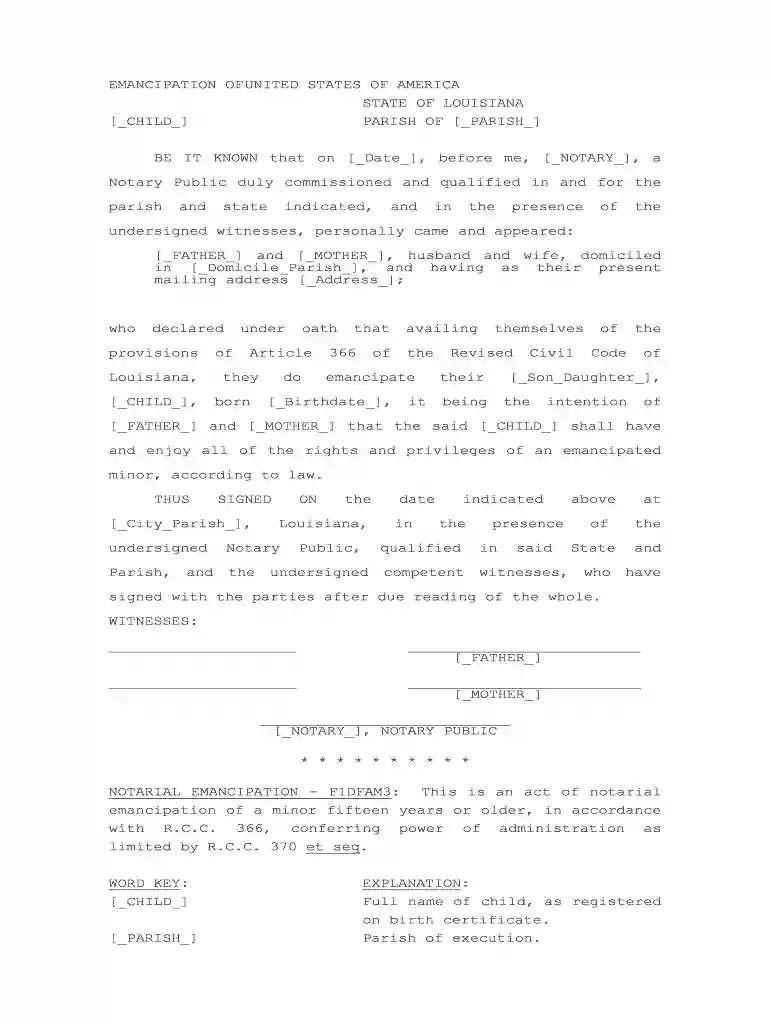
Louisiana emancipation forms are legal documents used to emancipate a minor, granting them rights typically reserved for adults. This process allows minors to assume legal responsibilities and make decisions without parental consent. According to the Louisiana Civil Code Article 366, the emancipation process involves a notarial act where the parents declare their intent to grant these rights to their minor child. The form includes essential details such as the names of the parents, the minor child, and the notary, along with the date and location of the act.
Using the Louisiana emancipation forms begins with understanding its purpose and gathering the necessary information. The form allows parents to formally request the court to grant their minor child adult status. When completing the form, ensure that every required field is accurately filled out, including personal details of the minor and both parents. Following completion, the document must typically be notarized to ensure its legality. After notarization, the form is submitted to the appropriate court for approval.
Obtaining the Louisiana emancipation forms involves accessing them through official legal resources. They can be acquired from the family court clerk's office or downloaded from legal service websites offering downloadable forms. Some platforms provide customizable templates that are compatible with standard legal requirements for the State of Louisiana.
Successfully completing the form requires careful attention to detail. Missteps can lead to delays or rejections, so following a detailed guide is essential.
Understanding the terminology used in the emancipation process is crucial to fully comprehend the legal contract.
These forms are designed for specific legal use and misuse can result in legal ramifications. Utilizing the form requires adhering to state law and intended purposes such as allowing a minor to manage their finances or obtain employment without parental consent.
The form is composed of essential components that ensure its completeness and validity. Proper understanding of each section is vital.
Unlike other states, Louisiana has unique rules regarding the emancipation of minors, which are important to understand.
Understanding and complying with these rules ensures the process is conducted legally and ethically within the state.
At DocHub, your data security is our priority. We follow HIPAA, SOC2, GDPR, and other standards, so you can work on your documents with confidence.
CHAPTER 2 - EMANCIPATION. Art. 365. There are three kinds of emancipation: judicial emancipation, emancipation by marriage, and limited emancipation byRead more
petition for judicial. 6 emancipation. See Civil Code Article 366. DIGEST. The digest printed below was prepared by House Legislative Services. It constitutesRead more
Dec 5, 2016 Many of the early French settlers were men, and marriageable women were in short supply. In 1690 only 16 white women were recorded on leRead more


