




Here's how it works

01. Edit your form online
Type text, add images, blackout confidential details, add comments, highlights and more.

02. Sign it in a few clicks
Draw your signature, type it, upload its image, or use your mobile device as a signature pad.

03. Share your form with others
Send it via email, link, or fax. You can also download it, export it or print it out.
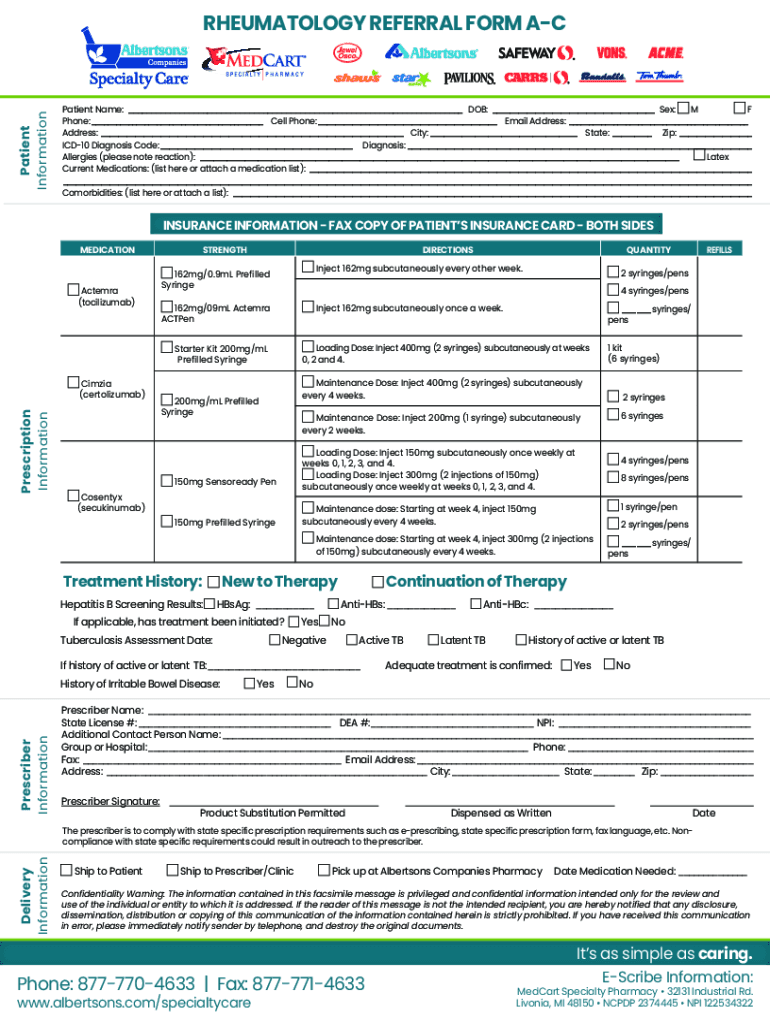
How to use or fill out Rheumatology Referral Form Fax# Patient Information

- Click ‘Get Form’ to open it in the editor.
- Begin by entering the patient's information, including their name, date of birth, sex, phone numbers, email address, and home address. Ensure all fields are accurately filled out for proper identification.
- Next, input the ICD-10 diagnosis code and a brief description of the diagnosis. This is crucial for insurance processing and treatment planning.
- List any known allergies along with their reactions. If there are no allergies, indicate this clearly.
- Document current medications either by listing them directly or attaching a medication list. This helps in understanding the patient's ongoing treatments.
- Include any comorbidities that may affect treatment decisions. Again, you can attach a list if necessary.
- Ensure to fax a copy of the patient’s insurance card (both sides) as required in the insurance information section.
- Finally, review all entries for accuracy before submitting the form through our platform to ensure seamless processing.
Start using our platform today to streamline your document editing and form completion!
Fill out Rheumatology Referral Form Fax# Patient Information online
It's free
It's free
See more Rheumatology Referral Form Fax# Patient Information versions
We've got more versions of the Rheumatology Referral Form Fax# Patient Information form. Select the right Rheumatology Referral Form Fax# Patient Information version from the list and start editing it straight away!
Got questions?
We have answers to the most popular questions from our customers. If you can't find an answer to your question, please contact us.
Contact us
When should a patient be referred to rheumatology?
When To See a Rheumatologist Signs and Symptoms. Recurrent fevers, joint swelling, fatigue, rash, anemia, weakness, and/or unexplained weight loss are signs and symptoms that may warrant a referral to rheumatology if no other explanation is found. Joint Pain. Skin Changes. Vision Changes. Abnormal Lab Tests.
What are the criteria for a rheumatology referral?
Adults with pain, swelling and stiffness of more than 1 joint, or the small joints of the hands or feet, are referred within 3 working days of their GP appointment to a specialist in rheumatology. Early referral means that they can be diagnosed and start treatment sooner if they have rheumatoid arthritis.
What is a referral for rheumatology?
If you develop symptoms that suggest a rheumatic disease, your primary care provider might refer you to a rheumatologist. These symptoms can be wide-ranging, but they have some common features your provider might recognize. Rheumatic diseases can: Happen in many places at once or all over your body.
Why would a person be referred to a rheumatologist?
Here are some reasons to see a rheumatologist: You have been diagnosed with arthritis or a rheumatic disease. You have joint pain and/or swelling. You have been told you have certain blood test results.
What are the 7 diagnostic criteria for RA?
The new criteria are as follows: 1) morning stiffness in and around joints lasting at least 1 hour before maximal improvement; 2) soft tissue swelling (arthritis) of 3 or more joint areas observed by a physician; 3) swelling (arthritis) of the proximal interphalangeal, metacarpophalangeal, or wrist joints; 4) symmetric
Security and compliance
At DocHub, your data security is our priority. We follow HIPAA, SOC2, GDPR, and other standards, so you can work on your documents with confidence.
Learn more


People also ask
Who gets referred to rheumatology?
If your GP spots any abnormal blood test results, it could be an indication of rheumatic disease, in which case they may refer you to a specialist rheumatologist for further investigation and an accurate diagnosis.
How to fill a patient referral form?
How to Write a Medical Referral Letter with Examples Header with Practice Details and Date. Recipients Information and Greeting. Patient Identification and Reason for Referral. Clinical Details. Investigations and Test Results. Reason for Referral and Request for Action. Patient Contact Information and Enclosures.