




01. Edit your 2023 schedule rk 1 online
Type text, add images, blackout confidential details, add comments, highlights and more.

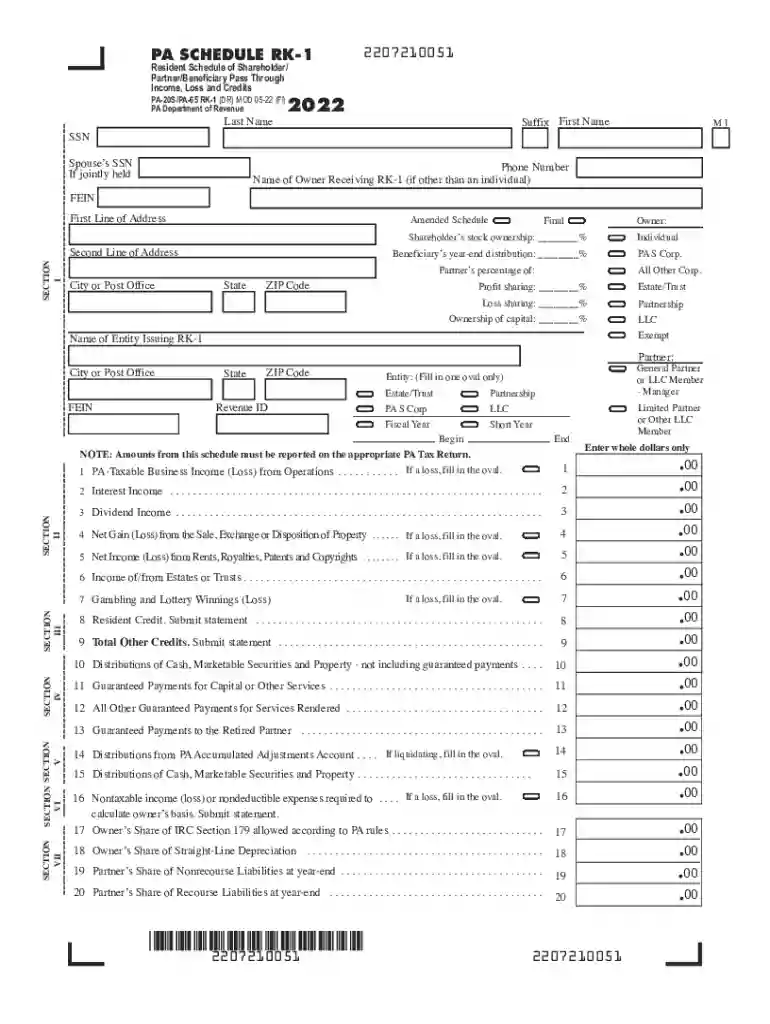
Type text, add images, blackout confidential details, add comments, highlights and more.

Draw your signature, type it, upload its image, or use your mobile device as a signature pad.

Send pa rk 1 via email, link, or fax. You can also download it, export it or print it out.
The PA-20S/PA-65 Schedule RK-1 is a form used in Pennsylvania by partnerships and S corporations to report income, losses, and credits to resident owners. This schedule is essential for ensuring compliance with Pennsylvania state tax laws. It requires the reporting of detailed financial information, including tax identification numbers, ownership percentages, and various types of income and distributions.
Partnerships and S corporations must follow specific instructions to accurately complete the Schedule RK-1. The form is primarily used to communicate financial data to resident owners, ensuring they can appropriately report this information on their personal tax returns.
The instructions for the PA-20S/PA-65 Schedule RK-1 can be accessed through Pennsylvania's Department of Revenue website. Alternatively, it is often available through e-Form RS systems used by accounting professionals and tax preparation services.
Failure to correctly complete and submit the Schedule RK-1 can result in penalties or fines, emphasizing the importance of understanding all requirements and deadlines.
The Schedule RK-1 must be completed and filed annually, typically aligned with federal tax filing deadlines. It is crucial for partnerships and S corporations to mark these key dates to avoid late filing penalties.
Preparation of the Schedule RK-1 necessitates a range of documents and data, including income statements, balance sheets, and partner-specific financial details.
Not adhering to the filing requirements or accurately reporting on the Schedule RK-1 can incur penalties, including fines or increased scrutiny from tax authorities.
Taxpayers have the option to submit their Schedule RK-1 digitally or via paper. Each method has its own processes and benefits.
While primarily for partnerships and S corporations, other business entities conducting operations or having income in Pennsylvania may also need to file the Schedule RK-1.
We've got more versions of the 2023 schedule rk 1 form. Select the right 2023 schedule rk 1 version from the list and start editing it straight away!
At DocHub, your data security is our priority. We follow HIPAA, SOC2, GDPR, and other standards, so you can work on your documents with confidence.
Feb 23, 2023 You can help bring these children home by looking at the photographs and calling 1-800-THE-LOST (1-800-843-5678) if you recog- nize a child.
Pennsylvania income tax forms, schedules, brochures, electronic filing options, and other information are available on the departments website. If you do not
May 6, 2008 Chapter 1 Introduction: Presents an overview of this manual, the other documentation and software provided with the PA PowerStation, and the


