
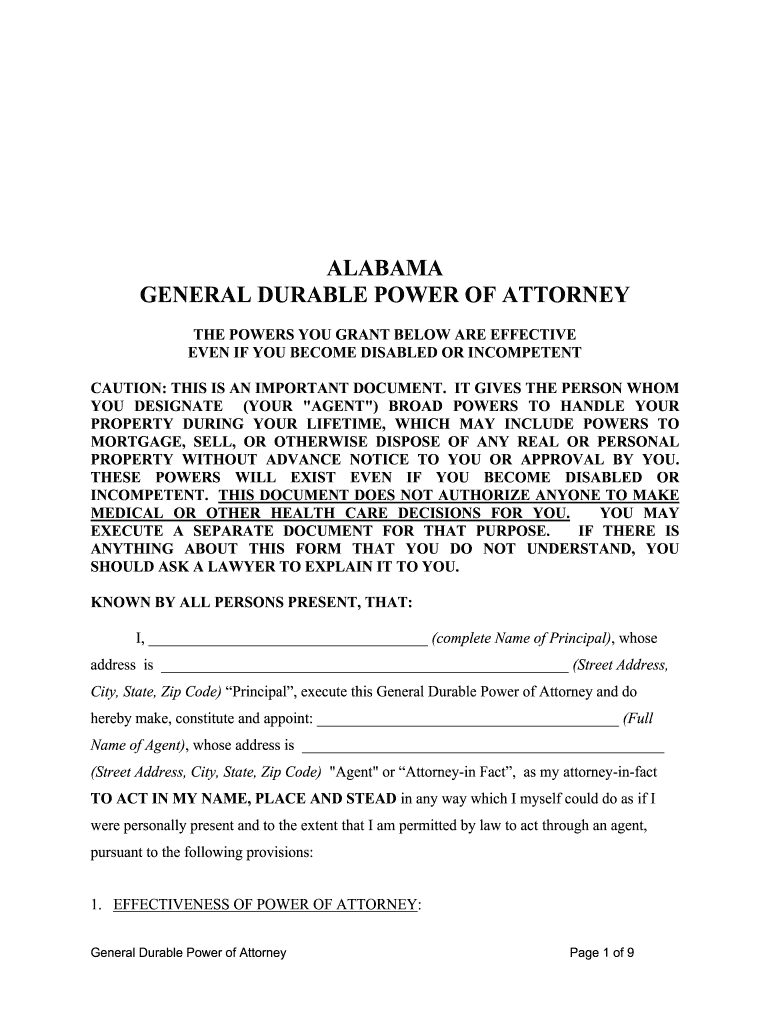







Definition & Meaning
A General Durable Power of Attorney for Alabama is a legal document granting authority to an agent to manage the property and financial affairs of the principal, even if the principal becomes incapacitated. This form is designed to cover a wide range of powers, such as managing bank accounts, real estate, or business interests, but it specifically excludes medical decision-making abilities. It is crucial to understand the scope and limitations assigned within this document to ensure it aligns with the principal's intentions.
How to Use the Alabama General Power of Attorney
The Alabama General Power of Attorney form is primarily utilized by individuals wishing to appoint an agent to handle their affairs when they are unable to do so themselves. The form should be filled out with exact information, clearly outlining the powers that the principal intends to bestow upon the agent. Critical for the document's effectiveness is specifying powers such as handling tax matters, real estate transactions, or financial administration. Always ensure the document is signed and notarized in accordance with Alabama law to be legally binding.
Common Use Cases
- Managing bank accounts and financial transactions
- Overseeing real estate matters, like buying or selling properties
- Managing business operations and interests
- Handling tax-related tasks and compliance
Steps to Complete the Alabama General Power of Attorney
- Appoint an Agent: Select a trusted individual who can manage your affairs responsibly.
- Define Powers: Clearly document the specific powers being granted. This might include financial, tax, property management, or business-related decisions.
- Revocation Criteria: Determine conditions that can lead to the revocation of the agent's authority.
- Legal Verification: Ensure the form is comprehensively completed, followed by signatures in the presence of a notary public.
- Distribution: Provide copies to relevant parties, such as financial institutions or legal advisors, to ensure broad understanding and acknowledgment.
Key Elements of the Alabama General Power of Attorney
A thorough Alabama General Power of Attorney includes specific components to guarantee legal compliance and clarify roles:
- Principal Information: Full name, address, and contact information of the person appointing an agent.
- Agent Details: Contact details of the appointed agent, including any potential successor agents.
- Scope of Power: A detailed account of what the agent is authorized to do.
- Effective Date and Duration: Clear statements on when the powers take effect and any expiration dates.
- Signatures: Both the principal and agent must sign, with notarization to ensure validity.
Optional Provisions
- Successor agents
- Indemnification clauses
- Detailed revocation process
Legal Use of the Alabama General Power of Attorney
In Alabama, the General Power of Attorney is legally recognized for authorizing an agent to carry out virtually any act that the principal could do themselves, excluding medical decisions. Alabama law requires these documents to be in writing, clearly stating the powers granted, and executing them with clear adherence to state regulations. Importantly, these documents must be signed and notarized to withstand scrutiny in legal or financial institutions.
Examples of Using the Alabama General Power of Attorney
Consider scenarios where a business owner might need someone to manage their financial interests during extended travel or medical emergencies. For instance, if the principal holds multiple properties, they might authorize their agent to manage leases and handle tenant relations. Alternatively, the power might be used to ensure that bills and taxes are paid during a prolonged illness.
Financial Management
- Overseeing investment portfolios
- Executing tax filing responsibilities
- Negotiating and signing loan documents
State-Specific Rules for the Alabama General Power of Attorney
Alabama requires the form to be not only written but also notarized to be valid. Any modifications or revocations must be documented in writing and also notarized to ensure enforceability. Furthermore, principals often appoint a successor agent, a measure that stands out particularly in Alabama to account for the primary agent's unavailability or incapacity.
Alabama-Specific Requirements
- Must be signed and notarized
- Cannot include medical decision-making authority
- Successor agent appointments are common
Important Terms Related to Alabama General Power of Attorney
Understanding key terms associated with the Alabama General Power of Attorney ensures clarity in its execution:
- Principal: The individual granting the power.
- Agent: The person receiving the authority to act on behalf of the principal.
- Durable: The document remains effective even if the principal becomes incapacitated.
- Successor Agent: An alternate agent designated to act if the original agent is unable or unwilling.
State-by-State Differences
While Alabama follows specific guidelines for executing general powers of attorney, these processes can vary significantly across states. Some states might have stricter notarization or witness requirements, while others could allow medical decision-making as part of the powers granted. Comparisons with neighboring states, for instance, might reveal differences in the duration for which a power of attorney remains valid or in the documents' revocation processes.




