




01. Edit your form online
Type text, add images, blackout confidential details, add comments, highlights and more.

Type text, add images, blackout confidential details, add comments, highlights and more.

Draw your signature, type it, upload its image, or use your mobile device as a signature pad.

Send it via email, link, or fax. You can also download it, export it or print it out.
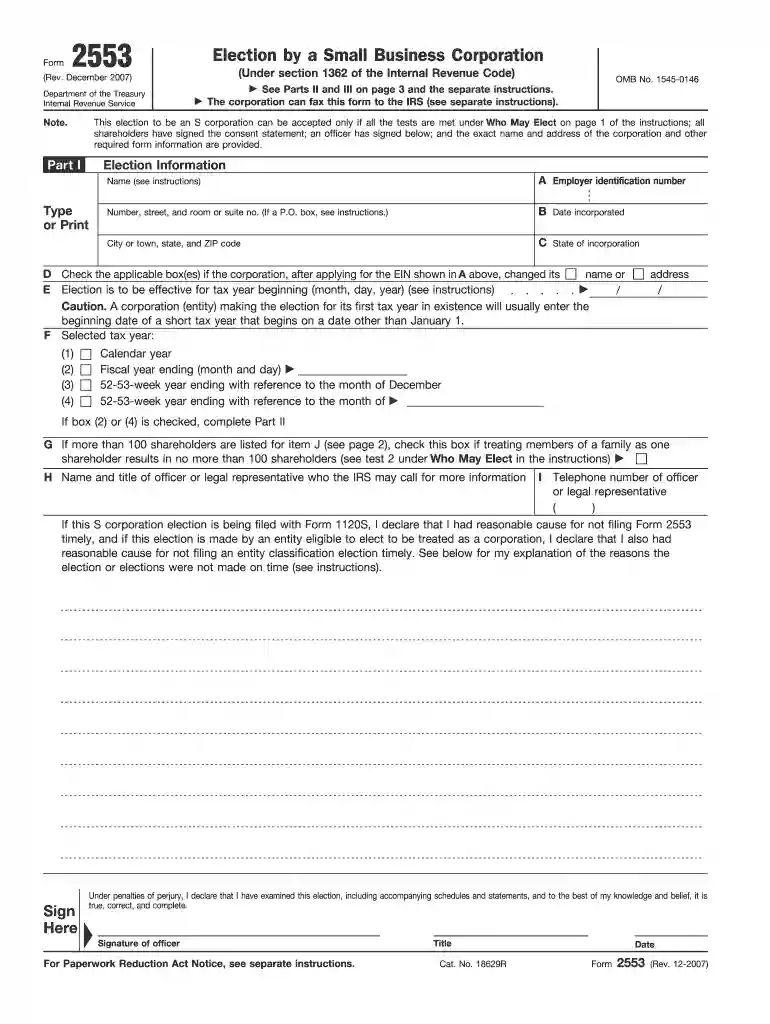
Form 2553, officially titled "Election by a Small Business Corporation," is a document filed with the Internal Revenue Service (IRS) that allows eligible small business corporations to elect S corporation status. This designation under the Internal Revenue Code provides the company with a particular tax treatment, enabling the income to be passed directly to shareholders and taxed at individual income tax rates. This tax classification can be beneficial for avoiding the double taxation that occurs with C corporations, as profits are taxed only at the shareholder level.
To qualify for S corporation status, corporations must meet specific criteria defined by the IRS:
Understanding these criteria ensures that businesses correctly determine their eligibility for filing Form 2553 before proceeding with the election process.


Filing Form 2553 requires precision and attention to detail. Here are the essential steps involved:
Accurate completion is critical, as errors or omissions can lead to delays or rejections by the IRS.
Understanding specific terminology is crucial when dealing with Form 2553:
This understanding ensures accurate completion and compliance with IRS regulations.
The IRS provides specific guidelines for the election of S corporation status. These guidelines include:
Following these guidelines is essential to ensure that the election is valid and to maintain the benefits of S corporation status.
Meeting filing deadlines is crucial for the successful election of S corporation status. Key dates include:
Adhering to these deadlines is paramount to ensure the election takes effect as intended.
Form 2553 can be submitted through several methods:
Select the method that best suits your business’s operational capabilities and filing preferences.
Certain types of business entities stand to gain the most from electing S corporation status via Form 2553:
Assessing your organization’s structural needs and tax goals can help determine if an S corporation election is advantageous.
Form 2553 holds significant legal implications. Its application extends to:
Due diligence in legal compliance is necessary to maintain the benefits afforded by this form.
eSignatures are a great alternative to traditional signing, as they save time, effort, and costs people spend on printing, scanning, and paper delivery. You can eSign your form 2553 2007 using a reliable and robust online document processing services like DocHub. It complies with primary eSignature standards (ESIGN and UETA), so all forms approved there are legally binding and have the same validity as manually signed ones.
It is a no-brainer on a computer or via a mobile device to fill out a form 2553 2007 with DocHub. All you need to do is open any installed browser on your smartphone and proceed to the DocHub website. Once authenticated, add your document and open it in editing mode. Use our toolbar to make your edits and save changes. Optionally, keep your document in your files or send it to a recipient immediately.
At DocHub, your data security is our priority. We follow HIPAA, SOC2, GDPR, and other standards, so you can work on your documents with confidence.
Application for Employer Identification Number. Form 2553, Election by a Small Business Corporation. Enter the mailing address Form 2553.
Attach to Form 2553 a statement describing the relevant facts and circumstances and, if applicable, the gross receipts from sales and services necessary toRead more


