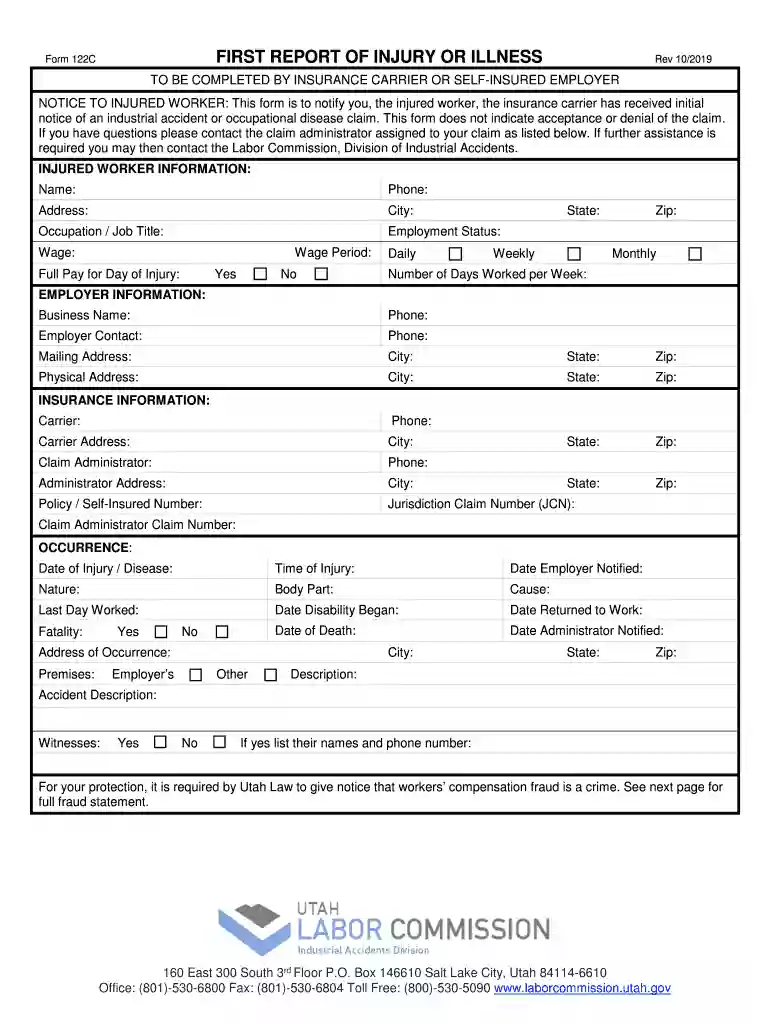
Form 122C 2026

Get Form
Form 122C Preview on Page 1

Here's how it works

01. Edit your form online
Type text, add images, blackout confidential details, add comments, highlights and more.

02. Sign it in a few clicks
Draw your signature, type it, upload its image, or use your mobile device as a signature pad.

03. Share your form with others
Send it via email, link, or fax. You can also download it, export it or print it out.

Definition and Meaning of Form 122C

Form 122C, officially known as the "First Report of Injury or Illness," serves as a critical component in the workers' compensation process within the United States. It is typically used by insurance carriers or self-insured employers to officially notify about an industrial accident or occupational disease claim. This form is essential in documenting the occurrence, details of the injury, and involved parties, ensuring a comprehensive record that guides subsequent insurance and legal actions.

Purpose and Functionality

The primary function of Form 122C is to streamline the claims process between employers, employees, and insurance entities. By capturing all the crucial information related to an injury or illness, such as dates, locations, and medical evaluations, the form facilitates a transparent flow of information that expedites the resolution process. It ensures that all parties have access to consistent data, thereby reducing potential disputes or misunderstandings regarding the incident.

Steps to Complete Form 122C

Completing Form 122C requires attention to detail to ensure accuracy and compliance with legal standards. Here's a detailed guide on how to fill out this essential form:

  1. Gather Necessary Information:

    • Collect details about the injured employee, including name, contact information, and employee ID.
    • Obtain information about the employer, such as company name, contact details, and insurance provider.
  2. Document the Incident:

    • Provide a detailed description of the incident, including the date, time, and location.
    • Include a thorough account of the circumstances leading to the injury.
  3. Medical Evaluation:

    • Record all relevant medical assessments, diagnosis, and treatment plans.
    • Attach any medical reports or evaluations provided by healthcare professionals.
  4. Submit the Form:

    • Ensure all sections are completed accurately and legibly.
    • Submit the form to the appropriate insurance carrier or regulatory authority as stipulated in your jurisdiction.

Important Considerations

  • Accuracy: Ensure that all information is correct to avoid delays.
  • Timeliness: Adhere to submission deadlines to maintain eligibility for compensation.

Key Elements of Form 122C

Form 122C includes several critical sections that must be completed accurately:

  • Injured Worker Information: Personal and contact details of the employee.
  • Employer Information: Company name, address, and insurance information.
  • Incident Description: Detailed account of how, when, and where the injury occurred.
  • Medical Assessment: Documentation of medical evaluations and treatments.
  • Insurance Details: Information about the insurance policy covering the incident.

Challenges and Solutions

  • Complex Terminology: Clarify any legal or medical jargon by consulting a supervisor or legal advisor.
  • Incomplete Information: Cross-reference with company records to ensure no information is missing.

Who Typically Uses Form 122C

Form 122C is primarily utilized by:

  • Insurance Carriers: To process and manage claims efficiently.
  • Employers: To fulfill legal obligations regarding workplace injuries.
  • Employees: To ensure they receive due compensation and support following an injury or illness.

Collaboration Among Stakeholders

Efficient use of Form 122C often involves collaboration between these entities to ensure a smooth and transparent claims process.

State-Specific Rules for Form 122C

While Form 122C is a standard form used across many states, specific regulations and requirements may vary:

  • Filing Deadlines: Some states mandate shorter timeframes for reporting injuries.
  • Required Documentation: Different states may require additional documentation or specific information.

Understanding Local Regulations

To ensure compliance, employers and employees should familiarize themselves with state-specific workers’ compensation laws and guidelines. It’s advisable to consult legal experts or local authorities for the most accurate information.

Penalties for Non-Compliance

Failure to comply with Form 122C requirements can lead to significant penalties, including:

  • Fines: Monetary penalties for late or incomplete submissions.
  • Legal Action: Potential lawsuits or claims disputes that can arise from non-compliance.
  • Loss of Benefits: Employees may be denied compensation if the form is not properly completed or submitted.

Mitigation Strategies

  • Regular Training: Conduct training sessions for HR and administrative staff on compliance and documentation.
  • Automated Reminders: Implement systems that alert responsible parties about upcoming deadlines and requirements.

Examples of Using Form 122C

To understand the practical application of Form 122C, consider these scenarios:

  • Construction Accident: An employee sustains an injury at a construction site, requiring the employer to fill out Form 122C to report the incident.
  • Industrial Illness: Exposure to hazardous materials leads to an illness, prompting the use of Form 122C to initiate a workers' compensation claim.

Real-World Insights

These examples underscore the form's role in ensuring that incidents are documented, assessed, and managed according to legal standards, helping safeguard both employees and employers.

Eligibility Criteria for Form 122C

To qualify for reporting using Form 122C, specific criteria must be met:

  • Employment Status: The injured party must be a recognized employee of the reporting company.
  • Nature of Incident: The injury or illness must be work-related, occurring within the scope of job duties.
decoration image ratings of Dochub

Verification Process

Employers should have clear processes in place to verify the eligibility of claims to prevent fraudulent reporting and ensure legitimate cases are addressed promptly.

Digital vs. Paper Version of Form 122C

The transition from paper to digital formats has improved the efficiency of handling Form 122C:

  • Accessibility: Digital forms can be completed and submitted online, facilitating quicker processing.
  • Environmental Impact: Reduces paper usage and storage needs, promoting sustainability.

Considerations for Digital Usage

While digital versions offer numerous benefits, companies must ensure that digital forms comply with accessibility standards and provide options for employees who may lack the necessary technology.

See more Form 122C versions

We've got more versions of the Form 122C form. Select the right Form 122C version from the list and start editing it straight away!
Versions Form popularity Fillable & printable
2019 4.8 Satisfied (101 Votes)
be ready to get more

Complete this form in 5 minutes or less

Get form

Got questions?

We have answers to the most popular questions from our customers. If you can't find an answer to your question, please contact us.
Contact us
Take your monthly income and deduct living expenses, priority debt payments, and secured payments. The remaining amount is your disposable income. Youd are responsible to pay this amount to creditors each month.
A 60 month plan is required if the debtors gross income in the six months prior to filing is above the median income for the family size in the state. Plans cannot exceed 60 months. That means that any debts that must be paid must be able to be paid within 60 months.
Official Form 122C-1 (Statement of Your Current Monthly Income and Calculation of Commitment Period) and Official Form 122C-2 (Chapter 13 Calculation of Your Disposable Income) (collectively the 122C Forms) are designed for use in chapter 13 cases.
To calculate your monthly payment amount in a Chapter 13 bankruptcy, calculate your income for the six months before your bankruptcy filing. Deduct allowable expenses to determine your disposable income. Pay your priority debtors and any secured debts that you want to keep after the bankruptcy.
Once you take your income and subtract your taxes (federal, state, and local), your required paycheck deductions (Social Security, Medicare, unemployment insurance, back taxes, and court-ordered child support), and any other mandatory government payments (licenses, fees, and permits), what remains is your disposable

Security and compliance

At DocHub, your data security is our priority. We follow HIPAA, SOC2, GDPR, and other standards, so you can work on your documents with confidence.

Learn more
ccpa2
pci-dss
gdpr-compliance
hipaa
soc-compliance
be ready to get more

Complete this form in 5 minutes or less

Get form