




01. Edit your m4np 2023 online
Type text, add images, blackout confidential details, add comments, highlights and more.

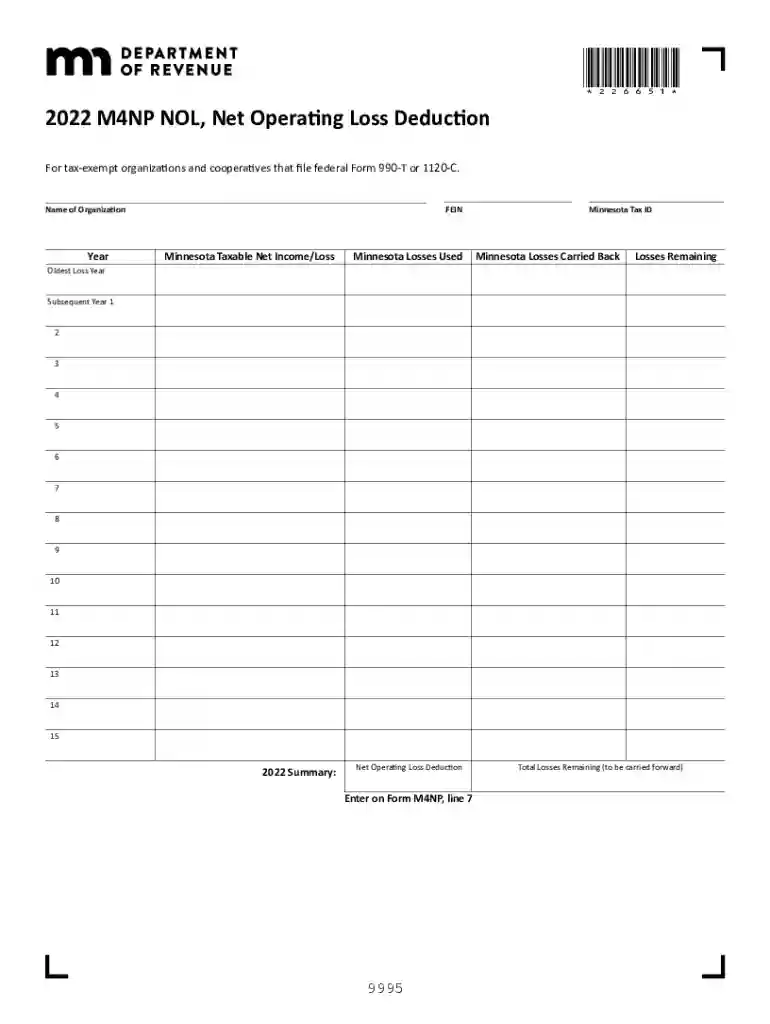
Type text, add images, blackout confidential details, add comments, highlights and more.

Draw your signature, type it, upload its image, or use your mobile device as a signature pad.

Send m4np via email, link, or fax. You can also download it, export it or print it out.
The M4NP form serves a critical role for tax-exempt organizations and cooperatives in the United States, enabling them to report and calculate their Net Operating Loss (NOL) deductions. This form is particularly significant for entities that have experienced financial losses and wish to carry these losses forward to offset future income. The primary objective of the M4NP is to streamline the process of claiming NOL deductions by establishing clear guidelines and limitations specific to these types of organizations.
Obtaining the M4NP form is an essential step for organizations planning to report their NOL deductions. The form can be accessed directly from the IRS website, ensuring that users have the most current version available. Additionally, many accounting software programs, such as TurboTax and QuickBooks, offer the option to download the form within their platform. For those preferring a physical copy, the form may be available through local IRS offices, or it can be ordered by phone through the IRS toll-free number.
Gather Required Documents: Begin by collecting all necessary financial statements and previous tax returns. This will facilitate accurate reporting of losses and ensure compliance with IRS requirements.
Calculate NOL Deductions: Accurately compute the Net Operating Losses by following the step-by-step instructions provided on the form. Remain within the 80% cap of the taxable net income and consider any prior year losses that need to be carried forward.
Complete Each Section Carefully: Fill out the form meticulously, paying close attention to each required field. Confirm that figures are accurate and calculations are correct to prevent errors that could delay processing.
Review for Errors: Before submission, double-check for any discrepancies or omissions. Correcting mistakes early can save time and avoid complications with the IRS.
Submit the Form: Once completed, the form can be submitted either electronically, through the IRS's online system, or by mailing it to the designated IRS address. Ensure all pertinent deadlines are met.
Consider a tax-exempt cooperative that experiences financial losses in a fiscal year. This cooperative would utilize the M4NP form to calculate their NOL and determine how much can be carried forward to reduce taxable income in future years. By adhering to the established 80% limitation, they ensure compliance while strategically planning for future tax minimization. Additionally, the cooperative might rely on past trends to predict future income and optimize their NOL utilization.
To efficiently complete the M4NP, organizations should collect:
Entities that frequently use the M4NP form include:


Compliance with the M4NP guidelines is mandatory to prevent penalties and ensure that an entity remains in good standing with the IRS. Tax-exempt entities must adhere to the specific provisions specified within the form, including deduction limitations and carryforward rules. Non-compliance can lead to fines or more severe legal consequences, emphasizing the importance of accuracy and rigorous record-keeping.
The IRS provides explicit guidelines for the M4NP, offering direction on:
Timely submission of the M4NP is critical, with specific deadlines aligned with the fiscal year of the organization. Typically, the form should be filed along with the annual tax return, with March 15 being a common deadline for many tax-exempt entities. Marking these dates is essential to avoid penalties and ensure smooth processing of the NOL deductions.
The IRS allows both digital and paper submissions of the M4NP form, providing flexibility to organizations based on their preferences and capabilities. Electronic filing can be done through the IRS.gov website for faster processing and immediate confirmation of receipt. Alternatively, mailing a physical copy remains an option, although it may require additional time for processing and acknowledgement.
These expanded details ensure that organizations using the M4NP form have a comprehensive understanding of its purpose, how to accurately complete it, and the implications of its use within the context of U.S. tax law compliance.
We've got more versions of the m4np 2023 form. Select the right m4np 2023 version from the list and start editing it straight away!
| Versions | Form popularity | Fillable & printable |
|---|---|---|
| 2025 | 4.4 Satisfied (20 Votes) | |
| 2024 | 4.9 Satisfied (39 Votes) | |
| 2023 | 4.2 Satisfied (56 Votes) | |
| 2022 | 4.8 Satisfied (84 Votes) | |
| 2021 | 4.3 Satisfied (154 Votes) | |
| 2020 | 4.3 Satisfied (25 Votes) | |
| 2019 | 4.3 Satisfied (98 Votes) | |
| 2018 | 4.4 Satisfied (60 Votes) | |
| 2016 | 4.2 Satisfied (47 Votes) | |
| 2015 | 4.3 Satisfied (165 Votes) | |
| 2014 | 4.2 Satisfied (59 Votes) | |
| 2004 | 4 Satisfied (41 Votes) | |
| 2003 | 4 Satisfied (53 Votes) |
At DocHub, your data security is our priority. We follow HIPAA, SOC2, GDPR, and other standards, so you can work on your documents with confidence.
by MLT Lee 2022 Cited by 5 Regression functions for the process and threshold parameters in these models are multivariate combinations of explanatory variates. TheRead more
by YX Li 2018 Cited by 5 Knowledge of solubility for 1-methyl-4-nitropyrazole (1-M-4-NP) in different solvents is important for its purification and further theoretical studies. In thisRead more


