




Understanding the Official Audiogram
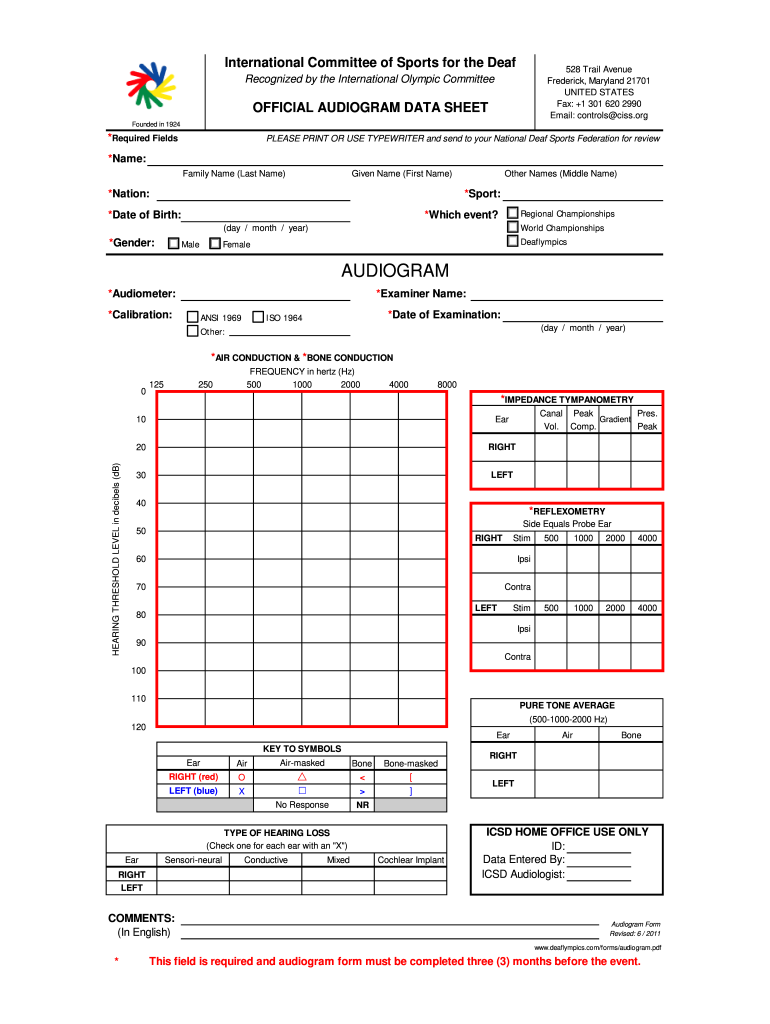
The official audiogram serves as a vital document for individuals with hearing impairments, especially within contexts such as athletics, medical evaluations, or educational assessments. The audiogram illustrates the degree and type of hearing loss experienced by an individual, captured through standardized testing methods.
Components of an Official Audiogram
Every official audiogram typically contains detailed sections to effectively communicate the individual's auditory abilities:
-
Personal Information:
- Name of the individual
- Date of birth
- Contact details
- Identification numbers (if applicable)
-
Hearing Test Results:
- Frequency levels tested (in Hertz)
- Decibel levels (dB) indicating the softest sounds heard
- Symbols to mark the thresholds of hearing for each ear
-
Types of Hearing Loss:
- Conductive hearing loss
- Sensorineural hearing loss
- Mixed hearing loss
- Configuration of hearing loss (flat, sloping, rising)
How to Complete an Audiogram Form
Completing an audiogram accurately is crucial for proper diagnosis and treatment. The following steps ensure clarity and precision:
-
Gather Necessary Information:
- Collect personal details and previous medical history related to hearing.
- Ensure the audiologist has the appropriate equipment for testing.
-
Conduct Hearing Tests:
- Perform pure-tone audiometry to determine hearing thresholds.
- Use additional tests like speech recognition or tympanometry as needed.
-
Document Results on the Form:
- Clearly mark thresholds for each frequency tested.
- Annotate any anomalies or specific conditions observed during testing.
-
Review for Accuracy:
- Double-check all entries for completeness and correctness.
- Confirm understanding between the audiologist and the individual regarding their hearing profiles.
Usage of the Official Audiogram
The official audiogram is used in various scenarios, including:
- Participation in Competitions: Athletes, particularly those competing in Deaflympics or similar events, often need official audiograms to verify eligibility.
- Medical Assessments: Audiologists utilize the audiogram to devise personalized treatment plans and recommend appropriate interventions.
- Educational Settings: Schools may require audiograms to assess students' needs and accommodations for hearing support.
Important Terminology Related to Audiograms
Familiarity with key terms is essential when interpreting an audiogram. Here are some significant terms:
- Threshold: The minimum level of sound an individual can hear at a certain frequency.
- Decibels (dB): A unit measuring sound intensity, crucial for interpreting hearing loss severity.
- Air Conduction vs. Bone Conduction: Methods used to evaluate hearing through air (ear canal) and bone (skull), respectively.
Legal and Ethical Considerations
The usage of audiograms involves various legal and ethical implications. Key points include:
- Compliance with Regulations: Audiograms must adhere to standards set by governing bodies such as the Americans with Disabilities Act (ADA), ensuring equal access to services.
- Data Privacy: Personal and medical information must be securely handled to maintain confidentiality.
Examples of Official Audiogram Applications
The efficacy of an official audiogram can be viewed through diverse practical applications:
- Athletics: A swimmer may present their official audiogram to prove fitness to compete in Deaflympics.
- Medical Diagnosis: Children with suspected hearing impairments undergo audiometric testing, the results being documented in an official audiogram to guide further evaluation.
- Educational Assessments: An audiogram may be submitted to the school district to help establish Individualized Education Programs (IEPs) for students with hearing impairments.
Accessing and Utilizing Audiogram Templates
To facilitate the creation and use of audiograms, a variety of templates and forms are available:
- Blank Audiogram Forms Printable: These can be filled out and printed for convenient use during assessments.
- Audiogram PDF Templates: Offer fillable fields to streamline the documentation process.
- Official Audiogram Data Sheets: These standardized sheets ensure compliance with relevant protocols and guidelines.
Understanding the official audiogram's structure, purpose, and application is vital for both individuals and professionals involved in auditory health and education.