Understanding Partition Action Forms
Partition action forms are essential legal documents utilized in real estate disputes where co-owners of property seek the division or sale of shared property. These forms typically arise in situations where individual co-owners can no longer cohabit the property harmoniously, necessitating judicial intervention to resolve the ownership and use issues.
Key Elements of Partition Action Forms
Partition action forms generally include several critical sections:
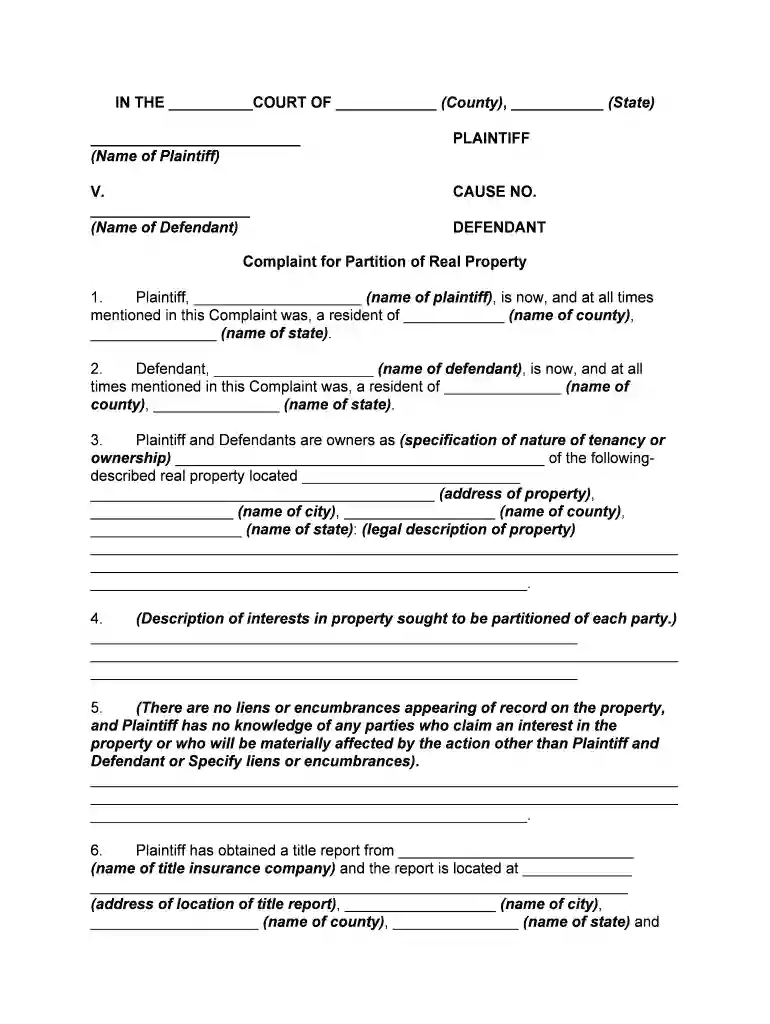
- Residency and Ownership Information: Details about the co-owners, including their legal names, addresses, and specific ownership percentages in the property.
- Property Description: This section provides a legal description of the property, including its address and physical boundaries, which helps the court identify the subject of the partition action.
- Legal Claims: Specific legal grounds for requesting the partition, along with any relevant statutes or case law that support the claim for division or sale.
- Requests for Court Orders: Clear requests for the court to grant a partition by sale or division, and any requests for recovery of attorney's fees or costs incurred during the partition action.
Filing a Partition Action
To file a partition action, co-owners must follow these steps:
- Complete the Necessary Forms: Obtain and fill out the required forms, including the partition complaint, and ensure accuracy in the information provided.
- Prepare Supporting Documents: Gather any supporting documents, such as deeds or agreements binding the co-owners to the property.
- File the Forms with the Appropriate Court: Submit the completed partition action forms to the courthouse that has jurisdiction over real property matters in the county where the property is located.
- Serve Notice to All Co-Owners: Ensure that all other co-owners receive formal notice of the filing, as this is critical for the legal process.
- Attend the Hearing: Prepare to present the case before a judge, outlining the reasons for the partition action and any supporting evidence.
Options for Co-Owners
Co-owners involved in a partition action often have several options, including:
- Partition by Sale: The court may order the property sold, with proceeds divided according to ownership percentages.
- Physical Partition: If feasible, property can be divided physically, ensuring each co-owner has a specific portion of the property.
- Mediation or Settlement: Often, parties may seek mediation to negotiate a resolution without court intervention, allowing for a more amicable outcome.
Costs Associated with Partition Action
Engaging in a partition action can be associated with various costs, including:
- Filing Fees: These vary by jurisdiction but can range from a few hundred to thousands of dollars depending on the court and complexity of the case.
- Attorney Fees: Legal assistance is often required, adding costs based on hourly rates or flat fees associated with filing and handling the case.
- Additional Costs: Possible costs may include expert appraisals, court costs related to hearings, and costs associated with physical partitioning.
Considerations in Filing for Partition
Co-owners should assess several important considerations before initiating a partition action:
- Legal Implications: Understanding the legal implications of the partition action is critical, including potential outcomes that may not favor one party.
- Emotional Impact: Partition actions can cause emotional stress among co-owners due to the contentious nature of disputes.
- Financial Consequences: Consideration should be given to the potential financial impact on both parties, especially when rental income or property value is involved.
Sample Partition Action Forms and Resources
Co-owners looking for guidance can find sample forms and resources to assist in preparation:
- Sample Complaint Forms: Many jurisdictions offer sample partition complaint forms to provide a template for filing.
- State-Specific Guidelines: Each state may have unique regulations regarding partition actions; reviewing state-specific legal resources can be beneficial.
- Legal Aid Resources: For those unable to afford legal representation, various legal aid organizations may provide assistance or free resources.
Conclusion
Navigating partition action forms requires a clear understanding of the implications, processes, and legal requirements involved in a partition action. Being informed about the necessary steps and considerations can significantly aid co-owners as they pursue resolution in their real estate disputes.