




01. Edit your form online
Type text, add images, blackout confidential details, add comments, highlights and more.

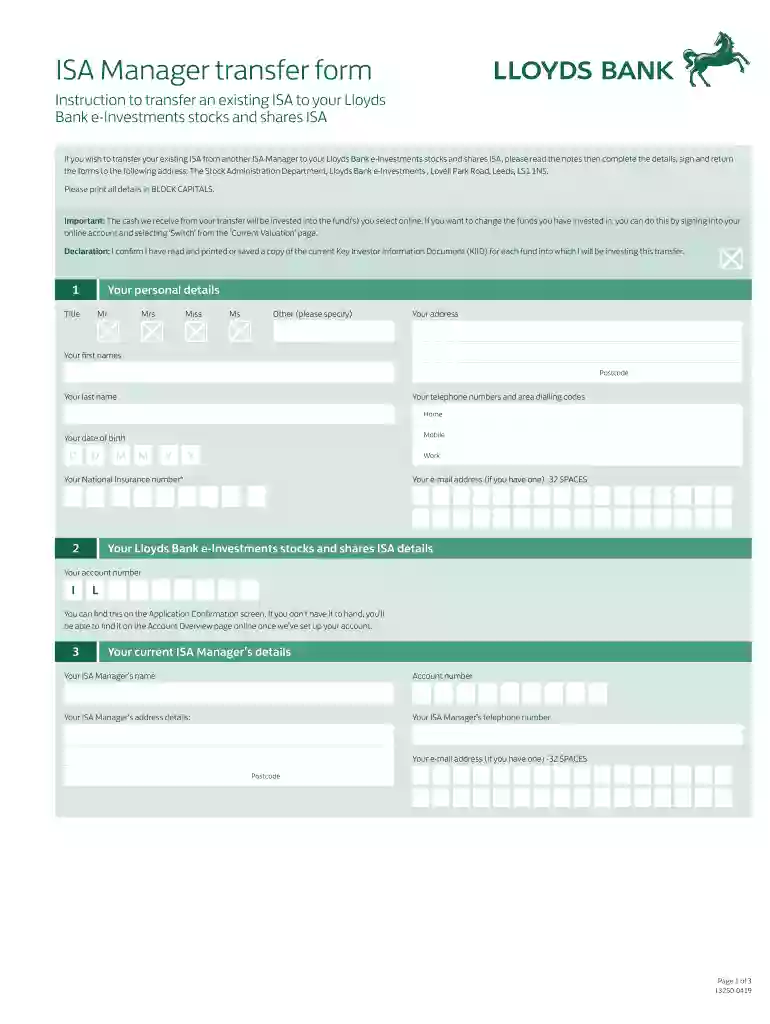
Type text, add images, blackout confidential details, add comments, highlights and more.

Draw your signature, type it, upload its image, or use your mobile device as a signature pad.

Send it via email, link, or fax. You can also download it, export it or print it out.
The ISA Manager transfer form is a critical tool for transferring an existing Individual Savings Account (ISA) to a new manager, such as Lloyds Bank e-Investments. This structured process allows you to move your ISA investments efficiently without losing tax benefits. To effectively use this form, follow these guidelines:
Determine Eligibility: Before initiating the transfer, confirm that your current ISA and the receiving account meet the eligibility criteria. This typically includes ensuring both ISAs are of a compatible type, such as stocks and shares or cash ISAs.
Gather Personal Information: You need to provide detailed personal information, including your full name, address, current ISA manager details, account numbers, and National Insurance number.
Identify Transfer Type: Specify whether you're transferring the entire ISA or part of it. Clearly delineate which investments or funds should be moved.
Submit the Form: After completing the form, submit it to both the current and new ISA managers. This can usually be done online or through mail, depending on the institutions involved.
Await Transfer Completion: The transfer process can take up to 15 working days; thus, it is crucial to track the progress and ensure all parties have received and processed your form.
Understanding and correctly filling in key sections of the ISA Manager transfer form is essential:
Obtaining the ISA Manager transfer form is straightforward. Depending on your preferred method, you can acquire it through several channels:
Completing the ISA Manager transfer form accurately is critical. Here are detailed instructions:
Start with Personal Details: Carefully fill in your personal information, ensuring it matches records on file with your current manager.
Specify Your Current ISA: Clearly detail your existing ISA, including account numbers and the type of account.
Decision on Transfer: Indicate whether the transfer is full or partial. Clearly specify which investments remain if not a full transfer.
Provide New ISA Details: Write down the details of the new ISA manager, ensuring no mistakes.
Sign the Form: Sign and date the form to authorize the transfer officially.
Submit the Form: Send the completed form to both the current and new ISA managers.
Familiarity with specific terms associated with the ISA Manager transfer form can streamline the process:
Using the ISA Manager transfer form involves specific legal compliance issues:
Submitting your ISA Manager transfer form efficiently impacts the speed of your transfer:
Using the ISA Manager transfer form is vital for several reasons:
Following a structured process when submitting the ISA Manager transfer form ensures completeness and efficiency:
We've got more versions of the isa manager transfer form form. Select the right isa manager transfer form version from the list and start editing it straight away!
At DocHub, your data security is our priority. We follow HIPAA, SOC2, GDPR, and other standards, so you can work on your documents with confidence.
The purpose of this ISA is to provide a vehicle by which funding can be made available to EOTSS to support executive office agency resources transferred toRead more
To request transfer credit, a student must have submitted an admissions application and the transfer credit request form below: Transfer Credit Request FormRead more
Jul 20, 2021 The joint planning team should submit the ISA and the MOU/A to the DAA or other authorizing management official of each organization, requestingRead more


