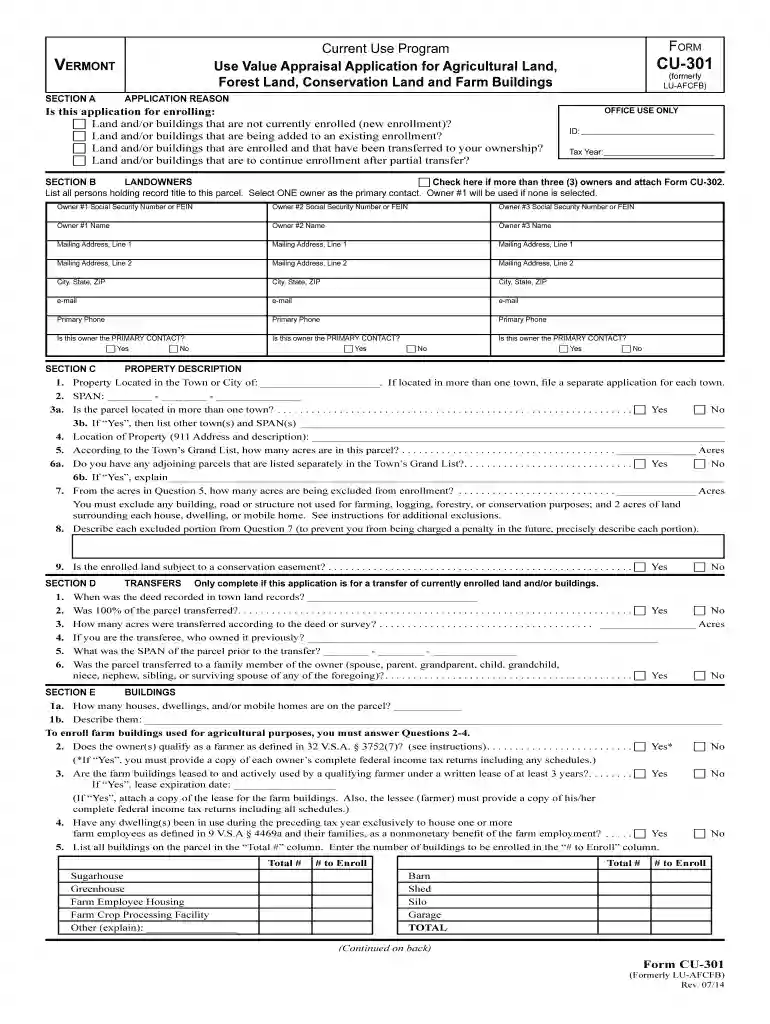
Cu 301 vermont 2026

Get Form
current use program vermont Preview on Page 1

Here's how it works

01. Edit your current use program vermont online
Type text, add images, blackout confidential details, add comments, highlights and more.

02. Sign it in a few clicks
Draw your signature, type it, upload its image, or use your mobile device as a signature pad.

03. Share your form with others
Send it via email, link, or fax. You can also download it, export it or print it out.

How to use or fill out cu 301 vermont with our platform

Form edit decoration
9.5
Ease of Setup
DocHub User Ratings on G2
9.0
Ease of Use
DocHub User Ratings on G2
  1. Click ‘Get Form’ to open the CU-301 Vermont application in the editor.
  2. Begin with Section A, where you select the reason for your application. Ensure you check all applicable boxes for new enrollment, additions, transfers, or continuations.
  3. In Section B, enter the details of all landowners. Designate one as the primary contact by checking the appropriate box next to their name.
  4. Proceed to Section C to describe your property. Fill in the town or city, SPAN number, and provide a detailed description of the property location.
  5. Complete Sections D through H based on your specific circumstances regarding transfers, buildings, agricultural land, forest land, and conservation land. Be thorough in your descriptions and ensure all required documentation is attached.
  6. Finally, review Section J for certification. All owners must sign before submission. Use our platform’s features to easily add signatures digitally.

Start filling out your CU-301 Vermont form online for free today!

See more cu 301 vermont versions

We've got more versions of the cu 301 vermont form. Select the right cu 301 vermont version from the list and start editing it straight away!
Versions Form popularity Fillable & printable
2023 4.7 Satisfied (41 Votes)
2019 4.8 Satisfied (22 Votes)
2014 4.3 Satisfied (276 Votes)
2013 4.4 Satisfied (360 Votes)
be ready to get more

Complete this form in 5 minutes or less

Get form

Got questions?

We have answers to the most popular questions from our customers. If you can't find an answer to your question, please contact us.
Contact us
According to the Vermont website: A Resident is an individual that is domiciled in Vermont or maintains a permanent home, and is physically present in the state for 183 days or more. A Nonresident is an individual that does not qualify as a resident or part-year resident during the tax year.
Small-Scale Commercial Farms (10-50 Acres) Crop Farms: Growing strawberries, blueberries, or seasonal vegetables typically requires at least 5 to 20 acres, especially if irrigation systems or dedicated row planting are part of the plan.
Eligibility. To file a property tax credit, you must meet ALL of the following eligibility requirements: Your property qualifies as a homestead, and you have filed a Homestead Declaration for the current years grand list. You were domiciled in Vermont for the entire taxable year.
Owners who wish to withdraw all or a portion of land and/or buildings should file Form LV-314, Request For Withdrawal From The Use Value Appraisal Program by mail or online at myVTax. See the guide on how file Form LV-314 using myVTax.
To enroll forestland in the program, landowners must meet the eligibility guidelines for the Managed Forestland category, as outlined by the Vermont Department of Forests, Parks and Recreation (FPR). Basic Requirements: Minimum Parcel Size: 25 contiguous acres of forestland.

Security and compliance

At DocHub, your data security is our priority. We follow HIPAA, SOC2, GDPR, and other standards, so you can work on your documents with confidence.

Learn more
ccpa2
pci-dss
gdpr-compliance
hipaa
soc-compliance

People also ask

Prime Development Land: $20,000 - $100,000+ per acre. Secondary Home Sites: $5,000 - $20,000 per acre. Recreational/Hunting Lands: $1,000 - $5,000 per acre. Remote Forests/Mountain Lands: $500 - $2,000 per acre.
At least 25 contiguous acres in active agricultural use; or smaller parcels which generate at least $2,000 annually from the sale of farm crops, or actively used agricultural land owned by or leased to a farmer. Taxed at use value.

Related links