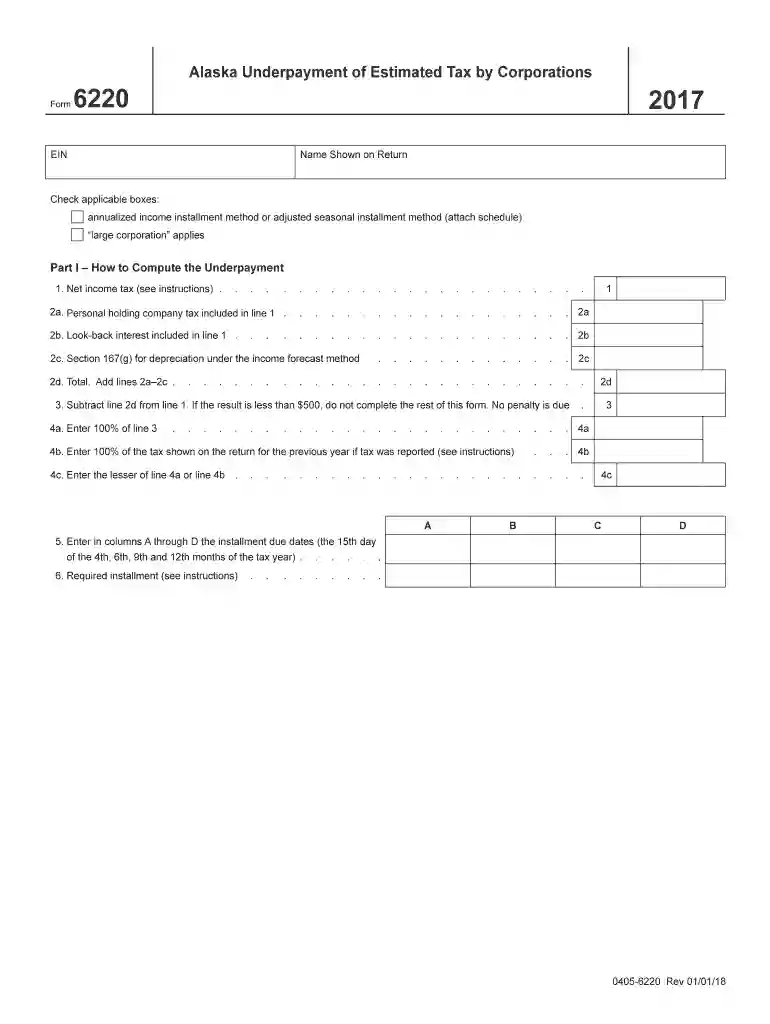
Annualized income installment method or adjusted seasonal installment method (attach schedule) 2026

Get Form
3 3 6 9 annualization method example Preview on Page 1

Here's how it works

01. Edit your 3 3 6 9 annualization method example online
Type text, add images, blackout confidential details, add comments, highlights and more.

02. Sign it in a few clicks
Draw your signature, type it, upload its image, or use your mobile device as a signature pad.

03. Share your form with others
Send it via email, link, or fax. You can also download it, export it or print it out.

How to use or fill out annualized income installment method or adjusted seasonal installment method (attach schedule) with our platform

Form edit decoration
9.5
Ease of Setup
DocHub User Ratings on G2
9.0
Ease of Use
DocHub User Ratings on G2
  1. Click ‘Get Form’ to open it in the editor.
  2. Begin by entering your EIN and the name shown on your return at the top of the form.
  3. In Part I, compute your underpayment by filling in line 1 with your net income tax. Refer to the instructions for accurate calculations.
  4. Complete lines 2a and 2b by including any personal holding company tax and look-back interest, respectively.
  5. Subtract line 2d from line 1 on line 3. If this amount is less than $500, you do not need to complete the rest of the form.
  6. On lines 4a, 4b, and 4c, enter the required amounts as instructed to determine your installment due dates.
  7. Finally, fill in columns A through D with the installment due dates corresponding to each quarter of your tax year.

Start using our platform today for free to streamline your document editing and form completion!

See more annualized income installment method or adjusted seasonal installment method (attach schedule) versions

We've got more versions of the annualized income installment method or adjusted seasonal installment method (attach schedule) form. Select the right annualized income installment method or adjusted seasonal installment method (attach schedule) version from the list and start editing it straight away!
Versions Form popularity Fillable & printable
2019 4.8 Satisfied (60 Votes)
2017 4.3 Satisfied (92 Votes)
2015 4.4 Satisfied (344 Votes)
2013 4.3 Satisfied (137 Votes)
be ready to get more

Complete this form in 5 minutes or less

Get form

Got questions?

We have answers to the most popular questions from our customers. If you can't find an answer to your question, please contact us.
Contact us
Annualized income can be calculated by multiplying the earned income figure by the ratio of the number of months in a year divided by the number of months for which income data is available.
To find your AGI, first determine your gross income by adding together your earnings. Then, adjust the resulting figure by subtracting the value of your above-the-line deductions. A lower AGI can lead to more tax credits, tax deductions, and a smaller tax bill.
An underpayment penalty is a charge the IRS imposes on taxpayers who did not pay all of their estimated income taxes for the year or paid their taxes late. Youll face an underpayment penalty if you: Didnt pay at least 90% of the tax on your current-year return or 100% of the tax shown on the prior years return.
Heres how to implement this strategy effectively: Step 1: Divide Your Tax Year into Periods. Step 2: Calculate Your Taxable Income for Each Period. Step 3: Annualize Your Income. Step 4: Calculate Your Tax Liability. Step 5: Determine Required Payment. Step 6: Make Your Payments.
To find the annualized salary for an employee, an employer must determine either the employees earned income or hourly rate. If using the employees earned income, divide the earned income amount by the number of months in a year. Then multiply that number by 12 to get the annualized summary.

Security and compliance

At DocHub, your data security is our priority. We follow HIPAA, SOC2, GDPR, and other standards, so you can work on your documents with confidence.

Learn more
ccpa2
pci-dss
gdpr-compliance
hipaa
soc-compliance

People also ask

The annualized income installment method refigures estimated tax payment installments so it correlates to when the taxpayer earned the money in the year. It is designed to limit underpayment and corresponding underpayment penalties related to uneven payments when a taxpayers income fluctuates throughout the year.
So if you want to be safe you should pay according to the annualized income installment method. But if it turns out that you paid 1/4 of 90% of your tax for this year (or paid more frontloaded than that), you wont need to use the annualized income installment method and wont need to attach form 2210.
The most basic way to annualize a number is to multiply the periodic rate by the number of periods that would make up one year. One months return would be multiplied by 12 months while one quarters return by four quarters. So a 0.50% interest rate paid monthly on a deposit would be (0.50 x 12 ) = 6% annualized.

Related links