




01. Edit your general laboratory requisition online
Type text, add images, blackout confidential details, add comments, highlights and more.

Type text, add images, blackout confidential details, add comments, highlights and more.

Draw your signature, type it, upload its image, or use your mobile device as a signature pad.

Send blood requisition form alberta via email, link, or fax. You can also download it, export it or print it out.
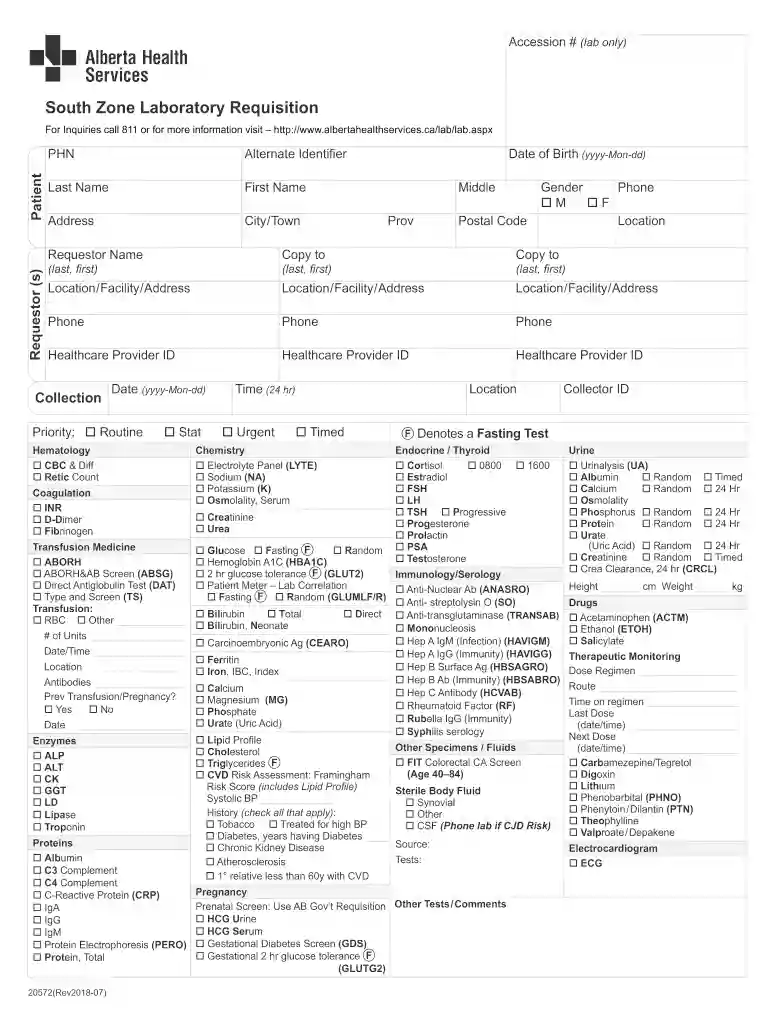
The South Zone Laboratory Requisition, utilized within Alberta Health Services, is a standardized form designed for healthcare providers to request laboratory tests for patients. This form is integral for ensuring that all necessary information is collected efficiently, facilitating accurate testing and timely results.
The requisition form encompasses several key components, including:
Each of these components plays a crucial role in patient care, helping to communicate the necessary information between healthcare providers and laboratories.
Completing the South Zone Laboratory Requisition involves several structured steps to ensure all necessary information is accurately recorded. Here’s a detailed guide:
Access the Form: Obtain a copy of the requisition form from Alberta Health Services or through your medical practice's documentation resources.
Fill in Patient Information:
Input Requestor Details:
Select Required Tests:
Include Additional Patient History:
Review for Accuracy:
Submit the Form:
By adhering to these steps, healthcare providers can minimize errors and enhance the quality of patient care.
Understanding relevant terminology is vital when dealing with the South Zone Laboratory Requisition. Here are key terms commonly associated with this form:
Being familiar with these terms improves communication among healthcare professionals and contributes to effective patient management.
The South Zone Laboratory Requisition is primarily utilized by healthcare professionals, including:
All of these roles contribute to optimal patient outcomes by ensuring efficient testing processes and accurate interpretations of laboratory results.


Real-world scenarios illustrate the practical applications of the South Zone Laboratory Requisition in healthcare settings:
Routine Blood Work: A physician might use the requisition to order annual blood tests for a patient to monitor cholesterol, blood sugar levels, and other routine health markers.
Diagnostic Testing: When a patient presents symptoms suggestive of an infection, a healthcare provider can utilize the requisition to request specific microbiological cultures and blood tests to identify pathogens and determine appropriate treatment.
Pre-Operative Testing: Before scheduled surgery, a healthcare provider often initiates multiple laboratory tests through the requisition to ensure that the patient is fit for the procedure and to identify any potential risks.
Chronic Disease Management: For patients with conditions such as diabetes or kidney disease, regular testing and monitoring are crucial to disease management, necessitating frequent use of the requisition for various laboratory tests.
By applying the requisition in these scenarios, healthcare providers strengthen their diagnostic capabilities and improve treatment outcomes for their patients.
We've got more versions of the general laboratory requisition form. Select the right general laboratory requisition version from the list and start editing it straight away!
| Versions | Form popularity | Fillable & printable |
|---|---|---|
| 2018 | 4.8 Satisfied (40 Votes) |
At DocHub, your data security is our priority. We follow HIPAA, SOC2, GDPR, and other standards, so you can work on your documents with confidence.
Access world-class musculoskeletal imaging at HSS. Our experts use advanced MRI, CT, and ultrasound for precise diagnosis to help restore your mobility.
by G Jessiman-Perreault 2023 Cited by 7 Using the patient postal code, each person was assigned to an AHS Zone (North, Edmonton, Central, Calgary, South) and a LGA using the Alberta Health Postal CodeRead more


