Legal Last Will and Testament Form for Divorced Person Not Remarried with No Children - Maryland 2026

Get Form
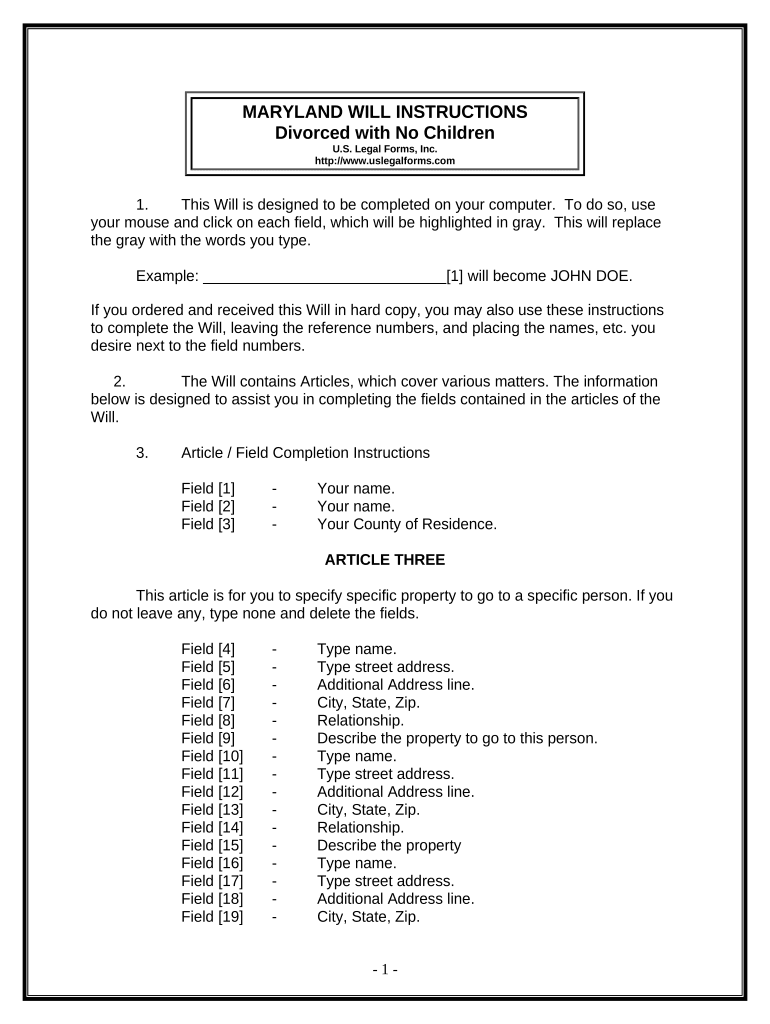
Legal Last Will and Testament Form for Divorced Person Not Remarried with No Children - Maryland Preview on Page 1

Here's how it works

01. Edit your form online
Type text, add images, blackout confidential details, add comments, highlights and more.
02. Sign it in a few clicks
Draw your signature, type it, upload its image, or use your mobile device as a signature pad.
03. Share your form with others
Send it via email, link, or fax. You can also download it, export it or print it out.

How to use or fill out Legal Last Will and Testament Form for Divorced Person Not Remarried with No Children - Maryland

Form edit decoration
9.5
Ease of Setup
DocHub User Ratings on G2
9.0
Ease of Use
DocHub User Ratings on G2
  1. Click ‘Get Form’ to open it in the editor.
  2. Begin by entering your name in Field [1] and your county of residence in Field [3]. This establishes your identity and jurisdiction.
  3. In Article Three, specify any specific property you wish to bequeath. If there are no specific items, simply type 'none' in the designated fields.
  4. For Article Four, if you own a homestead, enter the name(s) of the person(s) who will inherit it in Field [22].
  5. In Article Six, appoint a Personal Representative by filling out Fields [24] and [25] with their names. This person will manage your estate.
  6. Review all entries carefully before printing. Ensure that you sign the document in front of two witnesses who are not related to you.

Start using our platform today to complete your Last Will and Testament effortlessly!

be ready to get more

Complete this form in 5 minutes or less

Get form

Got questions?

We have answers to the most popular questions from our customers. If you can't find an answer to your question, please contact us.
Contact us
In Maryland, a will must be (1) in writing (typed or handwritten), (2) signed by the person making the will, and (3) attested and signed by two credible witnesses in the presence of the person making the will. The person making the will and the two witnesses must be at least 18 years of age and legally competent.
Unprobated Will Only (UN) - Will filed, along with Information Report and/or Application to Fix Inheritance Tax reporting no assets. Modified Administration (MA) - A procedure available when the residuary legatees consist of the personal representative and non-taxable recipients of property.
Under trusts and estates law, these assets are not probated, meaning that they are not distributed according to the decedents will in probate court. As a result, nonprobate assets are not subject to creditors claims.
Most state laws require that all wills be filed. They do not, however, require an executor to file a petition for probate or prove the validity of the last will and testament. Property could remain in the decedents estate indefinitely if no one probates the will.
Fortunately, there are ways to structure your estate to avoid probate in Maryland. Create a Revocable Living Trust. Utilize Joint Ownership with Right of Survivorship. Designate Beneficiaries on Accounts and Policies. Gift Assets Before Death. Establish a Small Estate. Use Marylands Simplified Probate Options.

Security and compliance

At DocHub, your data security is our priority. We follow HIPAA, SOC2, GDPR, and other standards, so you can work on your documents with confidence.

Learn more
ccpa2
pci-dss
gdpr-compliance
hipaa
soc-compliance

People also ask

In Maryland, a valid will must be (1) in writing, (2) signed, and (3) attested and signed by two credible witnesses. It may be handwritten or typed and any two adults can be witnesses. A will does not require a notary, though a notary can be a witness. Electronic, oral, and video wills are not valid in Maryland.
The difference between probate vs non probate assets is how ownership is legally classified during a decedents lifetime. Any assets solely owned by the decedent, in the absence of a beneficiary designation or other clause transferring ownership, will be required to pass through the probate process.

Related links