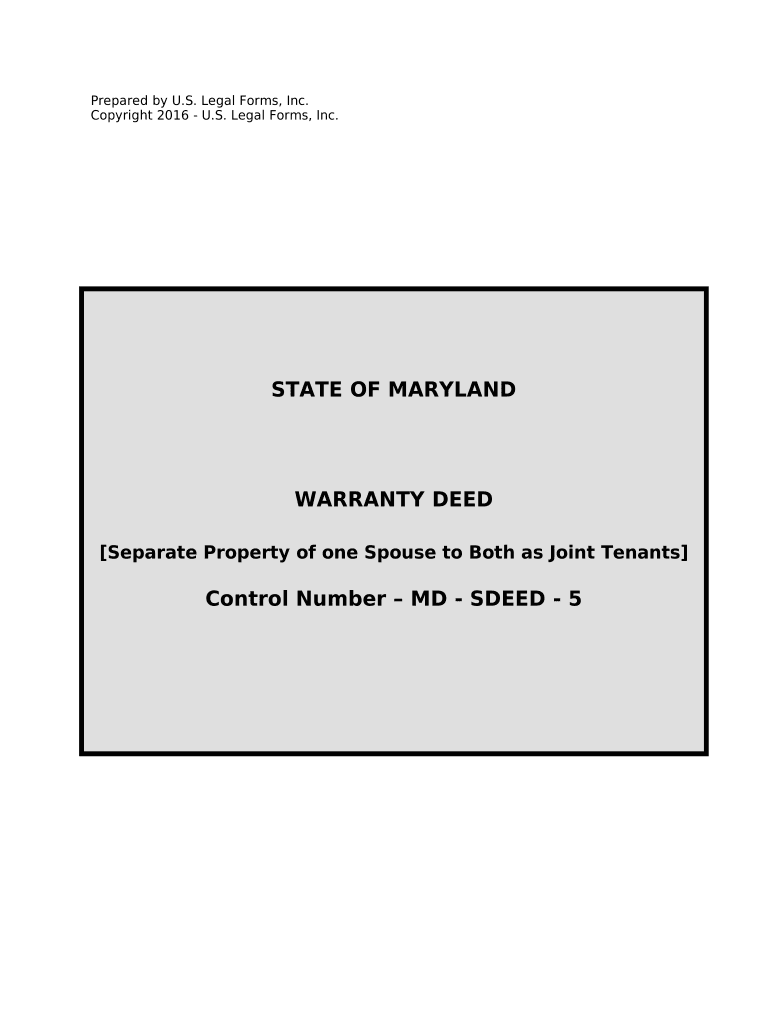
Warranty Deed to Separate Property of One Spouse to Both Spouses as Joint Tenants - Maryland 2026

Get Form
maryland tenants by the entirety Preview on Page 1

Here's how it works

01. Edit your maryland tenants by the entirety online
Type text, add images, blackout confidential details, add comments, highlights and more.
02. Sign it in a few clicks
Draw your signature, type it, upload its image, or use your mobile device as a signature pad.
03. Share your form with others
Send tenants by the entirety maryland via email, link, or fax. You can also download it, export it or print it out.

How to use or fill out Warranty Deed to Separate Property of One Spouse to Both Spouses as Joint Tenants - Maryland with Our Platform

Form edit decoration
9.5
Ease of Setup
DocHub User Ratings on G2
9.0
Ease of Use
DocHub User Ratings on G2
  1. Click ‘Get Form’ to open the Warranty Deed in the editor.
  2. Begin by entering the Grantor's name in the designated field, ensuring it matches legal documents.
  3. Next, input the names of both Grantees (Husband and Wife) in the appropriate fields, confirming their joint tenancy status.
  4. Provide a detailed description of the property being transferred. This can be typed directly into the form or attached as an exhibit.
  5. Fill in the date of execution and ensure all witness signatures are included where indicated.
  6. Complete the Notary section by entering your state and county, along with the notary's signature and commission expiration date.
  7. Finally, review all entries for accuracy before saving or printing your completed document.

Start using our platform today to streamline your document editing and signing process for free!

be ready to get more

Complete this form in 5 minutes or less

Get form

Got questions?

We have answers to the most popular questions from our customers. If you can't find an answer to your question, please contact us.
Contact us
Joint tenants must receive their interest in the property from the same source, such as a deed or title. Equal interest. Joint tenants must possess an equal share of the property.
It is important to note that Maryland law has a presumption against joint tenancy. Unless the deed clearly specifies the intent to create a joint tenancy with the right of survivorship, the property will be treated as a tenancy in common, which can lead to potential legal complications down the road.
The most straightforward method is often for one or more of the existing co-owners to buy out your share of the house. This process involves a Transfer of Equity, where the legal and/or beneficial ownership is formally transferred to the remaining owner(s).
When a partner refuses to pay out their share or sell jointly owned property, legal action may be necessary. Document all communications and attempts to resolve the issue amicably. If negotiations fail, filing a partition action in court can compel the sale or division of the property.
If the other person agrees to a buyout, you can purchase their share of the equity in your home (typically 50%). Youll also need to remove their name from any shared home debts by refinancing it in your name alone and have the other person file a quitclaim deed to take their name off the homes title.

Security and compliance

At DocHub, your data security is our priority. We follow HIPAA, SOC2, GDPR, and other standards, so you can work on your documents with confidence.

Learn more
ccpa2
pci-dss
gdpr-compliance
hipaa
soc-compliance

People also ask

General Warranty Deed (with Survivorship Rights) Couples who hold title to property as unmarried, but wish to have Survivorship Rights. Each party has a full ownership interest in the property. The property will pass instantly to the survivor upon the death of the other without probate.
In states like California, Texas, and Arizona, assets acquired during marriage are considered jointly owned. Each spouse is typically entitled to 50% of the sale proceeds unless a prenup or postnup states otherwise. One person is the legal owner and usually receives 100% of the proceeds.
Consider the following risks before you embrace joint tenancy as a planning tool. Loss of control. Exposure to creditor claims. Unexpected tax consequences. Strained relationships. Lose use of testamentary trusts.

Related links