Letter from Tenant to Landlord about Sexual Harassment - Maryland 2026

Get Form
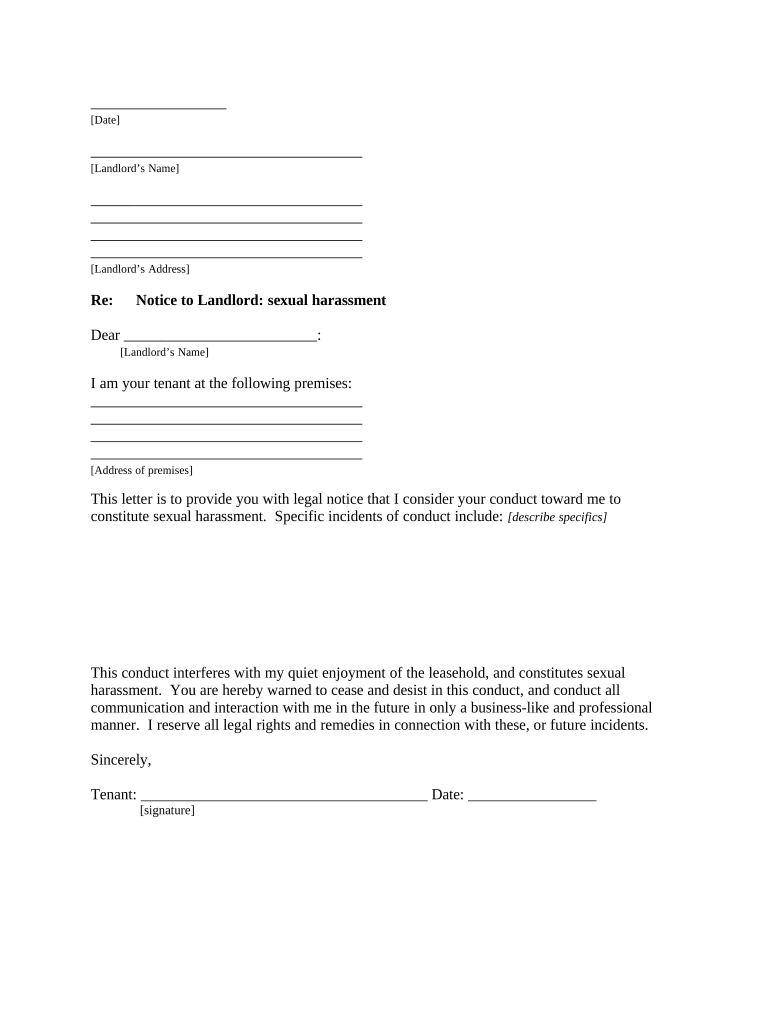
Letter from Tenant to Landlord about Sexual Harassment - Maryland Preview on Page 1

Here's how it works

01. Edit your form online
Type text, add images, blackout confidential details, add comments, highlights and more.
02. Sign it in a few clicks
Draw your signature, type it, upload its image, or use your mobile device as a signature pad.
03. Share your form with others
Send it via email, link, or fax. You can also download it, export it or print it out.

How to use or fill out Letter from Tenant to Landlord about Sexual Harassment - Maryland with DocHub

Form edit decoration
9.5
Ease of Setup
DocHub User Ratings on G2
9.0
Ease of Use
DocHub User Ratings on G2
  1. Click ‘Get Form’ to open it in the editor.
  2. Begin by entering the date at the top of the letter. This sets the context for your communication.
  3. Fill in the landlord’s name and address in the designated fields. Ensure accuracy to facilitate proper delivery.
  4. In the greeting, address your landlord directly by name, maintaining a professional tone.
  5. Clearly state your address as a tenant in the specified section. This identifies your leasehold.
  6. Detail specific incidents of harassment in the provided space. Be factual and concise to strengthen your notice.
  7. Reiterate your request for professional conduct moving forward, ensuring clarity on expectations.
  8. Sign and date at the bottom of the letter, confirming its authenticity.
  9. Complete the Proof of Delivery section by selecting how you will deliver this notice and signing it accordingly.

Start using our platform today to easily fill out and send your important documents for free!

be ready to get more

Complete this form in 5 minutes or less

Get form

Got questions?

We have answers to the most popular questions from our customers. If you can't find an answer to your question, please contact us.
Contact us
To break a lease for safety reasons, tenants should document all incidents threatening their safety, such as threats or harassment. Review the lease agreement for any clauses allowing early termination due to unsafe conditions. Notify the landlord in writing about the safety issues and your intent to terminate.
Protection against harassment The law protects tenants from landlord harassment, including excessive entry into a rented home. If a landlord is entering a tenants home frequently or without a valid reason, they may be violating the tenants right to quiet enjoyment of the property.
For harassment to be committed, there must be a course of conduct (i.e. two or more related occurrences). The information does not necessarily have to be violent in nature but must be oppressive and need to have caused some alarm or distress.
When a tenant harasses a landlord, it creates an environment of fear and/or unease for both the landlord and other tenants. Landlords should not tolerate such behavior and must take immediate action to protect themselves and their property.
You have to notify the landlord in writing that you are in an unsafe situation and demand that he do something about it. With multiple demand letters, you might be able to convince your landlord to let you out of the lease.

Security and compliance

At DocHub, your data security is our priority. We follow HIPAA, SOC2, GDPR, and other standards, so you can work on your documents with confidence.

Learn more
ccpa2
pci-dss
gdpr-compliance
hipaa
soc-compliance

People also ask

Landlords can sue tenants for any damages caused by harassment. This might include compensation for physical damage to the property, legal fees, or other losses incurred due to the tenants actions. Courts may issue orders restraining the tenant from continuing their harassing behavior.
Offensive conduct may include, but is not limited to, offensive jokes, slurs, epithets or name calling, physical assaults or threats, intimidation, ridicule or mockery, insults or put-downs, offensive objects or pictures, and interference with work performance.

Related links