Massachusetts trust the 2026

Get Form
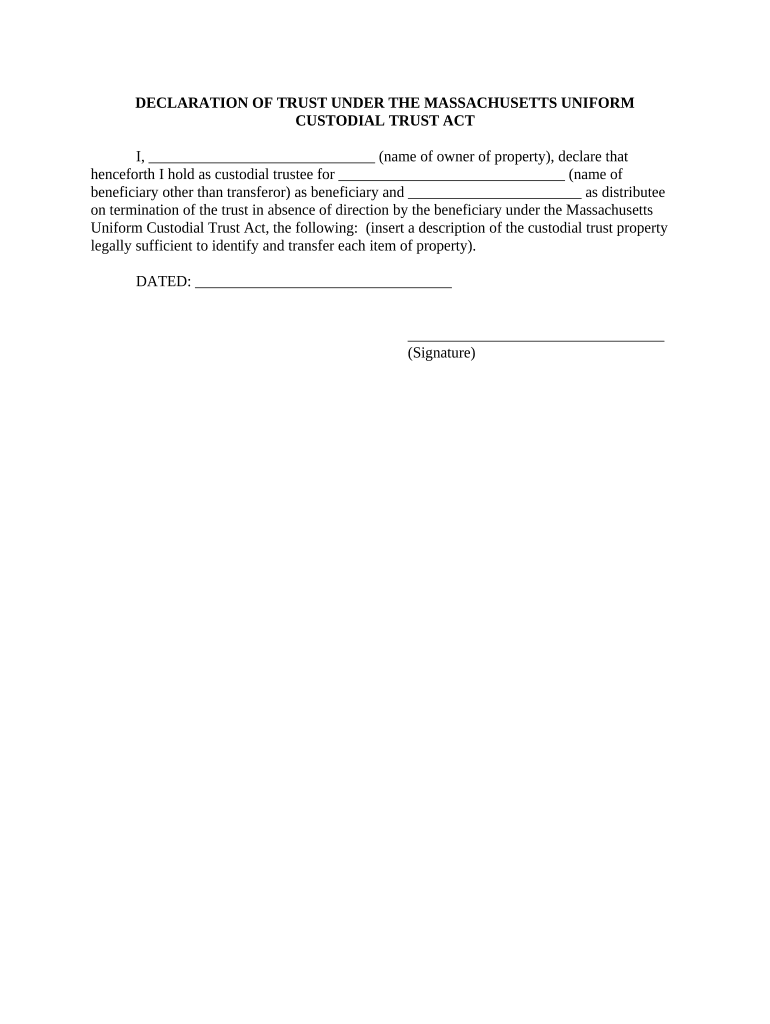
massachusetts trust the Preview on Page 1

Here's how it works

01. Edit your form online
Type text, add images, blackout confidential details, add comments, highlights and more.
02. Sign it in a few clicks
Draw your signature, type it, upload its image, or use your mobile device as a signature pad.
03. Share your form with others
Send it via email, link, or fax. You can also download it, export it or print it out.

How to use or fill out Massachusetts Trust the with our platform

Form edit decoration
9.5
Ease of Setup
DocHub User Ratings on G2
9.0
Ease of Use
DocHub User Ratings on G2
  1. Click ‘Get Form’ to open it in the editor.
  2. Begin by entering your name in the first blank space, identifying yourself as the owner of the property.
  3. In the next field, specify the name of the beneficiary who will receive benefits from the trust, ensuring clarity and accuracy.
  4. Next, indicate the name of the distributee who will manage distribution upon termination of the trust if no direction is provided by the beneficiary.
  5. Insert a detailed description of each item of custodial trust property. This should be legally sufficient to identify and transfer ownership.
  6. Finally, date your declaration and provide your signature at the bottom to finalize your document.

Start using our platform today for free to streamline your Massachusetts Trust form completion!

be ready to get more

Complete this form in 5 minutes or less

Get form

Got questions?

We have answers to the most popular questions from our customers. If you can't find an answer to your question, please contact us.
Contact us
Here are the cons: A living trust is more complex and typically more costly to set up, and you must retitle your assets in the name of the trust, which is also time-consuming. It doesnt offer any estate tax benefits or special asset protection.
If protecting your home from future legal or financial troubles is a priority, this could be a major reason to consider a trust. In Massachusetts, certain irrevocable trusts can also be used for MassHealth (Medicaid) planning, potentially protecting assets from long-term costs.
The average cost of establishing a living trust typically ranges from $1,500 to $2,500, depending on factors such as complexity and the types of assets involved in the estate planning process.
Married couples have a very simple technique available to avoid the Massachusetts estate tax. It is possible for married couples to use a tax shelter that is known as a credit shelter trust or a by-pass trust. These tax shelters are typically built into a revocable trust.
The disadvantages of a living trust can include the complex and costly process of establishing a trust, the lack of ability to name a guardian for a minor or incapacitated child or dependent, and the lack of tax benefits for a revocable living trust.
be ready to get more

Complete this form in 5 minutes or less

Get form