Jury Instruction - Defendant's Damage Instruction - Pre - existing Conditions - Mississippi 2026

Get Form
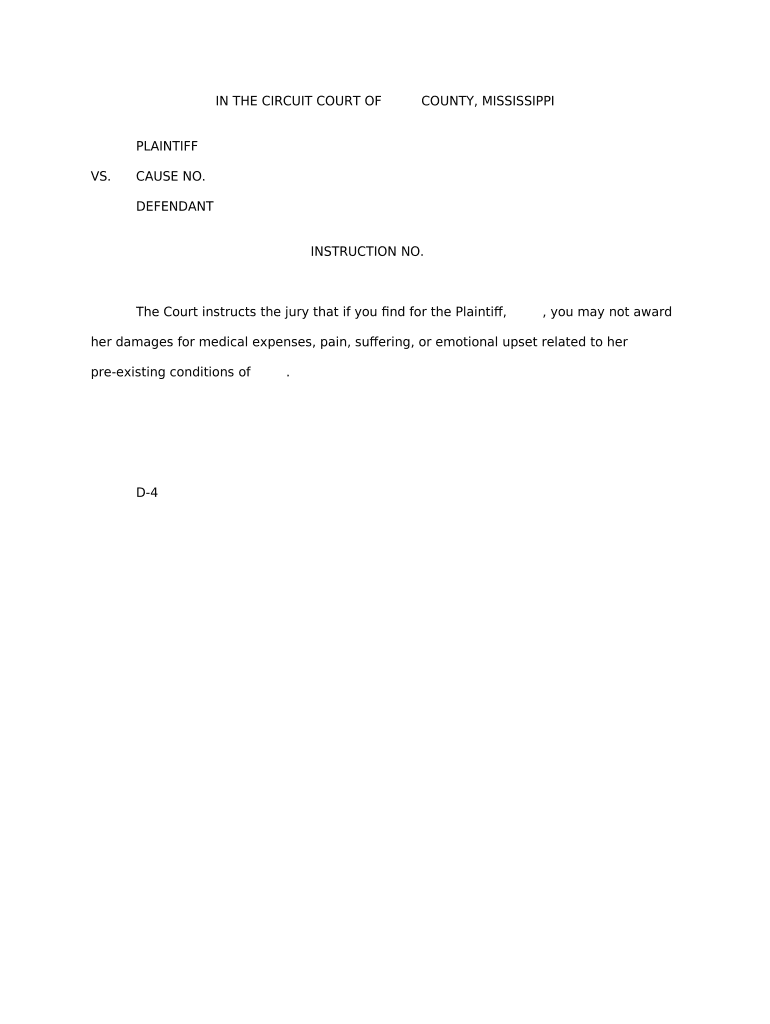
Jury Instruction - Defendant's Damage Instruction - Pre - existing Conditions - Mississippi Preview on Page 1

Here's how it works

01. Edit your form online
Type text, add images, blackout confidential details, add comments, highlights and more.
02. Sign it in a few clicks
Draw your signature, type it, upload its image, or use your mobile device as a signature pad.
03. Share your form with others
Send it via email, link, or fax. You can also download it, export it or print it out.

How to use or fill out Jury Instruction - Defendant's Damage Instruction - Pre-existing Conditions - Mississippi

Form edit decoration
9.5
Ease of Setup
DocHub User Ratings on G2
9.0
Ease of Use
DocHub User Ratings on G2
  1. Click ‘Get Form’ to open it in the editor.
  2. Begin by entering the name of the plaintiff in the designated field. This is crucial as it identifies who is involved in the case.
  3. Next, input the cause number associated with the case. This helps in tracking and referencing the specific legal matter.
  4. In the instruction section, clearly state that if a verdict is reached for the plaintiff, damages related to pre-existing conditions should not be awarded. Ensure this statement is accurately reflected.
  5. Finally, review all entries for accuracy before saving or exporting your completed document. This ensures that all information is correct and ready for submission.

Start using our platform today to streamline your document editing and form completion process for free!

be ready to get more

Complete this form in 5 minutes or less

Get form

Got questions?

We have answers to the most popular questions from our customers. If you can't find an answer to your question, please contact us.
Contact us
Jury instructions tell the jury what the laws are that govern a particular case. Each attorney gives the judge a set of proposed jury instructions. The judge considers each instruction and gives the one that properly states the law that applies to the case.
Preliminary instructions occur at the beginning of a trial and typically inform the jury on the basics of reviewing evidence and other responsibilities. During the trial, courts may give limiting instructions that inform jurors how to evaluate specific evidence and curative instructions to correct evidentiary errors.
If a judge gives incorrect or misleading instructions, it can have serious consequences. A party may appeal the verdict on the grounds that the jury was improperly instructed. Appellate courts may overturn a verdict and order a new trial if they determine that faulty instructions affected the outcome of the case.
[There are [number] plaintiffs in this trial. You should decide the case of each plaintiff separately as if it were a separate lawsuit. Each plaintiff is entitled to separate consideration of that plaintiffs own claim(s).]
This jury instruction addresses the establishment of the two factual elements underlying the presumption of negligence. If they are not established, then a finding of negligence cannot be based on the alleged statutory violation. However, negligence can still be proven by other means. (See Nunneley v.

Security and compliance

At DocHub, your data security is our priority. We follow HIPAA, SOC2, GDPR, and other standards, so you can work on your documents with confidence.

Learn more
be ready to get more

Complete this form in 5 minutes or less

Get form

People also ask

405 Comparative Fault of Plaintiff. 2. That [name of plaintiff]s negligence was a substantial factor in causing [his/her/nonbinary pronoun] harm. If [name of defendant] proves the above, [name of plaintiff]s damages are reduced by your determination of the percentage of [name of plaintiff]s responsibility.

Related links