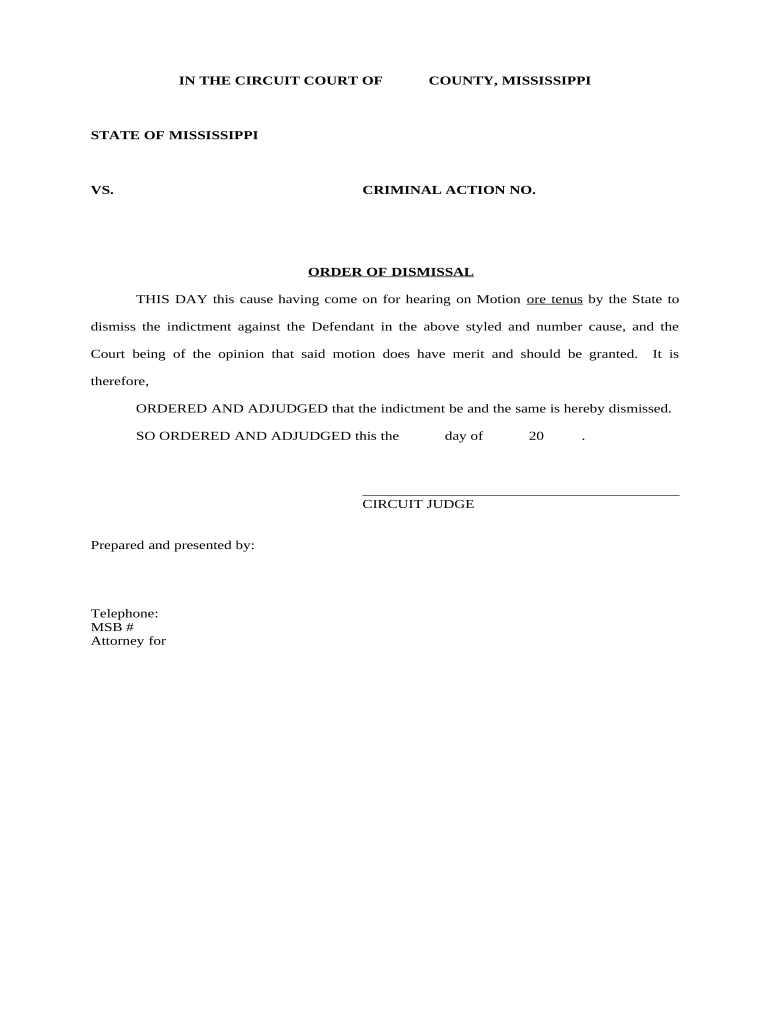
Order of Dismissal - Mississippi 2026

Get Form
Order of Dismissal - Mississippi Preview on Page 1

Here's how it works

01. Edit your form online
Type text, add images, blackout confidential details, add comments, highlights and more.
02. Sign it in a few clicks
Draw your signature, type it, upload its image, or use your mobile device as a signature pad.
03. Share your form with others
Send it via email, link, or fax. You can also download it, export it or print it out.

How to use or fill out Order of Dismissal - Mississippi with our platform

Form edit decoration
9.5
Ease of Setup
DocHub User Ratings on G2
9.0
Ease of Use
DocHub User Ratings on G2
  1. Click ‘Get Form’ to open the Order of Dismissal in the editor.
  2. Begin by entering the name of the County where the case is being heard at the top of the form.
  3. Fill in the 'STATE OF MISSISSIPPI' section, ensuring accuracy for jurisdiction purposes.
  4. Input the Criminal Action Number in the designated field to reference your specific case.
  5. In the body of the document, confirm that a hearing has occurred and that a motion to dismiss has been made by entering relevant details.
  6. Complete the date fields with today's date and ensure all information is correct before finalizing.
  7. Sign off on behalf of your client or yourself as necessary, including any required attorney information such as telephone number and MSB number.

Start using our platform today to streamline your document editing and signing process for free!

be ready to get more

Complete this form in 5 minutes or less

Get form

Got questions?

We have answers to the most popular questions from our customers. If you can't find an answer to your question, please contact us.
Contact us
A Dismissal Order ends the case. Upon dismissal the automatic stay ends and creditors may start to collect debts unless a discharge is entered before the dismissal and the discharge is not revoked by the court. An Order of Dismissal does not free the debtor from any debt.
Code 11-55-1 et seq. Mississippis Rule 11(b) allows a court to award reasonable attorneys fees if the opposing party filed a motion or pleading which, in the opinion of the court, is frivolous or is filed for the purpose of harassment or delay. M.R.C.P. 11(b).
Dismissal for Want of Prosecution (DWOP) occurs when a case is dismissed due to inactivity. Courts may dismiss a case if the plaintiff fails to take necessary actions within specified timelines.
Judgments come in different forms, including in personam (against a person), in rem (against property), and quasi in rem (limited to specific property), and can arise from both civil and criminal cases.
An Order is a separate document that a judge signs which sets forth the judges ruling on a motion. A Judgment is a separate document that a judge signs and sets forth the judges ruling at the end of an adversary proceeding.

Security and compliance

At DocHub, your data security is our priority. We follow HIPAA, SOC2, GDPR, and other standards, so you can work on your documents with confidence.

Learn more
ccpa2
pci-dss
gdpr-compliance
hipaa
soc-compliance

People also ask

In the formal legal world, a court case that is dismissed with prejudice means that it is dismissed permanently. A case dismissed with prejudice is over and done with, once and for all, and cant be brought back to court. A case dismissed without prejudice means the opposite. Its not dismissed forever.
While the terminology overlaps, its important to distinguish the two very different outcomes, one of which is a judgment on the merits and the other is . . .not. Instead, the other (confusingly termed a dismissal) brings a case to an end without a judgment being entered.

Related links