Notice deposition 2026

Get Form
deposition streaming Preview on Page 1

Here's how it works

01. Edit your deposition streaming online
Type text, add images, blackout confidential details, add comments, highlights and more.
02. Sign it in a few clicks
Draw your signature, type it, upload its image, or use your mobile device as a signature pad.
03. Share your form with others
Send it via email, link, or fax. You can also download it, export it or print it out.

How to use or fill out notice deposition with our platform

Form edit decoration
9.5
Ease of Setup
DocHub User Ratings on G2
9.0
Ease of Use
DocHub User Ratings on G2
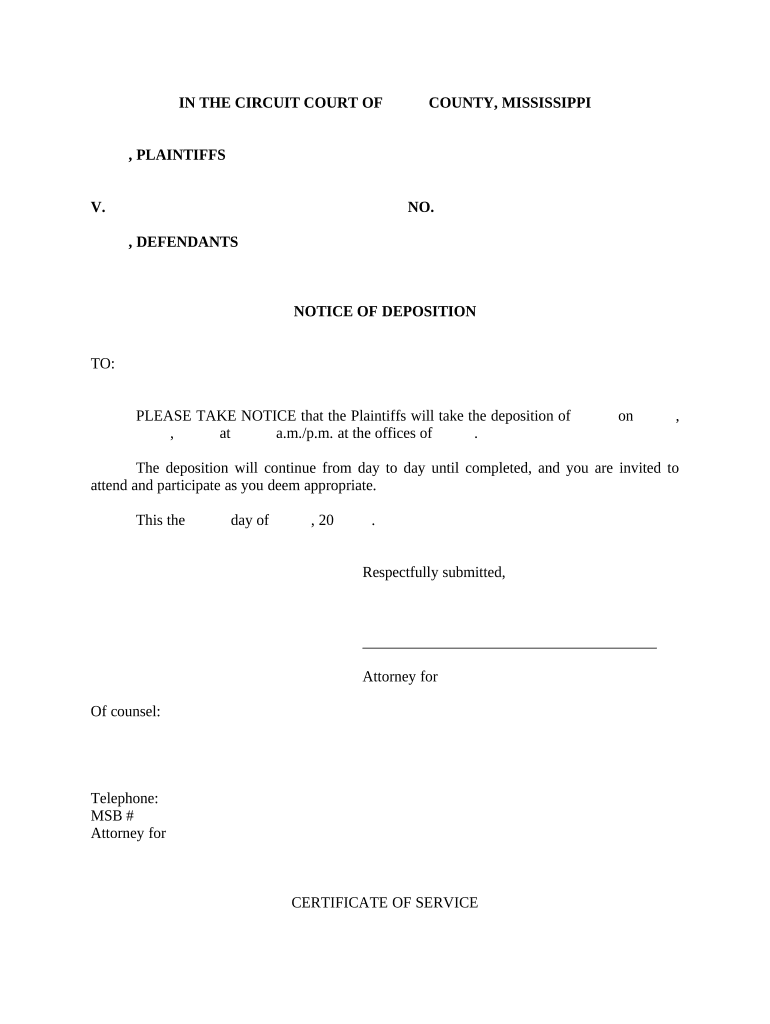
  1. Click ‘Get Form’ to open the notice deposition in the editor.
  2. Begin by filling in the 'Plaintiffs' and 'Defendants' sections at the top of the form. Ensure you enter the correct names as they appear in your case.
  3. In the section labeled 'TO:', specify the name of the individual whose deposition is being taken. This is crucial for clarity.
  4. Next, indicate the date and time of the deposition in the designated fields. Use a.m. or p.m. as appropriate to avoid confusion.
  5. Fill in the location where the deposition will take place, ensuring it is accurate for all parties involved.
  6. Complete any additional details regarding continuance and participation, then sign off with your name and contact information at the bottom of the form.
  7. Finally, review your entries for accuracy before saving or sending out your completed notice deposition.

Start using our platform today to streamline your document editing and ensure a smooth process!

be ready to get more

Complete this form in 5 minutes or less

Get form

Got questions?

We have answers to the most popular questions from our customers. If you can't find an answer to your question, please contact us.
Contact us
They provide an opportunity for the parties involved in the lawsuit to gather information and evidence to be used in court. Depositions can be used to establish the facts of a case, to identify potential witnesses, and to determine the credibility of a witness.
Deposition Basics Unlike the information recorded in documents or the attorneys answers to interrogatories, a deposition involves a living, breathing witness. The deposition has two significant purposes: To find out what the witness knows and believes. To preserve that witnesss testimony.
At a minimum, it contains the time and place of the deposition, the identity of the deponent, and a description of how the deposition will be recorded. It can also contain any other information that the attorney noticing the deposition believes will help the deposition go off smoothly and on time.
5 Steps for Responding to a Deposition Notice Analyze the documents that were served. Notify the party deponent. Decide whether to contact a nonparty witness. Object to defects in the deposition notice. Object to the production demand.
There is no judge to decide if the question is too broad or unrelated to the case. Think of it as a fact-finding mission, especially since depositions take place during the discovery phase of a lawsuit. They dont happen during the trial itself, and not in a courtroom.
be ready to get more

Complete this form in 5 minutes or less

Get form

People also ask

The goal of a deposition is to present the facts of the case to each side in preparation for the actual trial. For some, the deposition is the final step of their claim before receiving a settlement. However, the case may still go to trial in certain situations.
The deposition is an opportunity to learn the facts good and bad to prepare for trial. Second, a deposition preserves the parties version of events. Thats why depositions are part of the official record and either transcribed by a court reporter or recorded.

Related links