






Definition and Meaning of Mississippi Affirmative Defenses
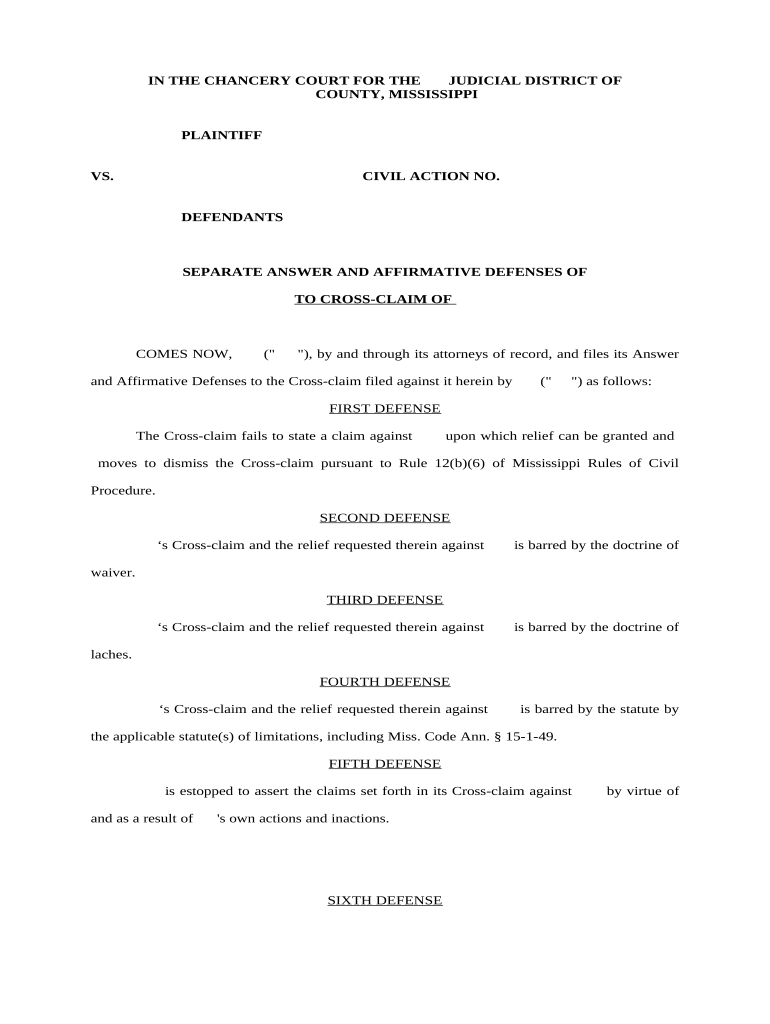
In the context of Mississippi law, affirmative defenses are legal arguments or reasons put forward by a defendant to counter a plaintiff’s allegations, effectively acknowledging the claim but asserting additional facts that can negate or mitigate liability. Common affirmative defenses include:
- Failure to State a Claim: The defendant asserts that the plaintiff’s complaint does not present a valid legal basis for a lawsuit.
- Waiver: The defendant claims that the plaintiff has voluntarily relinquished a known right.
- Laches: This defense argues that the plaintiff has failed to act promptly, which prejudices the defendant’s ability to defend themselves effectively.
- Statute of Limitations: The defendant can argue that the plaintiff's claim is barred because too much time has passed since the event causing the claim occurred.
- Estoppel: This defense prevents a party from taking a legal position inconsistent with a prior established position, often based on the other party's reliance on that position.
Understanding these defenses can provide essential strategies for defendants looking to navigate legal claims effectively in Mississippi courts.
How to Use Mississippi Affirmative Defenses
Using affirmative defenses in Mississippi involves strategic legal planning and careful consideration of case specifics. Defendants must present these defenses promptly within their response to a complaint or a cross-claim. Steps to using affirmative defenses include:
- Identify Relevant Defenses: Review the claims against you and determine applicable affirmative defenses relevant to those claims. Each defense should directly address aspects of the case.
- Drafting the Answer: When drafting your responsive pleading, incorporate the affirmative defenses clearly in the designated section. A well-structured answer includes citations to laws, rules, or precedents that support the defenses.
- Supporting Evidence: Gather evidence to substantiate the validity of your affirmative defenses. This could include documents, witness statements, or expert testimonies that reinforce your position.
- Filing with the Court: Submit your answer, including the affirmative defenses, with the court within established deadlines to ensure they are heard and considered.
Positive engagement and thorough preparation in employing affirmative defenses can significantly influence the outcome of a case.
Important Terms Related to Mississippi Affirmative Defenses
Understanding key legal terminology is crucial when navigating Mississippi affirmative defenses. Some terms include:
- Defendant: The party being accused in a lawsuit.
- Plaintiff: The individual or group bringing the lawsuit.
- Civil Procedure: The complex rules and processes governing the conduct of civil litigation.
- Pleading: A formal written statement of the cause of action or defense utilized in court.
- Burden of Proof: The obligation to prove assertions or allegations, which can shift depending on the defense being raised.
Familiarity with these terms enhances comprehension of the legal landscape and improves the efficacy of legal arguments.
Legal Use of Mississippi Affirmative Defenses
Affirmative defenses serve a vital role in the Mississippi legal system, allowing defendants to establish a counter-narrative to claims against them. Their legal implementation hinges upon proper adherence to procedural rules and evidentiary standards:
- Court Rules: Defendants must comply with the Mississippi Rules of Civil Procedure, which govern the timelines and formats for filing affirmative defenses.
- Prior Case Law: Courts often refer to precedents set in previous cases. Successful affirmative defenses frequently cite established rulings to support their arguments.
- Judicial Discretion: The acceptance of affirmative defenses can depend on the discretion of the presiding judge and their interpretation of the relevance and appropriateness of the defense presented.
Effective usage of affirmative defenses can shape case trajectories, conferring advantages like dismissal of claims or reduced liability.
Examples of Using Mississippi Affirmative Defenses
Utilizing examples can clarify the application of affirmative defenses in real-world scenarios:
-
Failure to State a Claim: A defendant in a breach of contract lawsuit may argue that the plaintiff’s claim does not specify how the defendant allegedly failed to meet contractual obligations, leading to a dismissal.
-
Statute of Limitations: In a personal injury case, a defendant can cite that the complaint was filed beyond the three-year statute of limitations, thus defending against the claim successfully.
-
Estoppel: If a plaintiff previously assured the defendant that a payment would not be pursued, the defendant might use estoppel to argue that the plaintiff should not be allowed to revisit the claim after relying on that assurance.
Presenting clear examples of these defenses can enhance understanding and provide insight into effective legal strategies when facing claims in Mississippi courts.