Type text, add images, blackout confidential details, add comments, highlights and more.
02. Sign it in a few clicks
Draw your signature, type it, upload its image, or use your mobile device as a signature pad.
03. Share your form with others
Send it via email, link, or fax. You can also download it, export it or print it out.
How to use or fill out Quitclaim Deed from Corporation to LLC - Oregon with our platform
Ease of Setup
DocHub User Ratings on G2
Ease of Use
DocHub User Ratings on G2
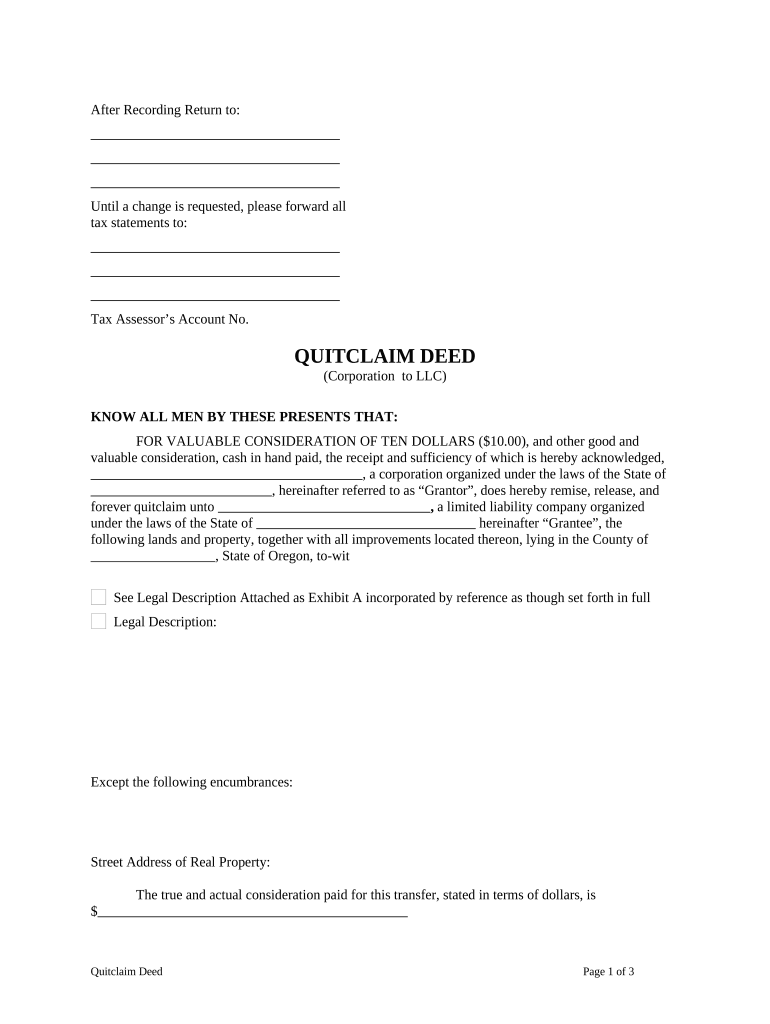
Click ‘Get Form’ to open the Quitclaim Deed in the editor.
Begin by entering the name of the Grantor (the corporation) and the Grantee (the LLC) in the designated fields. Ensure that both entities are correctly identified as per their legal names.
Fill in the County and State where the property is located, along with a detailed legal description of the property. This information is crucial for proper identification of the asset being transferred.
Indicate any encumbrances on the property, if applicable, and specify the street address of the real property being conveyed.
Complete the section regarding consideration paid for this transfer, ensuring accuracy in monetary terms.
Review and fill out tax proration details as agreed upon by both parties, selecting whether taxes will be paid by Grantor or Grantee.
Finally, ensure that all signatures are obtained from authorized representatives of both entities, including notarization to validate the deed.
Start using our platform today to streamline your Quitclaim Deed process for free!
Fill out Quitclaim Deed from Corporation to LLC - Oregon online It's free
Methods for Transferring Personal Assets to an LLC There are three primary ways to transfer assets to an LLC: Contribution: You can contribute personal property as a capital investment. This is common for startup assets and often does not trigger immediate tax consequences. Sale: You may sell the asset to the LLC.
Is a quitclaim deed legal in Oregon?
In Oregon, a quitclaim deed is a legal instrument used to transfer a grantors interest in real property without any warranties of title. This means the grantor does not guarantee that they hold clear ownership or that the property is free from other claims, such as liens or encumbrances.
How to change name on deed to LLC?
Transferring Property to the LLC The deed should clearly state the LLC as the new owner of the property. File the Deed with the County Recorders Office Once the deed is prepared, file it with the county recorders office where the property is located. This officially transfers ownership of the property to your LLC.
How do I transfer assets from sole proprietor to LLC?
Once you form your LLC, you must transfer any business assets from your sole proprietorship to the LLC itself. This is normally done by creating and signing an LLC Operating Agreement. The Agreement is a contract between you and the LLC, in which you exchange assets for your membership interest.
Can you quit claim a deed to an LLC?
A quit claim deed to LLC transfers property ownership but does not guarantee the property is free from liens or encumbrances. LLCs provide liability protection for real estate owners, but transferring property using a quit claim deed does not remove personal liability from an existing mortgage.
Related Searches
Quitclaim deed from corporation to llc oregon templateQuitclaim deed from corporation to llc oregon exampleQuitclaim deed from corporation to llc oregon onlineQuitclaim deed from corporation to llc oregon formOregon quit claim Deed PDFTax consequences of transferring property to LLCOregon Quit claim deed instructionsTransferring property to LLC with mortgage
Security and compliance
At DocHub, your data security is our priority. We follow HIPAA, SOC2, GDPR, and other standards, so you can work on your documents with confidence.
Follow these steps to transfer property to LLC business structures. Make sure your LLC is registered. Review the property title and LLC operating agreement. Draft a deed of transfer. docHub and file the deed. Notify your mortgage company. Update tax records. Transfer utilities and insurance. Plan for tax complications.
Related links
RECENT CASES INVOLVING LIMITED LIABILITY
by ES Miller 2010 Cited by 1 Michael by quit claim deeds from the LLC. Richard then sought relief from the stay to foreclose the mortgage against the real estate. The bankruptcy court
Electric Power Transmission Line Data Source: PennWell Corporation This map includes information copyrighted by PennWell Corporation. This information is
93.110 Quitclaim deed sufficient to pass estate. A deed of quitclaim and release, of the form in common use, is sufficient to pass all the estate which the
Cookie consent notice
This site uses cookies to enhance site navigation and personalize your experience.
By using this site you agree to our use of cookies as described in our Privacy Notice.
You can modify your selections by visiting our Cookie and Advertising Notice.