Form 13.8A Additional Findings at Time of Sentencing - Oklahoma 2026

Get Form
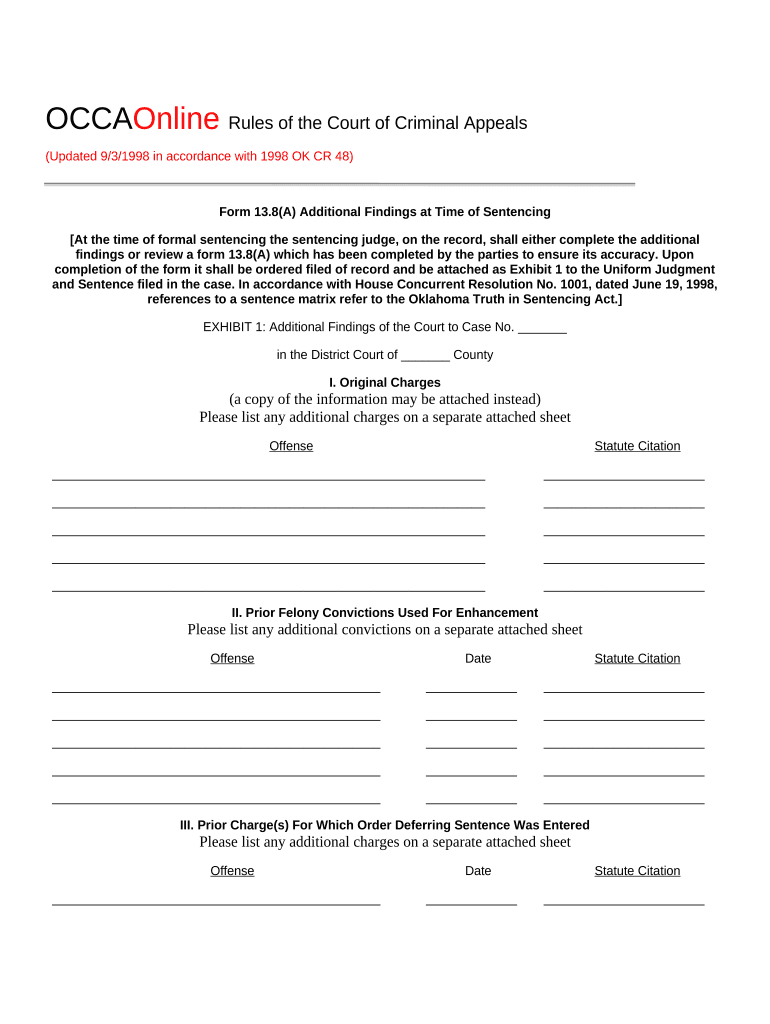
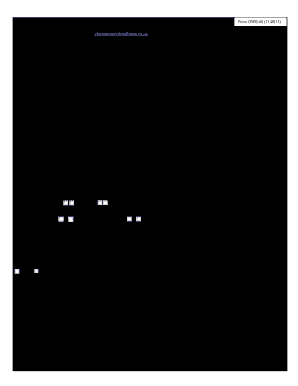
Form 13.8A Additional Findings at Time of Sentencing - Oklahoma Preview on Page 1

Here's how it works

01. Edit your form online
Type text, add images, blackout confidential details, add comments, highlights and more.
02. Sign it in a few clicks
Draw your signature, type it, upload its image, or use your mobile device as a signature pad.
03. Share your form with others
Send it via email, link, or fax. You can also download it, export it or print it out.

How to use or fill out Form 13.8A Additional Findings at Time of Sentencing - Oklahoma

Form edit decoration
9.5
Ease of Setup
DocHub User Ratings on G2
9.0
Ease of Use
DocHub User Ratings on G2
  1. Click ‘Get Form’ to open it in the editor.
  2. Begin with Section I, where you will list the original charges. Enter the offense and statute citation for each charge. If there are additional charges, attach a separate sheet.
  3. Proceed to Section II, which requires prior felony convictions used for enhancement. Fill in the offense, date, and statute citation for each conviction, attaching more sheets if necessary.
  4. In Section III, document any prior charges for which an order deferring sentence was entered. Again, provide offense details and attach additional sheets as needed.
  5. Section IV focuses on prior felony convictions not used for enhancement. Complete this section similarly by listing offenses and their details.
  6. For Section V, circle 'Yes' or 'No' regarding whether multiple counts arose from the same transaction.
  7. In Section VI, answer questions about enhancers that may affect sentencing by circling 'Yes' or 'No' as applicable.
  8. Finally, complete Section VII by providing offender characteristics such as gender and race. Ensure all information is accurate before finalizing your form.

Start using our platform today to fill out Form 13.8A easily and efficiently!

be ready to get more

Complete this form in 5 minutes or less

Get form

Got questions?

We have answers to the most popular questions from our customers. If you can't find an answer to your question, please contact us.
Contact us

Upload your Form 13.8A Additional Findings at Time of Sentencing - Oklahoma to DocHub (after you’ve set up an account for this). If you need to complete fields in it, use appropriate tools from the top pane. For instance, drop Signature Fields, assign each to specific person, and click on Sign → Request signatures from others. Personalize your message for your recipients and click Send Request. You can also send your document by fax or as a Signing link instead of using email (you’ll locate these options by navigating to the Menu → Send)

You may quickly complete, modify, and even eSign your Form 13.8A Additional Findings at Time of Sentencing - Oklahoma using DocHub. Create a new account and start your free trial. After that, you may add the document with the form and easily make all the required edits. No need to print on paper or use a third-party application to sign it, as you can place your electronic signature on your document faster through DocHub.

How Does the 85% Rule Work? The 85% rule is imposed by the state of Oklahoma and dictates how much of a convicted criminals sentence they must serve before they are eligible for parole. The law surrounding this matter states that those convicted of certain offenses cannot serve less than 85% of their sentence.
If an offender has been convicted of a violent crime, they must serve 85% of their sentence to be eligible for parole consideration.
0:22 2:52 So in Oklahoma law its typically 24 or 48.MoreSo in Oklahoma law its typically 24 or 48.

Security and compliance

At DocHub, your data security is our priority. We follow HIPAA, SOC2, GDPR, and other standards, so you can work on your documents with confidence.

Learn more
ccpa2
pci-dss
gdpr-compliance
hipaa
soc-compliance

People also ask

Split sentences: Judges may impose a combination of incarceration and probation. Suspended or deferred sentences: Not all probation is alike; some allow eventual dismissal if conditions are met. Financial hardship: Courts may adjust fines or fees based on the defendants ability to pay.

Related links