Letter from Tenant to Landlord containing Notice to landlord to cease retaliatory threats to evict or retaliatory eviction - Ohio 2026

Get Form
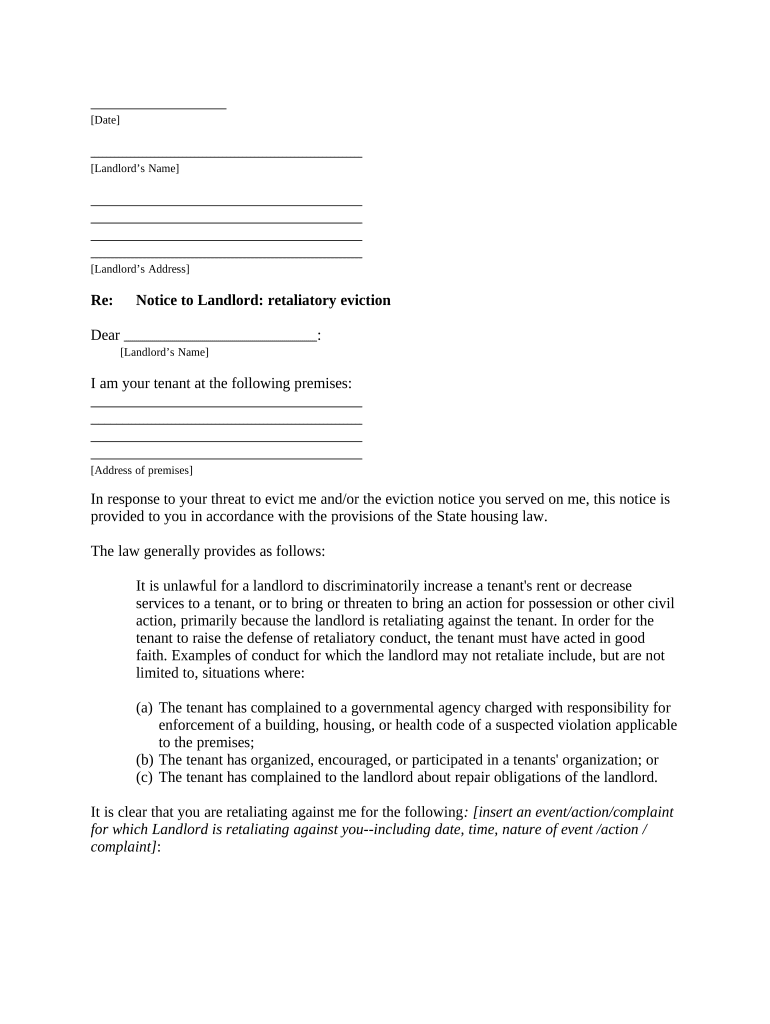
Letter from Tenant to Landlord containing Notice to landlord to cease retaliatory threats to evict or retaliatory eviction - Ohio Preview on Page 1

Here's how it works

01. Edit your form online
Type text, add images, blackout confidential details, add comments, highlights and more.
02. Sign it in a few clicks
Draw your signature, type it, upload its image, or use your mobile device as a signature pad.
03. Share your form with others
Send it via email, link, or fax. You can also download it, export it or print it out.

How to use or fill out Letter from Tenant to Landlord containing Notice to landlord to cease retaliatory threats to evict or retaliatory eviction - Ohio

Form edit decoration
9.5
Ease of Setup
DocHub User Ratings on G2
9.0
Ease of Use
DocHub User Ratings on G2
  1. Click ‘Get Form’ to open it in the editor.
  2. Begin by entering the date at the top of the document. This establishes when the notice is being sent.
  3. Fill in the landlord’s name and address in the designated fields. Ensure accuracy for proper delivery.
  4. In the salutation, address your landlord directly using their name. This personalizes your communication.
  5. Provide your address as a tenant in the specified section. This clarifies your identity and residence.
  6. Clearly state the reason for this notice, referencing any threats or eviction notices received. Be specific about dates and events that prompted this action.
  7. List examples of protected tenant actions that may have led to retaliation, ensuring you highlight your good faith efforts.
  8. Conclude with a demand for withdrawal of any eviction attempts, emphasizing potential defenses against retaliatory actions.
  9. Sign and date the document at the bottom, ensuring all necessary parties are aware of its contents.
  10. Complete the proof of delivery section by selecting how you delivered this notice and signing it accordingly.

Start using our platform today to easily fill out and manage your important documents for free!

be ready to get more

Complete this form in 5 minutes or less

Get form

Got questions?

We have answers to the most popular questions from our customers. If you can't find an answer to your question, please contact us.
Contact us
Note that even if the landlord proves that he or she has a valid reason for the eviction, the tenant can prove retaliation by showing that the landlords effort to evict the tenant is not in good faith and is primarily based on a goal of punishing the tenant for exercising said rights.
Ohio law is specific about the prohibitions against landlords. The landlord cannot retaliate against the tenant by increasing rent, decreasing services owed to the tenant, or threatening or actually evicting the complaining tenant.
Ohio Revised Code Section 5321.02(A) states that a landlord may not retaliate against a tenant by increasing the tenants rent, decreasing services that are due to the tenant, or bringing or threatening to bring an action for possession of the tenants premises because: (1) The tenant has complained to an appropriate
First, and foremost, if a tenant threatens you or someone on your staff, you are not required to just accept that sort of treatment. You may take aggressive legal action to remove such a tenant from your property.
To sue a landlord for retaliation or unauthorized entry, tenants should document all incidents, including dates and communications. Review your lease and local tenant laws to confirm prohibited landlord actions. Typically, landlords must provide proper notice before entry and cannot retaliate for tenant complaints.

Security and compliance

At DocHub, your data security is our priority. We follow HIPAA, SOC2, GDPR, and other standards, so you can work on your documents with confidence.

Learn more
ccpa2
pci-dss
gdpr-compliance
hipaa
soc-compliance

People also ask

Under California law, landlords are required to adhere to the implied warranty of habitability, which ensures that rental properties meet basic health and safety standards. Examples of landlord negligence include: Ignoring critical repairs, such as broken plumbing or faulty electrical systems.
A landlord cannot harass you by demanding over and over to enter a home or by entering at unreasonable times of the day or without a proper purpose. d. A landlord is not permitted to put you out or remove any of your property from the home without a court order signed by a judge.

Related links