Ohio defendant 2026

Get Form
ohio defendant Preview on Page 1

Here's how it works

01. Edit your form online
Type text, add images, blackout confidential details, add comments, highlights and more.
02. Sign it in a few clicks
Draw your signature, type it, upload its image, or use your mobile device as a signature pad.
03. Share your form with others
Send it via email, link, or fax. You can also download it, export it or print it out.

How to use or fill out ohio defendant with our platform

Form edit decoration
9.5
Ease of Setup
DocHub User Ratings on G2
9.0
Ease of Use
DocHub User Ratings on G2
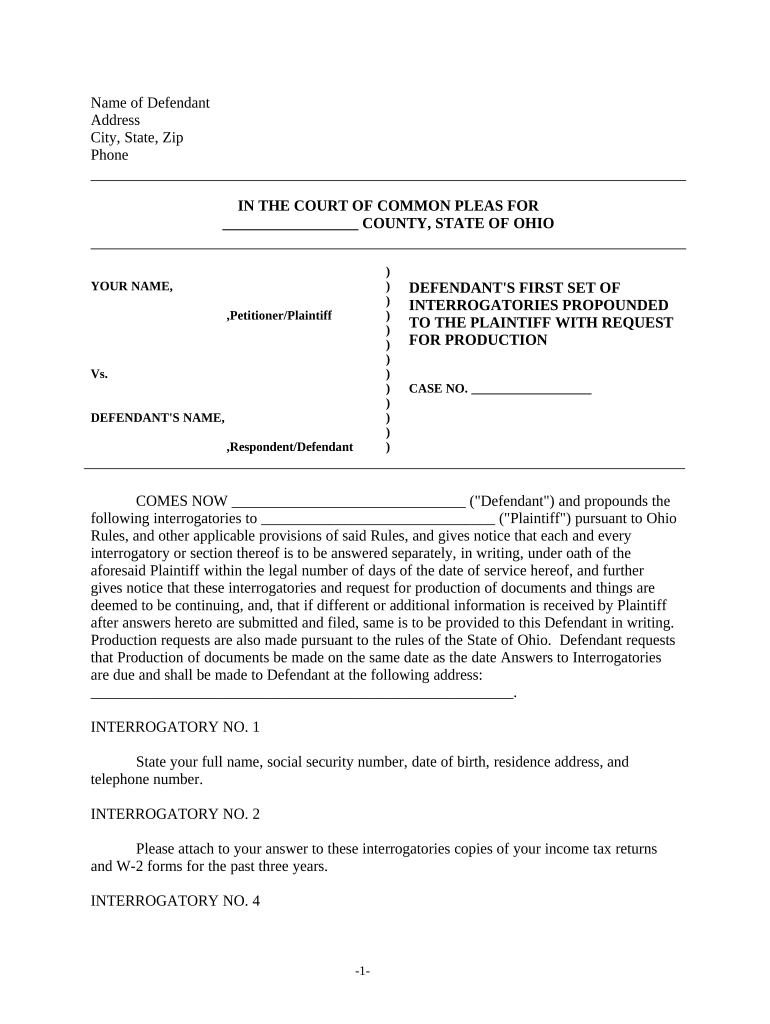
  1. Click ‘Get Form’ to open the ohio defendant document in the editor.
  2. Begin by entering the Name of Defendant and their Address, City, State, and Zip code in the designated fields. Ensure accuracy as this information is crucial for identification.
  3. Fill in your Phone number to maintain communication regarding the case.
  4. In the section labeled 'IN THE COURT OF COMMON PLEAS FOR', specify the County and State of Ohio where your case is being filed.
  5. Complete the sections for Petitioner/Plaintiff and Respondent/Defendant names accurately, as these will be referenced throughout the document.
  6. Proceed to answer each interrogatory carefully. For example, provide your full name, social security number, and date of birth in response to Interrogatory No. 1.
  7. Attach any required documents such as income tax returns or paycheck stubs as specified in subsequent interrogatories.
  8. Review all entries for completeness and accuracy before finalizing your responses. This ensures that you meet legal requirements effectively.

Start using our platform today to fill out your ohio defendant form easily and for free!

be ready to get more

Complete this form in 5 minutes or less

Get form

Got questions?

We have answers to the most popular questions from our customers. If you can't find an answer to your question, please contact us.
Contact us
Dollree Mapp was convicted of possessing obscene materials after an admittedly illegal police search of her home for a fugitive. She appealed her conviction on the basis of freedom of expression.
R. Reasonable doubt. A standard that requires proof offered to be of the highest degree. In a criminal case, reasonable doubt is present when jurors, after carefully considering and comparing all the evidence, cannot say they are firmly convinced of the truth of the charge against a defendant.
OHIO, decided on 20 June 1961, was a landmark court case originating in Cleveland, in which the U.S. Supreme Court ruled that under the 4th and 14th Constitutional amendments, illegally seized evidence could not be used in a state criminal trial.
Dollree Mapp was charged with possession of obscene material. She was convicted in the Cuyahoga County Court of Common Pleas even though no valid search warrant was produced in court and no reason was given for the lack of a search warrant.
defendant - In a civil suit, the person complained against; in a criminal case, the person accused of the crime.

Security and compliance

At DocHub, your data security is our priority. We follow HIPAA, SOC2, GDPR, and other standards, so you can work on your documents with confidence.

Learn more
ccpa2
pci-dss
gdpr-compliance
hipaa
soc-compliance

People also ask

As the search of Mapps second-floor, two-bedroom apartment began, police handcuffed her for being belligerent. The police searched the house thoroughly, and discovered Ogletree (who was eventually cleared on the bombing charge) hiding in the apartment of the downstairs tenant.
Assistant Prosecuting Attorney for Cuyahoga County, Gertrude Bauer Mahon, represented the State of Ohio. She called the following witnesses: Sergeant Carl Delau and Officer Michael Haney. A. L. Kearns was Mapps attorney.
Defendant, in criminal cases, is the person accused of the crime. In civil cases, the defendant is the person or entity that is being sued by the plaintiff. In certain types of actions, the defendant is called the respondent. However, the term respondent is usually used to designate the person responding to an appeal.

Related links