Mutual Wills or Last Will and Testaments for Unmarried Persons living together with Minor Children - New York 2026

Get Form
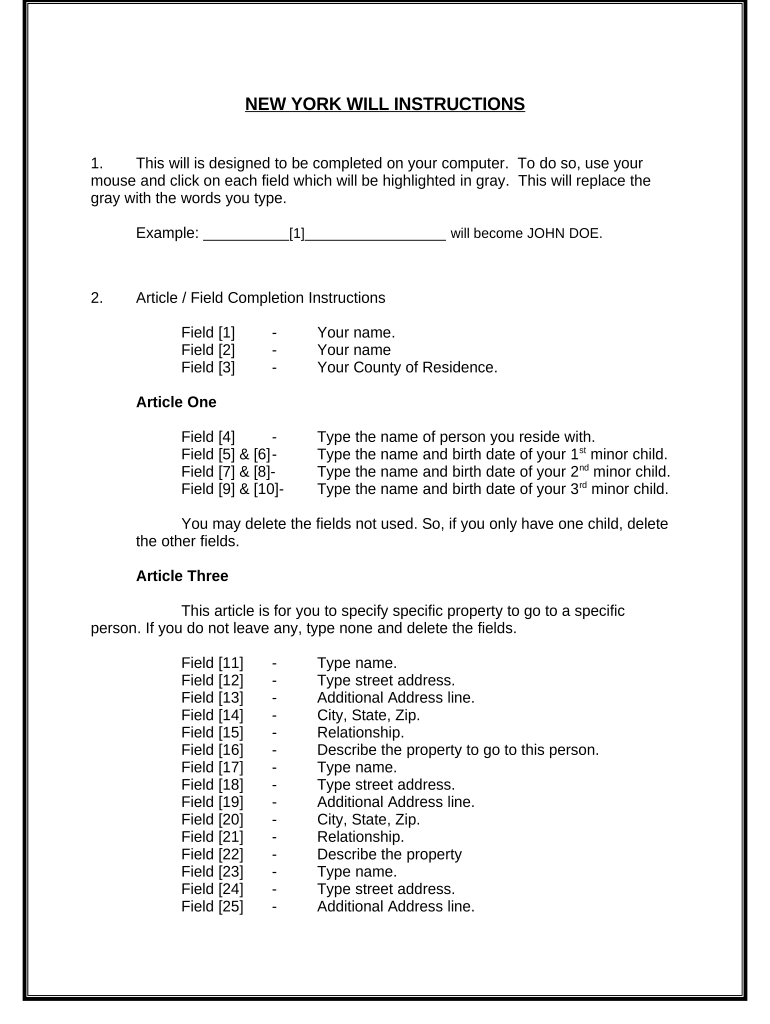
Mutual Wills or Last Will and Testaments for Unmarried Persons living together with Minor Children - New York Preview on Page 1

Here's how it works

01. Edit your form online
Type text, add images, blackout confidential details, add comments, highlights and more.
02. Sign it in a few clicks
Draw your signature, type it, upload its image, or use your mobile device as a signature pad.
03. Share your form with others
Send it via email, link, or fax. You can also download it, export it or print it out.

How to use or fill out Mutual Wills or Last Will and Testaments for Unmarried Persons living together with Minor Children - New York

Form edit decoration
9.5
Ease of Setup
DocHub User Ratings on G2
9.0
Ease of Use
DocHub User Ratings on G2
  1. Click ‘Get Form’ to open it in the editor.
  2. Begin by entering your name in Field [1] and your county of residence in Field [3].
  3. In Article One, specify the name of the person you reside with in Field [4] and list your minor children's names and birth dates in Fields [5]-[10]. You can delete unused fields if necessary.
  4. For Article Three, detail any specific bequests by filling out Fields [11]-[24], including names, addresses, relationships, and descriptions of property. If no property is left, type 'none'.
  5. In Article Four, indicate who will receive your homestead by completing Field [29] or selecting your children in Field [30].
  6. Continue through Articles Five to Eleven, filling out each section as applicable. Ensure you designate a Trustee and Guardian for your children.
  7. Review all entries for accuracy before printing. Sign the document in front of two witnesses.

Start using our platform today to easily create and manage your legal documents online for free!

be ready to get more

Complete this form in 5 minutes or less

Get form

Got questions?

We have answers to the most popular questions from our customers. If you can't find an answer to your question, please contact us.
Contact us
If someone dies intestate and they were unmarried and had no children, their close relatives inherit the estate in the following order of priority: Parents. Brothers and sisters with the same parents as the person who died if any brothers and sisters have already died, their share will pass to their children.
Unfortunately, domestic couples often legally have no automatic right to inheritance if a partner passes away without a Will or any other Estate Plans in place. So for cohabitating couples, if one passes away without a Will (which is called dying Intestate), it can be devastating.
If the common intention is expressed in one instrument, the will may be called a joint will, and if the testators have executed two separate instrument to manifest their common intention, the will may be called a mutual will.
For a Will to be valid in New York, the Will must be in writing, signed by the Testator in the presence of two attesting witnesses who must both attest the Testators signature and, at the request of the Testator, sign their names and affix their residence addresses at the end of the Will within 30 days.
Unmarried partners do not have a lot of rights. If you pass away and are unmarried with no children, your parents will inherit your estate. If your parents are deceased, your estate will go to your siblings. If you are unmarried and share children with your partner, the children will likely be entitled to everything.

Security and compliance

At DocHub, your data security is our priority. We follow HIPAA, SOC2, GDPR, and other standards, so you can work on your documents with confidence.

Learn more
be ready to get more

Complete this form in 5 minutes or less

Get form

People also ask

If you are not on the deed and your husband passes, the house would need to go through probate. If he has a will, then it would depend on what the provisions on the will are. If he does not have a will, or you elect to take against the will, then you would receive what the statute provides.

Related links