Grant, Bargain, Sale Deed from Corporation to Corporation - Nevada 2026

Get Form
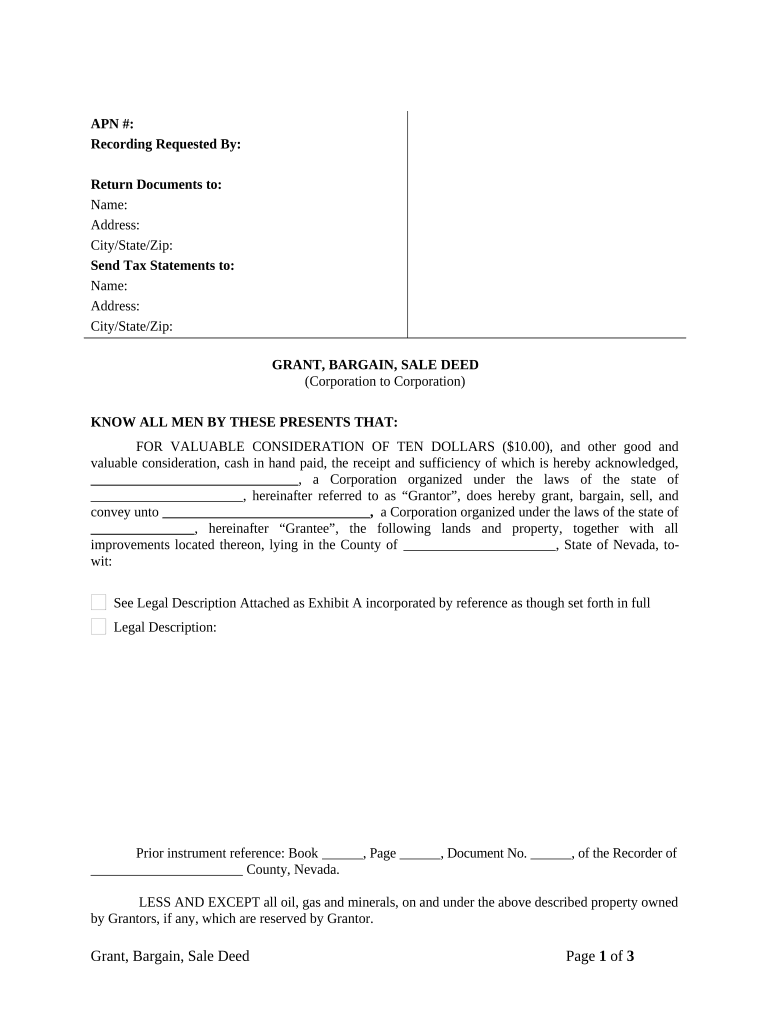
Grant, Bargain, Sale Deed from Corporation to Corporation - Nevada Preview on Page 1

Here's how it works

01. Edit your form online
Type text, add images, blackout confidential details, add comments, highlights and more.
02. Sign it in a few clicks
Draw your signature, type it, upload its image, or use your mobile device as a signature pad.
03. Share your form with others
Send it via email, link, or fax. You can also download it, export it or print it out.

How to use or fill out Grant, Bargain, Sale Deed from Corporation to Corporation - Nevada

Form edit decoration
9.5
Ease of Setup
DocHub User Ratings on G2
9.0
Ease of Use
DocHub User Ratings on G2
  1. Click ‘Get Form’ to open it in the editor.
  2. Begin by entering the APN # and the details of the party requesting the recording. Fill in the 'Recording Requested By' and 'Return Documents to' sections with accurate names and addresses.
  3. In the 'Grantor' section, input the name of the corporation selling the property along with its state of incorporation. Similarly, complete the 'Grantee' section with the purchasing corporation's information.
  4. Provide a detailed legal description of the property being transferred in Exhibit A. Ensure all relevant details are included for clarity.
  5. Complete any prior instrument references if applicable, noting book, page, and document numbers as required.
  6. Have an authorized representative sign and date the deed. Ensure that their title is clearly printed beneath their signature.
  7. Finally, include notary information by filling out the acknowledgment section at the bottom of the form.

Start using our platform today to streamline your document editing and signing process for free!

be ready to get more

Complete this form in 5 minutes or less

Get form

Got questions?

We have answers to the most popular questions from our customers. If you can't find an answer to your question, please contact us.
Contact us
While the bargain and sale deed asserts that the grantor holds the title, it does not cover any liens, encumbrances, or claims from previous owners. This limitation necessitates that buyers perform thorough due diligence, such as a detailed title search, before proceeding with the purchase.
Grant, Bargain, Sale Deed A Grant, Bargain, and Sale Deed is a legal document used to transfer property ownership from a seller (the grantor) to a buyer (the grantee). Vesting Sole Ownership: Sole ownership may be described as ownership by an individual or other entity capable of acquiring title.
A bargain and sale deed with covenant against grantors acts provides the grantee with a covenant that the grantor has not committed any act that would encumber title to the real property being conveyed.
With a grant deed, the grantor is granting their interest in a property to the grantee. It is guaranteeing that the property hasnt been transferred to any other grantee, and that it is free from any encumbrances, such as liens or taxes.
☞ No Safeguards Against Undisclosed Defects: A grant deed typically does not include any protection for the grantee against defects in the property that the grantor did not disclose. The grantee may be responsible for any liens or encumbrances on the property that the grantor did not disclose.

Security and compliance

At DocHub, your data security is our priority. We follow HIPAA, SOC2, GDPR, and other standards, so you can work on your documents with confidence.

Learn more
ccpa2
pci-dss
gdpr-compliance
hipaa
soc-compliance
be ready to get more

Complete this form in 5 minutes or less

Get form

People also ask

The purpose of a bargain and sale deed is to transfer property between a property owner and a buyer. In the case of this type of deed, the owner is not taking any responsibility for any issues that could come up with the property title. Thus, the buyer must be willing to take on possible liabilities.
The most common deed form in Nevada is the Grant Bargain and Sale Deed. This is a type of deed that typically involves two key elements. First, it warrants that the seller has not conveyed the property to another person.

Related links