Legal Last Will and Testament Form for Divorced Person Not Remarried with Adult and Minor Children - New Mexico 2026

Get Form
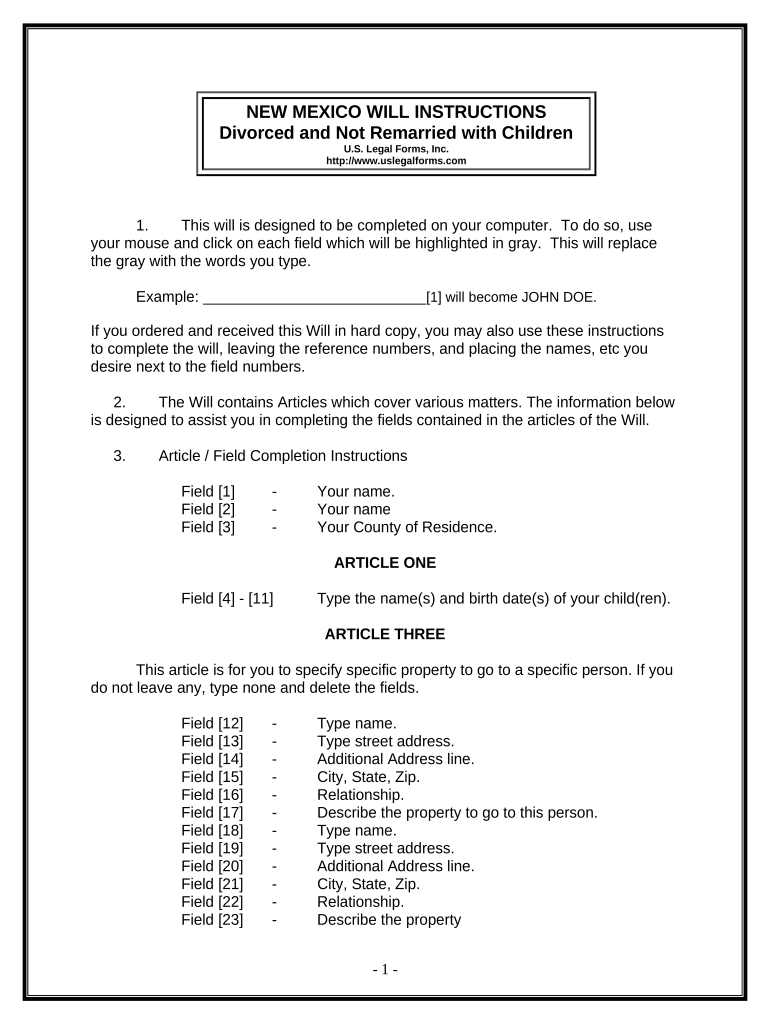
Legal Last Will and Testament Form for Divorced Person Not Remarried with Adult and Minor Children - New Mexico Preview on Page 1

Here's how it works

01. Edit your form online
Type text, add images, blackout confidential details, add comments, highlights and more.
02. Sign it in a few clicks
Draw your signature, type it, upload its image, or use your mobile device as a signature pad.
03. Share your form with others
Send it via email, link, or fax. You can also download it, export it or print it out.

How to use or fill out Legal Last Will and Testament Form for Divorced Person Not Remarried with Adult and Minor Children - New Mexico

Form edit decoration
9.5
Ease of Setup
DocHub User Ratings on G2
9.0
Ease of Use
DocHub User Ratings on G2
  1. Click ‘Get Form’ to open it in the editor.
  2. Begin by entering your name and county of residence in the designated fields. This establishes your identity as the testator.
  3. In Article One, list the names and birth dates of your children. Ensure accuracy as this information is crucial for inheritance.
  4. Proceed to Article Three to specify any particular property you wish to bequeath. If there are no specific items, simply type 'none' in the relevant fields.
  5. In Article Four, designate your children as beneficiaries for all remaining property. This ensures they inherit everything not specifically mentioned earlier.
  6. For minor children, complete Article Five by indicating the age at which their inheritance will be managed by a trustee until they reach maturity.
  7. Continue filling out Articles Six through Twelve, appointing guardians, personal representatives, and trustees as necessary.
  8. Once completed, review all entries carefully before printing. Remember to sign in front of two witnesses and a notary public if applicable.

Start using our platform today to effortlessly complete your Legal Last Will and Testament form online for free!

be ready to get more

Complete this form in 5 minutes or less

Get form

Got questions?

We have answers to the most popular questions from our customers. If you can't find an answer to your question, please contact us.
Contact us
Top five mistakes when writing a Will Failing to have the Will witnessed correctly. All Wills need to be signed in the presence of two independent witnesses, who in turn must sign the document. Creating a DIY Will. Forgetting key assets. Not updating the Will after your circumstances change. Not writing one at all.
Laws related to wills differ by state, but for a will to be valid in New Mexico it must be signed in front of two witnesses. Any individual who has docHubed the age of 18 and is of a sound mind can do this at any time after their 18th birthday. According to Caring.com (2022), only 32% of Americans have a will.
To make a valid will in New Mexico, you must be at least 18, have a sound mind, put your will in writing, and sign it in front of two witnesses. Although you do not need a notary, having one can streamline the probate process.
In New Mexico, if your estate is worth more than $50,000, probate is required. For smaller estates or certain assets (like property held in a trust), probate might not be necessary.
Basic Requirements for a Valid Will Written Document. California requires that wills be written, either typed or handwritten. Signature of the Testator. The will must be signed by the testator or by someone else at the testators direction and in their presence. Two Witnesses.

Security and compliance

At DocHub, your data security is our priority. We follow HIPAA, SOC2, GDPR, and other standards, so you can work on your documents with confidence.

Learn more
ccpa2
pci-dss
gdpr-compliance
hipaa
soc-compliance

People also ask

New Mexico There are no restrictions against remarriage following a divorce decree.
In New Mexico, you can make a living trust to avoid probate for virtually any asset you ownreal estate, bank accounts, vehicles, and so on. You need to create a trust document (similar to a will), naming someone to take over as trustee after your death (called a successor trustee).

Related links