Notice of Breach of Written Lease for Violating Specific Provisions of Lease with Right to Cure for Residential Property from Landlord to Tenant - New Mexico 2026

Get Form
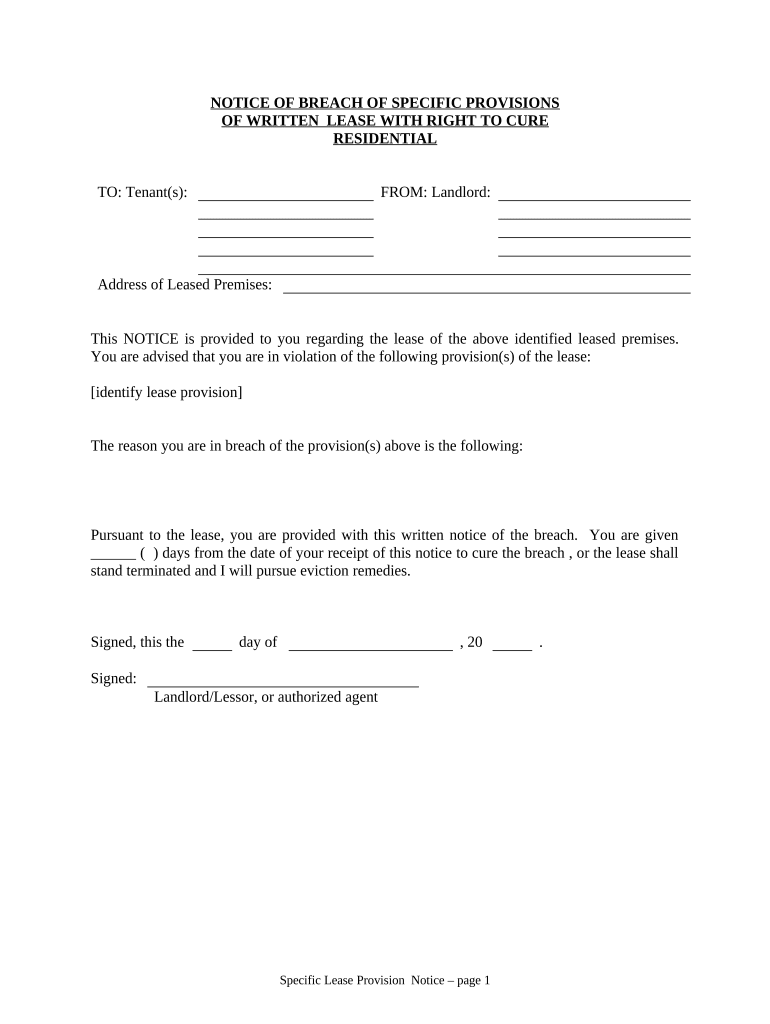
Notice of Breach of Written Lease for Violating Specific Provisions of Lease with Right to Cure for Residential Property from Landlord to Tenant - New Mexico Preview on Page 1

Here's how it works

01. Edit your form online
Type text, add images, blackout confidential details, add comments, highlights and more.
02. Sign it in a few clicks
Draw your signature, type it, upload its image, or use your mobile device as a signature pad.
03. Share your form with others
Send it via email, link, or fax. You can also download it, export it or print it out.

How to use or fill out Notice of Breach of Written Lease for Violating Specific Provisions of Lease with Right to Cure for Residential Property from Landlord to Tenant - New Mexico

Form edit decoration
9.5
Ease of Setup
DocHub User Ratings on G2
9.0
Ease of Use
DocHub User Ratings on G2
  1. Click ‘Get Form’ to open it in the editor.
  2. Begin by entering the Tenant(s) name and the Landlord's name at the top of the form. This identifies both parties involved in the lease agreement.
  3. Fill in the address of the leased premises where the violation has occurred. This ensures clarity on which property is being referenced.
  4. Identify and specify the lease provision(s) that have been violated. Clearly stating this helps in understanding the basis of the breach.
  5. Provide a detailed explanation of why you believe there is a breach. This section should be concise yet informative, outlining specific incidents or behaviors.
  6. Indicate the number of days allowed for curing the breach. This is crucial as it informs tenants about their timeframe to rectify the issue.
  7. Sign and date the notice at the bottom, ensuring that it is officially recognized as a formal communication from you, the landlord.
  8. Complete the Proof of Delivery section by selecting how you delivered this notice (hand, registered mail, or posting). Fill in your name and capacity before signing again.

Start using our platform today to streamline your document editing and ensure effective communication with your tenants!

be ready to get more

Complete this form in 5 minutes or less

Get form

Got questions?

We have answers to the most popular questions from our customers. If you can't find an answer to your question, please contact us.
Contact us
A cure or quit notice is a written demand from a landlord directing a tenant to stop violating a lease provision within a specified period or face eviction. The time allowed to cure the violation is determined by state landlord-tenant statutes or the lease agreement.
The tenant must also remedy the problem within a given time period. Take note that a violation notice is simply a warning, not an eviction. However, multiple lease violations notices without any action from the tenant can lead to termination of the rental agreement.
The lease agreement specifies important terms regarding rent payment, security deposits, property maintenance, and proper notice requirements. When landlords violate these terms, they bdocHub the contract, giving tenants legal grounds to seek remedies.
Your risk facing some hefty fees. This is the most common penalty for breaking a lease without legal justification. Sometimes the fine is equal to one- or two months worth of rent. In other words, you risk forfeiting your security deposit. Your landlord has the right to keep your security deposit.
A bdocHub of a commercial lease occurs when either the landlord or the tenant fails to comply with the terms stipulated in the lease agreement. Common bdocHubes by tenants include non-payment of rent, unauthorized alterations to the property, subletting without permission, and violating usage clauses.

Security and compliance

At DocHub, your data security is our priority. We follow HIPAA, SOC2, GDPR, and other standards, so you can work on your documents with confidence.

Learn more
ccpa2
pci-dss
gdpr-compliance
hipaa
soc-compliance

People also ask

One of the most common problems landlords face is unpaid rent. Lease agreements should state the due date for payments, so even a single late payment can constitute a violation of the agreement.

Related links