Type text, add images, blackout confidential details, add comments, highlights and more.
02. Sign it in a few clicks
Draw your signature, type it, upload its image, or use your mobile device as a signature pad.
03. Share your form with others
Send it via email, link, or fax. You can also download it, export it or print it out.
How to use or fill out Estate Planning Questionnaire and Worksheets - New Jersey with our platform
Ease of Setup
DocHub User Ratings on G2
Ease of Use
DocHub User Ratings on G2
Click ‘Get Form’ to open the Estate Planning Questionnaire and Worksheets in the editor.
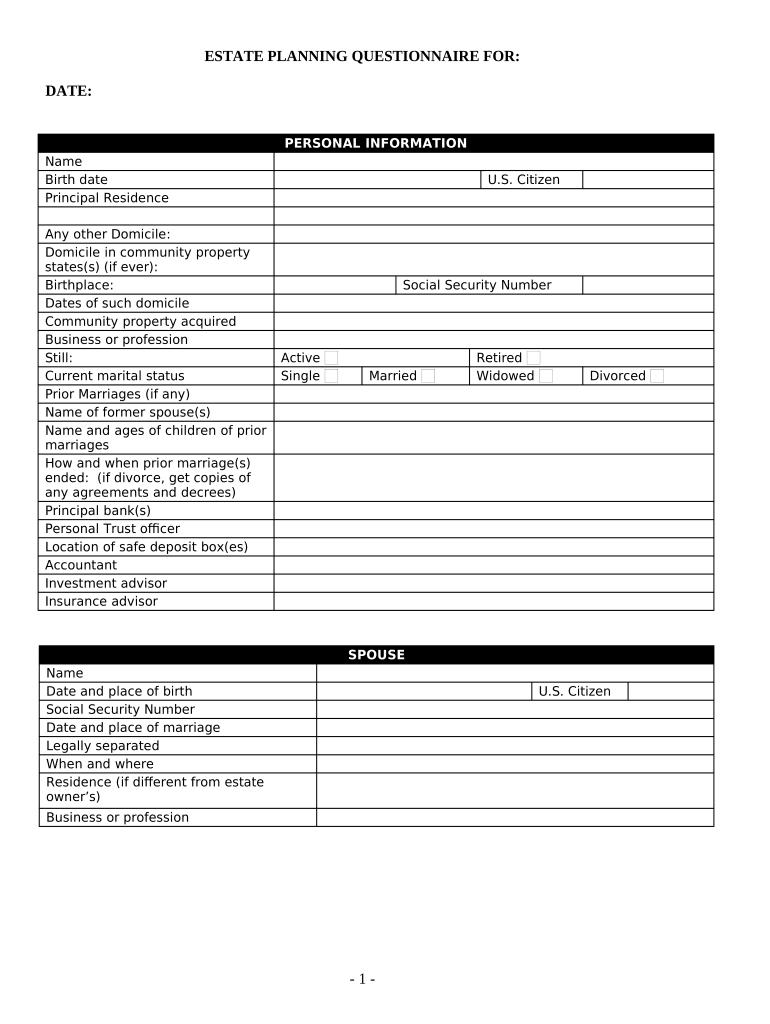
Begin by filling out the 'Personal Information' section. Enter your name, birth date, principal residence, and any other domicile details. Be sure to include your marital status and information about prior marriages if applicable.
Proceed to the 'Children and Grandchildren' section. Clearly designate which children or grandchildren are adopted or from prior marriages, including their names and birth dates.
In the 'Who Will Benefit Under Will' section, list beneficiaries along with their addresses, ages, and relationship to you.
Complete the 'Fiduciaries' section by providing names and addresses for executors, trustees, and guardians.
Fill out the 'Financial Information' sections thoroughly. Include details about real estate, stocks, bonds, cash accounts, life insurance policies, and any liabilities.
Finally, review your entries for accuracy before saving or sharing your completed questionnaire using our platform's features.
Start filling out your Estate Planning Questionnaire today for free on our platform!
Fill out Estate Planning Questionnaire and Worksheets - New Jersey online It's free
The IRSs 5 and 5 rule limits the amount beneficiaries can withdraw from a Crummey Trust in a given year. Specifically, it allows beneficiaries to withdraw the greater of $5,000 or 5% of the trusts value annually.
What is the 5 by 5 rule in estate planning?
Checklist Details. Do you have a (i) Last Will and Testament, (ii) Revocable Trust, (iii) General Durable Power of Attorney, and (iv) Health Care Power of Attorney/Health Care Proxy/Living Will? Every complete estate plan must contain at least three of these documents.
What is the biggest mistake parents make when setting up a trust fund?
The five or five power is the power of the beneficiary of a trust to withdraw annually $5,000 or five percent of the assets of the trust.
What is the 5 or 5 rule in estate planning?
The idea behind the 5-by-5 rule is pretty straightforward. If something wont matter five years down the line, dont bother wasting more than five minutes obsessing over it. On paper, it sounds quite simple.
What documents are needed for estate planning in NJ?
What are the 7 steps in the estate planning process? Step 1: Define Your Goals and Objectives. Step 2: Create or Update Your Will. Step 3: Establish Trusts. Step 4: Designate Beneficiaries. Step 5: Plan for Incapacity. Step 6: Address Taxation. Step 7: Regularly Review and Update.
Related Searches
Estate planning questionnaire and worksheets new jersey templateFree estate planning questionnaire and worksheets new jerseyEstate planning questionnaire and worksheets new jersey pdfEstate planning questionnaire and worksheets new jersey pdf freeEstate planning questionnaire and worksheets new jersey 2021
Security and compliance
At DocHub, your data security is our priority. We follow HIPAA, SOC2, GDPR, and other standards, so you can work on your documents with confidence.
What are the 7 steps in the estate planning process?
An estate planning questionnaire is a form that asks you questions about your personal information, family, finances, and more. It helps you gather important information and organize your thoughts about your simple estate plan.
Related links
ESTATE PLANNING - Princeton Alumni
This guide book can be used as a starting point when creating a new estate plan and can CALCULATE YOUR ESTATES WORTH. Worksheets to Help Evaluate Your Estate.
Cookie consent notice
This site uses cookies to enhance site navigation and personalize your experience.
By using this site you agree to our use of cookies as described in our Privacy Notice.
You can modify your selections by visiting our Cookie and Advertising Notice.