Mutual Wills containing Last Will and Testaments for Unmarried Persons living together with No Children - New Jersey 2026

Get Form
Mutual Wills containing Last Will and Testaments for Unmarried Persons living together with No Children - New Jersey Preview on Page 1

Here's how it works

01. Edit your form online
Type text, add images, blackout confidential details, add comments, highlights and more.
02. Sign it in a few clicks
Draw your signature, type it, upload its image, or use your mobile device as a signature pad.
03. Share your form with others
Send it via email, link, or fax. You can also download it, export it or print it out.

How to use or fill out Mutual Wills containing Last Will and Testaments for Unmarried Persons living together with No Children - New Jersey

Form edit decoration
9.5
Ease of Setup
DocHub User Ratings on G2
9.0
Ease of Use
DocHub User Ratings on G2
  1. Click ‘Get Form’ to open it in the editor.
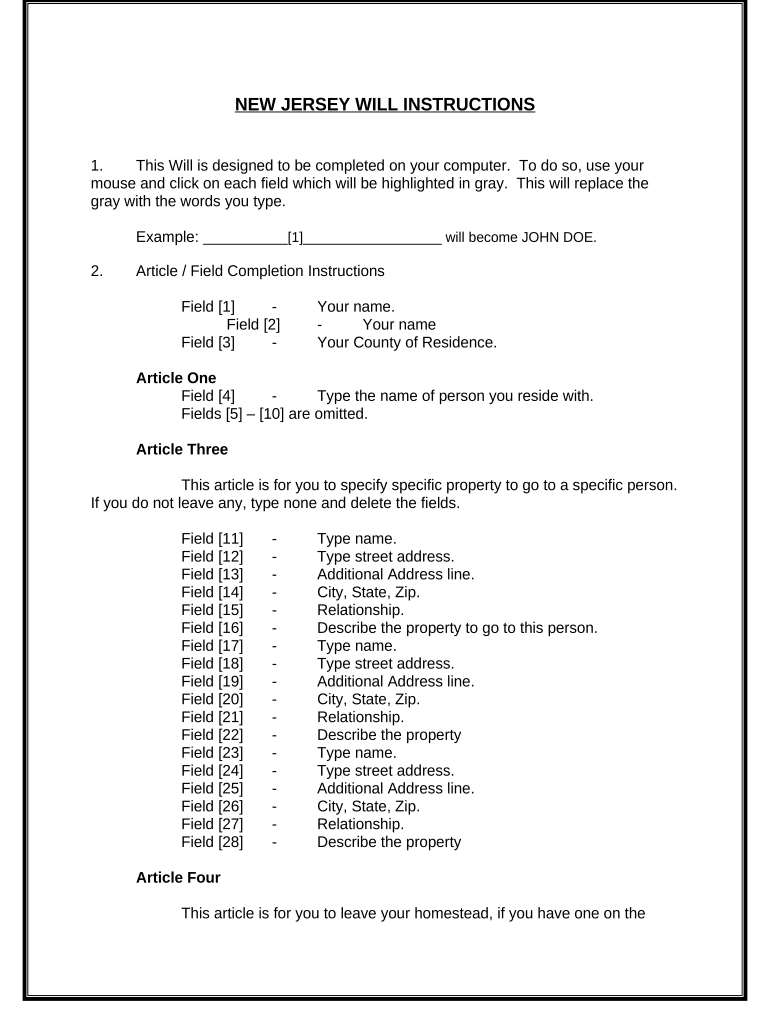
  2. Begin by entering your name in Field [1] and your county of residence in Field [3].
  3. In Article One, specify the name of the person you reside with in Field [4].
  4. For Article Three, list any specific property you wish to bequeath. If none, type 'none' in the designated fields.
  5. In Article Four, indicate who will receive your homestead by filling out Field [29] or selecting heirs at law.
  6. Complete Article Five by naming a person to receive all remaining property in Field [31], or select heirs at law.
  7. Designate a Personal Representative in Article Six by filling out Fields [34] and [35].
  8. Review all entries for accuracy before printing. Ensure to sign the document in front of two witnesses.

Start using our platform today to easily complete your Mutual Wills online for free!

be ready to get more

Complete this form in 5 minutes or less

Get form

Got questions?

We have answers to the most popular questions from our customers. If you can't find an answer to your question, please contact us.
Contact us
Unmarried couples living together do not enjoy the same automatic property rights as married couples. Despite this, these couples can use cohabitation agreements or own property jointly to ensure their individual property rights. Many couples live together before marriage. Some remain together and never marry.
Unmarried Couples and Property Rights If it can be established to the satisfaction of the court that a separating couples assets are jointly owned, the court will generally divvy them on a 50/50 basis unless one partner can provide written proof that he or she made a greater contribution to their acquisition.
While even married or state-registered couples need an estate plan, unmarried or unregistered couples can provide important protections for a surviving partner and/or any minor children by drafting an estate plan, as well as naming the people responsible for making important decisions about their health and property.
Unmarried couples have joint property rights in assets that they own together. Therefore, if you and your partner purchase real estate and title it in both names, you each own an interest in it. The same applies to other assets, including bank accounts and vehicles titled in both names.
Basic Requirements for a Valid Will Written Document. California requires that wills be written, either typed or handwritten. Signature of the Testator. The will must be signed by the testator or by someone else at the testators direction and in their presence. Two Witnesses.

Security and compliance

At DocHub, your data security is our priority. We follow HIPAA, SOC2, GDPR, and other standards, so you can work on your documents with confidence.

Learn more
ccpa2
pci-dss
gdpr-compliance
hipaa
soc-compliance

People also ask

Because common law marriage is not recognized in New Jersey, this is true even if the couple lived together for 20 years. That does not mean, however, that assets which are legally held jointly cannot be divided.
Unmarried couples will still have joint rights to any property they actually own together, and all couples with children, regardless of marital status or agreement, will be bound by child support and child custody laws.

Related links