Type text, add images, blackout confidential details, add comments, highlights and more.
02. Sign it in a few clicks
Draw your signature, type it, upload its image, or use your mobile device as a signature pad.
03. Share your form with others
Send it via email, link, or fax. You can also download it, export it or print it out.
How to use or fill out Legal Last Will and Testament for Married person with Minor Children from Prior Marriage - New Hampshire
Ease of Setup
DocHub User Ratings on G2
Ease of Use
DocHub User Ratings on G2
Click ‘Get Form’ to open it in the editor.
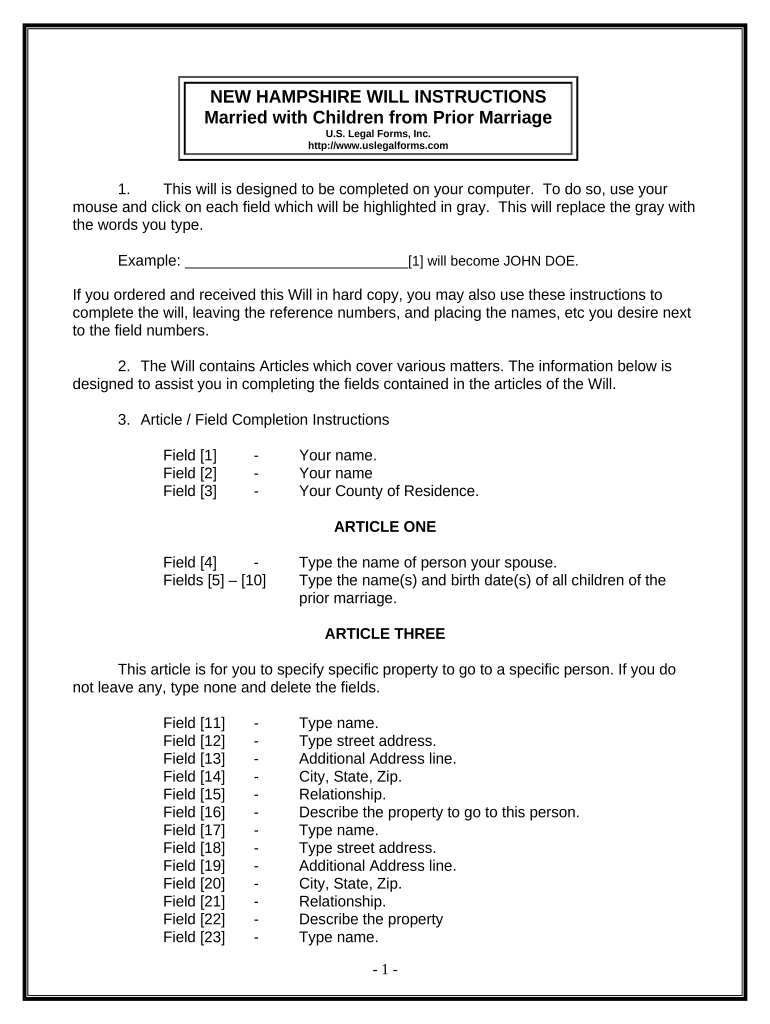
Begin by entering your name in Field [1] and your county of residence in Field [3].
In Article One, specify your spouse's name in Field [4] and list all children from prior marriages along with their birth dates in Fields [5]-[10].
Proceed to Article Three to detail any specific bequests. Fill out the names, addresses, relationships, and descriptions of property for each beneficiary in Fields [11]-[28]. If no specific property is to be left, type 'none'.
In Article Four, indicate whether your homestead will go to your spouse or children by checking the appropriate box and filling out the necessary fields.
Continue through Articles Five to Eleven, ensuring you complete each section regarding remaining property distribution, trustee appointments, guardianship for minor children, and personal representatives.
Once completed, review all entries carefully before printing. Ensure you sign the document in front of two witnesses.
Start using our platform today to easily fill out your Last Will and Testament for free!
Fill out Legal Last Will and Testament for Married person with Minor Children from Prior Marriage - New Hampshire online It's free
As a beneficiary in New Hampshire, you have several rights. At the most basic level, you are entitled to receive information about the estate and its administration. You also have a right to an accounting of the estates assets, debts, and distributions.
Can you have a will if you are married?
RSA 551:2(d) states that a will must be signed by 2 or more credible witnesses, who shall, at the request of the testator and in the testators presence, attest to the testators signature. Since a holographic will by definition does not have witnesses, a holographic will is not valid in New Hampshire.
What makes a will legal in New Hampshire?
Some assets are not probate assets. Life insurance, annuities, pensions, IRAs, and 40lks usually have named beneficiaries, so they dont need probate.
How long does an executor have to settle an estate in New Hampshire?
MANAGING THE ESTATE For all forms of administration, the estate must remain open for at least six months from the date of appointment to allow creditors to present claims. If all claims have been paid, the estate may be closed and a final account filed after six months.
What is the inheritance law in New Hampshire?
Getting married does not automatically void, invalidate, or revoke your current will. Your will is still considered valid after you get married. Although your current will is valid and it does not provide for your spouse, your spouse still has rights to your assets at your death.
Related Searches
$199 WillWill legal documentDraw up a willCompleting a will onlineEstate willMy will
Security and compliance
At DocHub, your data security is our priority. We follow HIPAA, SOC2, GDPR, and other standards, so you can work on your documents with confidence.
How much can you inherit in New Hampshire without paying taxes?
Does New Hampshire Have an Inheritance Tax or Estate Tax? New Hampshire does not have an inheritance tax. However, if you inherit from someone who lived in or owned property in a state that does have an estate tax, such as Maryland or Kentucky, then you may have to deal with that tax.
What is the maximum amount you can inherit without paying taxes?
While state laws differ for inheritance taxes, an inheritance must exceed a certain threshold to be considered taxable. For federal estate taxes as of 2024, if the total estate is under $13.61 million for an individual or $27.22 million for a married couple, theres no need to worry about estate taxes.
Related links
Uncategorized | Inheritance Laws of the United States 2015
Nov 11, 2015 Students prepare a variety of documents including a last will and testament, and petitions to open and close an estate. law because in NY the
Jul 19, 2020 Mormonism is a new religious movement founded by Joseph Smith in the early 1800s. The official name of the church today is The Church of Jesus Christ of
Cookie consent notice
This site uses cookies to enhance site navigation and personalize your experience.
By using this site you agree to our use of cookies as described in our Privacy Notice.
You can modify your selections by visiting our Cookie and Advertising Notice.