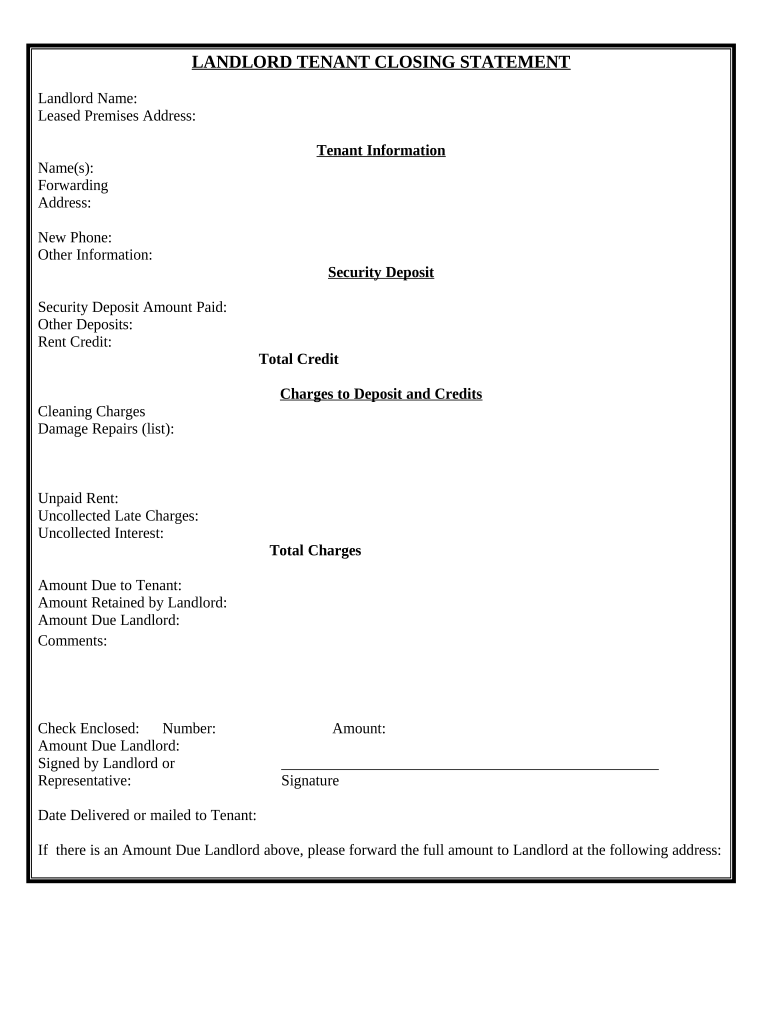
Landlord Tenant Closing Statement to Reconcile Security Deposit - New Hampshire 2026

Get Form
nh landlord tenant law security deposit Preview on Page 1

Here's how it works

01. Edit your nh landlord tenant law security deposit online
Type text, add images, blackout confidential details, add comments, highlights and more.
02. Sign it in a few clicks
Draw your signature, type it, upload its image, or use your mobile device as a signature pad.
03. Share your form with others
Send it via email, link, or fax. You can also download it, export it or print it out.

How to use or fill out Landlord Tenant Closing Statement to Reconcile Security Deposit - New Hampshire with DocHub

Form edit decoration
9.5
Ease of Setup
DocHub User Ratings on G2
9.0
Ease of Use
DocHub User Ratings on G2
  1. Click ‘Get Form’ to open the Landlord Tenant Closing Statement in our editor.
  2. Begin by entering the Landlord's name and the leased premises address at the top of the form. This establishes the primary parties involved.
  3. Fill in the tenant information, including names, forwarding address, and new phone number. This ensures that all communication is directed appropriately.
  4. Input the security deposit amount paid, along with any other deposits and rent credits. This section summarizes financial transactions related to the lease.
  5. Detail any charges against the deposit, such as cleaning charges or damage repairs. Be specific about each charge to maintain transparency.
  6. Calculate total charges, unpaid rent, uncollected late charges, and interest. This will help determine what is owed to both parties.
  7. Finally, indicate amounts due to the tenant and retained by the landlord. Include comments if necessary for clarity.
  8. Sign and date the document before delivering it to the tenant via mail or in person.

Start using our platform today for free to streamline your document editing and signing process!

be ready to get more

Complete this form in 5 minutes or less

Get form

Got questions?

We have answers to the most popular questions from our customers. If you can't find an answer to your question, please contact us.
Contact us
Payment deadlines for damages after moving out depend on lease terms and local laws. Typically, landlords must provide an itemized list of damages and related costs within a specified period, often 14 to 30 days after tenancy ends. Tenants usually have a set time to pay or dispute charges.
At the end of your tenancy Your landlord must return your deposit within 10 days of you both agreeing how much youll get back. If youre in a dispute with your landlord, then your deposit will be protected in the TDP scheme until the issue is sorted out.
Tell the scheme if the landlord or agent do not reply or refund your deposit within 10 days of you writing to ask for it back. The scheme will contact your landlord. They will tell them to pay the money into an account until the dispute is resolved and offer dispute resolution to you both.
When writing a security deposit receipt, include the following information: Date of the deposit receipt. Name of the tenant. Name and location of the financial institution where the security deposit is held. Account number, if required. Amount deposited and date the deposit was made.
NH Rev Stat 540-A:5 to 540-A:8; 540-B:10. Return of Security Deposit: A landlord is required to return a tenants security deposit within 30 days after the tenant has vacated the rental property.

Security and compliance

At DocHub, your data security is our priority. We follow HIPAA, SOC2, GDPR, and other standards, so you can work on your documents with confidence.

Learn more
ccpa2
pci-dss
gdpr-compliance
hipaa
soc-compliance
be ready to get more

Complete this form in 5 minutes or less

Get form

People also ask

Yes, a landlord can deduct money from your deposit for cleaning, but only if the property is left in a worse condition than it was when you moved in.
How to write a security deposit return letter Landlords name and contact information. Tenants name and contact information. Date of the letter. Amount of security deposit being returned to the tenant. Breakdown of any deductions made from the security deposit, including an explanation for each deduction.