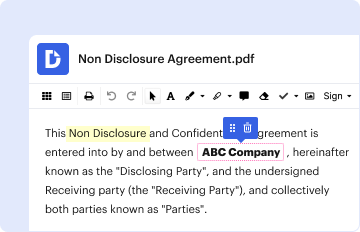
Type text, add images, blackout confidential details, add comments, highlights and more.
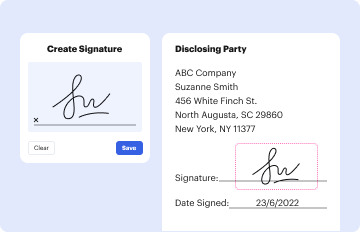
02. Sign it in a few clicks
Draw your signature, type it, upload its image, or use your mobile device as a signature pad.
03. Share your form with others
Send it via email, link, or fax. You can also download it, export it or print it out.
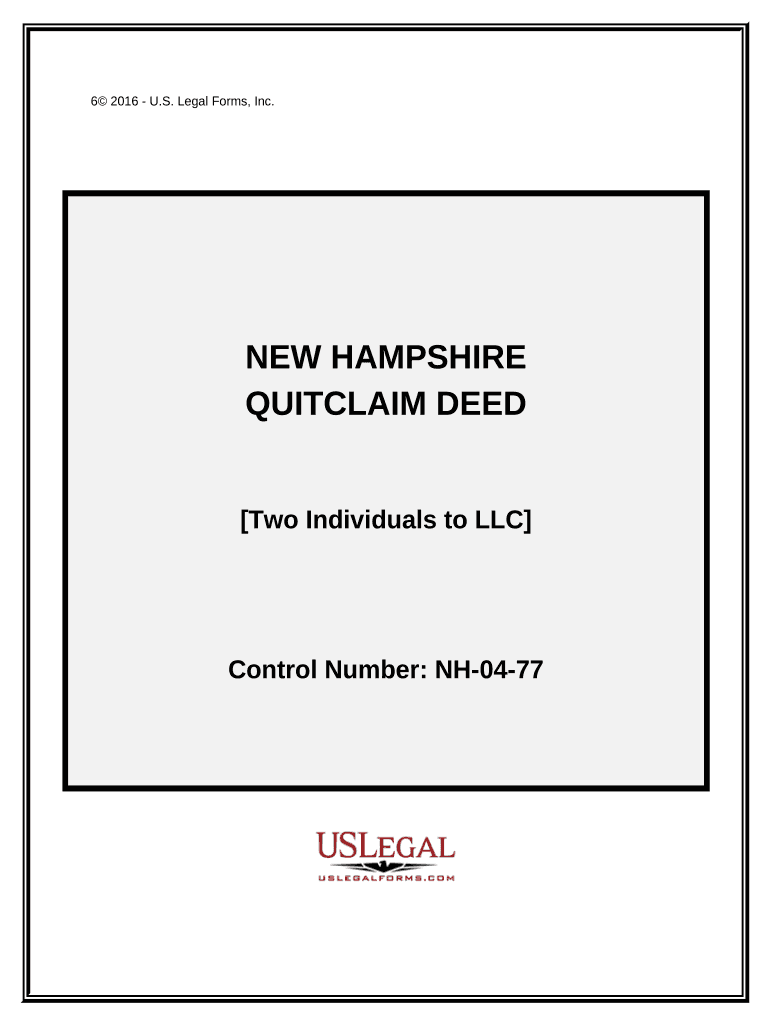
How to use or fill out Quitclaim Deed by Two Individuals to LLC - New Hampshire
Ease of Setup
DocHub User Ratings on G2
Ease of Use
DocHub User Ratings on G2
Click ‘Get Form’ to open it in the editor.
Begin by entering the names of the two individuals acting as Grantors in the designated fields. Ensure that both names are clearly printed.
In the Grantee section, input the name of the Limited Liability Company (LLC) receiving the property. Make sure to include any necessary details about its organization under New Hampshire law.
Fill in the legal description of the property being transferred. If you have an attached Exhibit A, reference it accordingly.
Complete any additional fields regarding prior instrument references and easements, ensuring all information is accurate and complete.
Both Grantors must sign and date the document. Include their printed names beneath their signatures for clarity.
Finally, ensure that a Notary Public or Justice of Peace acknowledges the signatures as required by New Hampshire law.
Start using our platform today to easily complete your Quitclaim Deed for free!
Fill out Quitclaim Deed by Two Individuals to LLC - New Hampshire online It's free
Potential for Fraud or Duress: If a grantor is coerced or tricked into signing, the deed can later be voided. Difficulty Proving Ownership: Without warranties or title insurance, the grantee may struggle to prove valid ownership in future disputes.
What are common quitclaim deed mistakes?
Failing to Verify the Titles Condition. One of the biggest mistakes people make when using a quitclaim deed is assuming that the propertys title is free and clear. A quitclaim deed transfers ownership, but it does not guarantee that the property is free from encumbrances such as liens, judgments, or unpaid taxes.
What is the most common circumstance in which someone will issue a quitclaim deed?
Quitclaim deeds can be used in a number of different situations, though they are most common when transferring property between family members or spouses. For example, after a divorce one spouse may sign a quitclaim deed to officially sign over ownership of the home.
What do you need for a quitclaim deed in NH?
To transfer New Hampshire real estate property using a quitclaim deed, both the grantor and grantee must each submit a declaration of consideration form and an inventory of property transfer form [1] within 30 days. These documents serve as evidence of payment of the real estate transfer tax, consistent with N.H. Rev.
What is the most common use of a quit claim deed?
Quitclaim deeds are typically used to transfer property in non-sale situations, such as transfers of property between family members.
Related Searches
Quitclaim deed by two individuals to llc new hampshire sampleNH Quit Claim deed formQuitclaim deed by two individuals to llc new hampshire formQuitclaim deed by two individuals to llc new hampshire exampleQuitclaim deed by two individuals to llc new hampshire onlinersa 477:28NH recordsNH Deeds
Security and compliance
At DocHub, your data security is our priority. We follow HIPAA, SOC2, GDPR, and other standards, so you can work on your documents with confidence.
However, this approach has certain risks, so its not always the best option. Using a quitclaim deed might create tax issues or result in a loss of control of the property after the transfer. Additionally, the property could still require probate if you dont handle the transfer correctly.
Can you do a quit claim deed to an LLC?
A quit claim deed to LLC transfers property ownership but does not guarantee the property is free from liens or encumbrances. LLCs provide liability protection for real estate owners, but transferring property using a quit claim deed does not remove personal liability from an existing mortgage.
What are the common reasons to remove a name from a deed?
Death, divorce, and changes to personal circumstances are all common and can result in the need to remove an individual from a house deed. Removing yourself from a deed is relatively easy. You can simply utilize a quitclaim deed, a deed of conveyance, or an interspousal transfer deed, depending on your situation.
Related links
PLJOv18#3 Probate Law Journal of Ohio - Hahn Loeser
General warranty deed + endorsement Note: a quitclaim deed may be problematic, depending on how the insurance company views quitclaim deeds because it
The Internal Revenue Service Collects from an Innocent
Dec 30, 2003 The petitioners claim resulted from a mechanics lien; the federal tax lien resulted from unpaid social security and federal withholding taxes.
Cookie consent notice
This site uses cookies to enhance site navigation and personalize your experience.
By using this site you agree to our use of cookies as described in our Privacy Notice.
You can modify your selections by visiting our Cookie and Advertising Notice.