Warning of Default on Commercial Lease - Missouri 2026

Get Form
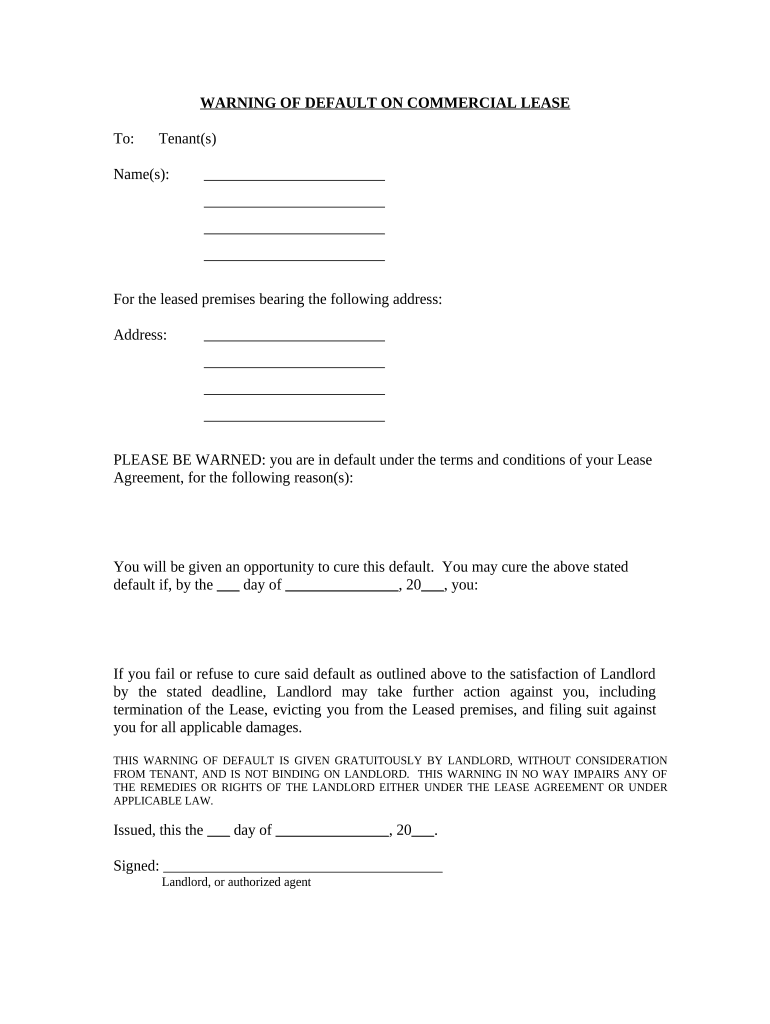
Warning of Default on Commercial Lease - Missouri Preview on Page 1

Here's how it works

01. Edit your form online
Type text, add images, blackout confidential details, add comments, highlights and more.
02. Sign it in a few clicks
Draw your signature, type it, upload its image, or use your mobile device as a signature pad.
03. Share your form with others
Send it via email, link, or fax. You can also download it, export it or print it out.

How to use or fill out Warning of Default on Commercial Lease - Missouri with our platform

Form edit decoration
9.5
Ease of Setup
DocHub User Ratings on G2
9.0
Ease of Use
DocHub User Ratings on G2
  1. Click ‘Get Form’ to open it in the editor.
  2. Begin by entering the Tenant(s) name(s) in the designated field. Ensure accuracy as this identifies who is receiving the warning.
  3. Next, input the address of the leased premises. This is crucial for clarity regarding which property the warning pertains to.
  4. In the section outlining reasons for default, specify the exact issues leading to this notice. Be clear and concise to avoid misunderstandings.
  5. Fill in the deadline by which the tenant must cure the default. Use a date format that is easy to understand, ensuring compliance with lease terms.
  6. Finally, sign and date the document in the provided fields. This confirms that you are issuing this warning formally.

Start using our platform today to streamline your document editing and ensure your forms are completed efficiently!

be ready to get more

Complete this form in 5 minutes or less

Get form

Got questions?

We have answers to the most popular questions from our customers. If you can't find an answer to your question, please contact us.
Contact us
This notice states that if the bdocHub is not solved in the next 14 days, then the lease between the tenant and landlord will end in 30 days. So if you serve or mail a 14/30-day notice to the landlord on the 31st and the problem is not solved by the 14th, then the lease would end on the 30th.
Common Reasons Leases Get Terminated Often, unexpected circumstances might prompt a necessary change. A few reasons you might be considering ending your commercial lease agreement early include: Financial hardship. Relocation of your business.
Many commercial leases do not have pre-negotiated early termination rights. However, when lease termination clauses are negotiated, its common for the landlord to require the tenant to pay three to six months of rent obligation, plus unamortized lease up costs.
If a tenant does not resolve the default, landlords may issue a Notice of Termination, formally ending the lease. Similar to the written Notice of Default, this notice should: Clearly state why the lease is being terminated. Provide any notice period required by the lease agreement.
Commercial leases require an effective default clause that allows the landlord to force a tenant to comply with all lease obligations. The default clause commonly provides the procedure for obtaining an eviction or the threat of an eviction for a commercial tenants violation of the lease.
be ready to get more

Complete this form in 5 minutes or less

Get form

People also ask

Your landlord may take you to court to obtain a judgment against you for the unpaid rent. If the court rules in your landlords favor, you may be ordered to pay the rent, plus interest and costs. If you do not pay, your landlord may be able to enforce the judgment by seizing your assets or making you bankrupt.
Yes, a tenant can give up their right to a lease by negotiating the surrender terms with the landlord. The terms must be agreed to by both parties, otherwise the surrender cannot take place. Often, landlords can be reluctant to agree to lease surrender, as theyll lose rental income, even if only for a short period.
Understanding Penalties Most landlords will pursue some combination of the following: Acceleration of rent (requiring payment of all remaining lease term rent immediately) Forfeiture of your security deposit. Possibly additional damages for lost income or property condition.

Related links