Nonearning Disclosure - Minnesota 2026

Get Form
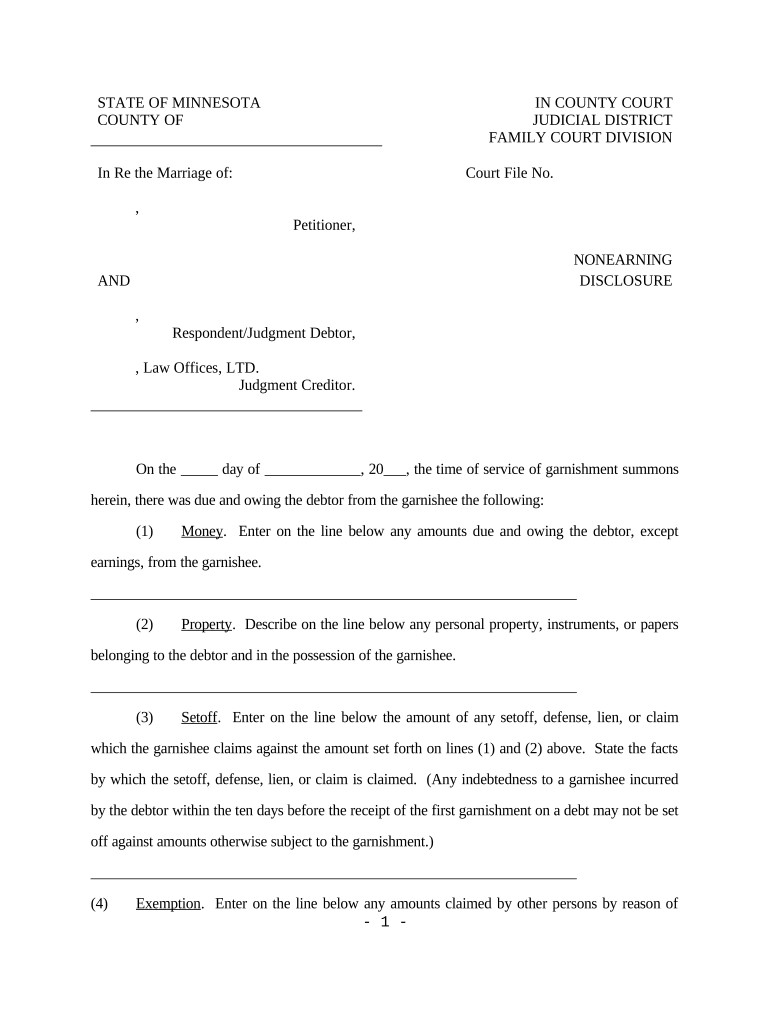
Nonearning Disclosure - Minnesota Preview on Page 1

Here's how it works

01. Edit your form online
Type text, add images, blackout confidential details, add comments, highlights and more.
02. Sign it in a few clicks
Draw your signature, type it, upload its image, or use your mobile device as a signature pad.
03. Share your form with others
Send it via email, link, or fax. You can also download it, export it or print it out.

How to use or fill out Nonearning Disclosure - Minnesota with our platform

Form edit decoration
9.5
Ease of Setup
DocHub User Ratings on G2
9.0
Ease of Use
DocHub User Ratings on G2
  1. Click ‘Get Form’ to open the Nonearning Disclosure - Minnesota in the editor.
  2. Begin by entering the names of the Petitioner and Respondent at the top of the form, along with the Court File Number.
  3. In section (1), input any amounts due and owing to the debtor from the garnishee, excluding earnings.
  4. For section (2), describe any personal property or papers belonging to the debtor that are in possession of the garnishee.
  5. In section (3), detail any setoff, defense, lien, or claim against amounts listed in lines (1) and (2). Provide factual support for these claims.
  6. Complete section (4) by entering amounts claimed by other persons regarding ownership or interest in the debtor's property.
  7. Fill out section (5) with any adverse interests claimed by others on the debtor's property.
  8. Calculate and enter totals as instructed in sections (6), (7), and (8). Ensure all calculations are accurate.
  9. Finally, complete the affirmation section by signing and providing your title and telephone number. Ensure all information is truthful and complete.

Start using our platform today to easily fill out your Nonearning Disclosure - Minnesota for free!

be ready to get more

Complete this form in 5 minutes or less

Get form

Got questions?

We have answers to the most popular questions from our customers. If you can't find an answer to your question, please contact us.
Contact us
Upon termination of the prohibition of disclosure, the government entity shall make publicly viewable all documents and certificates of title relative to the participant that were previously partially or wholly private and not viewable.
Minnesota law specifies that the seller of a residential property must make a written disclosure to the prospective buyer that includes all material facts of which the seller is aware that could adversely and significantly affect 1) an ordinary buyers use and enjoyment of the property, or 2) any intended use of the
524.2-702 REQUIREMENT OF SURVIVAL FOR 120 HOURS FOR DEVISEES, BENEFICIARIES OF CERTAIN TRUSTS, AND APPOINTEES OF CERTAIN POWERS OF APPOINTMENT; SIMULTANEOUS DEATH ACT FOR OTHER CASES.
First degree sale or possession of a controlled substance is the most serious felony drug offense under Minnesota law. As a first-time offense, the crime is punishable by up to 30 years in prison and a $1,000,000 fine.
0:08 2:21 Starting next year you could pay $75 a month or less. Well be saving close to $2,000 for LeahMoreStarting next year you could pay $75 a month or less. Well be saving close to $2,000 for Leah Greenside. Thats real savings. Especially since she spends about $2,500.

Security and compliance

At DocHub, your data security is our priority. We follow HIPAA, SOC2, GDPR, and other standards, so you can work on your documents with confidence.

Learn more
ccpa2
pci-dss
gdpr-compliance
hipaa
soc-compliance
be ready to get more

Complete this form in 5 minutes or less

Get form

People also ask

Rule 56. Summary Judgment The court shall grant summary judgment if the movant shows that there is no genuine issue as to any material fact and the movant is entitled to judgment as a matter of law. The court shall state on the record or in a written decision the reasons for granting or denying the motion.
Rule 115.07Relaxation of Time Limits If irreparable harm will result absent immediate action by the court, or if the interests of justice otherwise require, the court may waive or modify the time limits established by this rule.

Related links