Paving Contract for Contractor - Minnesota 2026

Get Form
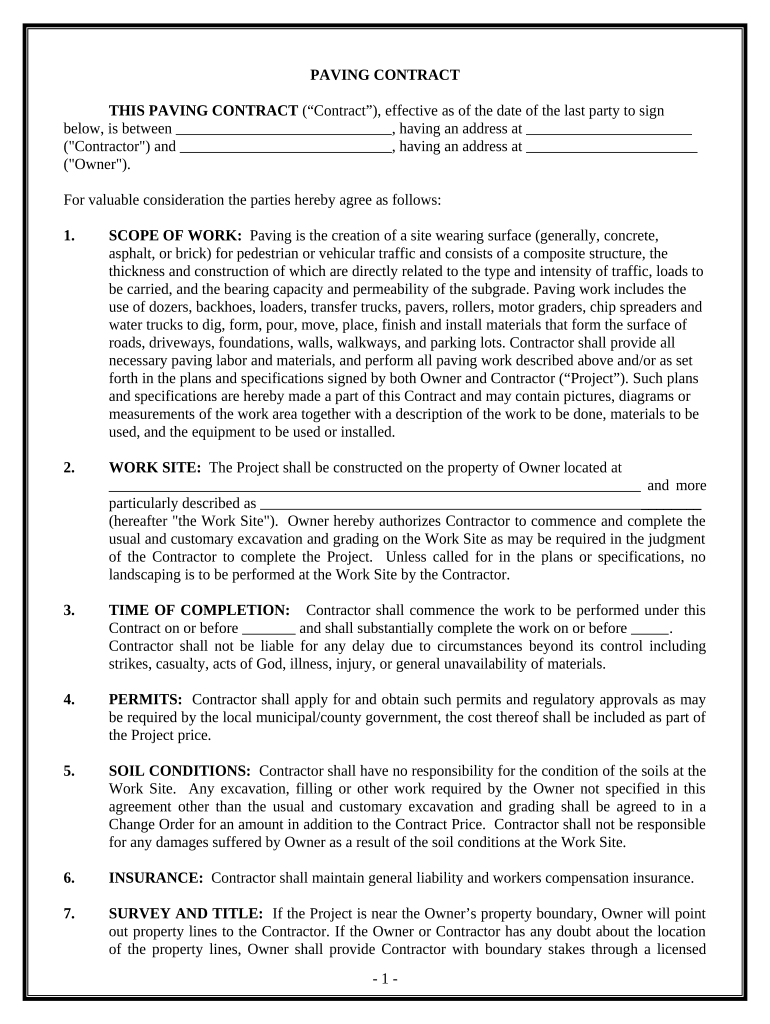
Paving Contract for Contractor - Minnesota Preview on Page 1

Here's how it works

01. Edit your form online
Type text, add images, blackout confidential details, add comments, highlights and more.
02. Sign it in a few clicks
Draw your signature, type it, upload its image, or use your mobile device as a signature pad.
03. Share your form with others
Send it via email, link, or fax. You can also download it, export it or print it out.

How to use or fill out Paving Contract for Contractor - Minnesota with our platform

Form edit decoration
9.5
Ease of Setup
DocHub User Ratings on G2
9.0
Ease of Use
DocHub User Ratings on G2
  1. Click ‘Get Form’ to open the Paving Contract for Contractor - Minnesota in the editor.
  2. Begin by filling in the Contractor's name and address at the top of the form. This identifies who will be performing the paving work.
  3. Next, enter the Owner's name and address. This section specifies who is hiring the contractor for the project.
  4. In the 'SCOPE OF WORK' section, detail the specific paving tasks to be completed, including materials and methods. Ensure this aligns with any attached plans or specifications.
  5. Fill in the 'WORK SITE' section with the exact location of where the paving will occur, ensuring clarity on property boundaries.
  6. Specify dates in 'TIME OF COMPLETION' for when work will start and when it is expected to be completed.
  7. Complete sections regarding permits, soil conditions, insurance, and any changes to scope as necessary based on your project specifics.
  8. Finally, review all entries for accuracy before signing. Both parties should sign and date at the end of the document to finalize the contract.

Start using our platform today to easily fill out your Paving Contract for Contractor - Minnesota online for free!

be ready to get more

Complete this form in 5 minutes or less

Get form

Got questions?

We have answers to the most popular questions from our customers. If you can't find an answer to your question, please contact us.
Contact us
There are five key components you need to address in each construction contract as a protection against legal trouble. Scope of the project. Total cost and payment requirements. Project timeline. Lien law protection. Dispute resolution.
A contract should contain everything agreed upon by you and your licensed contractor. It should detail the work, price, when payments will be made, who gets the necessary building permits, and when the job will be finished. The contract also must identify the contractor, and give their address and license number.
Five main principles of Contract Law: Offer and acceptance, consideration, intention to create legal relations, capacity, and legality. Consideration contract law involves the mutual exchange of value between parties, such as money, goods, services, or promises, in order to make the contract legally enforceable.
9 Essential Contract Documents The Agreement. General Conditions. Special Conditions. Scope of Work. Construction Drawings. Specifications. The Schedule. Schedule of Values.
Make sure you establish your credentials with every contact and make them aware of the scope of work you can perform, especially any developers or general contractors you meet. Let them know about your qualifications and the types of jobs youd like to bid on.

Security and compliance

At DocHub, your data security is our priority. We follow HIPAA, SOC2, GDPR, and other standards, so you can work on your documents with confidence.

Learn more
ccpa2
pci-dss
gdpr-compliance
hipaa
soc-compliance

People also ask

It is illegal for an employer to classify a worker as an independent contractor if the worker qualifies as an employee. An employer also cannot make a worker an independent contractor by having workers to sign a contract saying that they are independent contractors, when in reality they are employees.
For a contract to be enforceable, it must include all five elements: offer, acceptance, consideration, capacity, and lawful purpose. These elements ensure that the agreement is legal, fair, and binding for everyone.

Related links