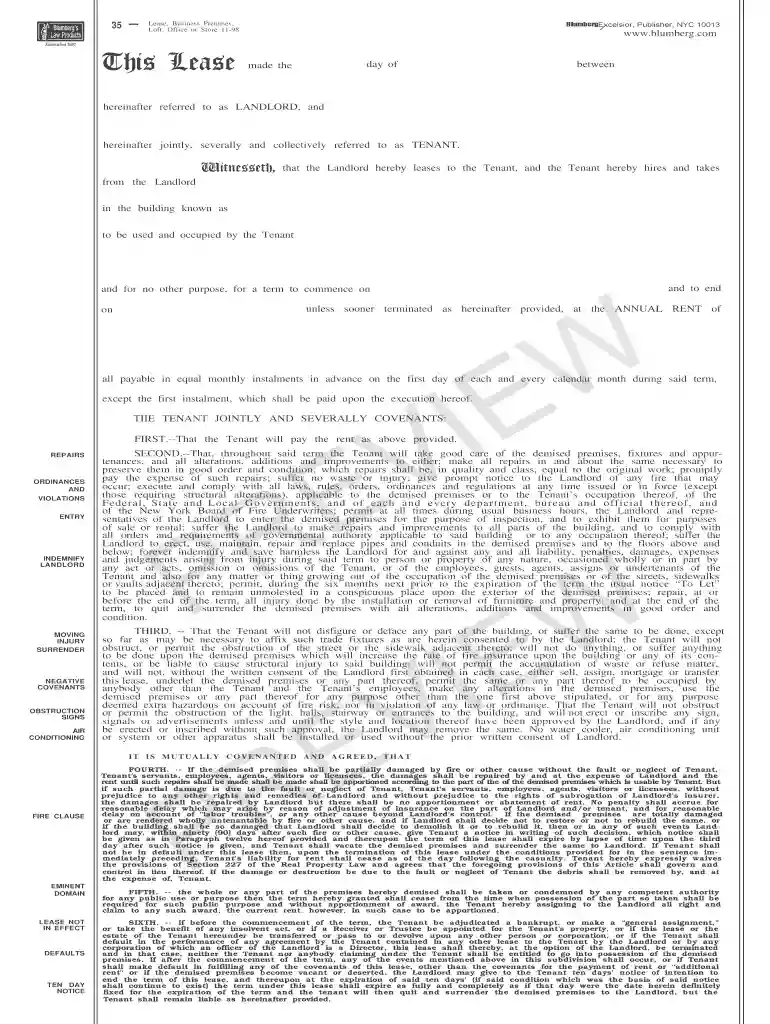
Blumberg commercial lease 2026

Get Form
blumberg commercial lease Preview on Page 1

Here's how it works

01. Edit your blumberg commercial lease online
Type text, add images, blackout confidential details, add comments, highlights and more.
02. Sign it in a few clicks
Draw your signature, type it, upload its image, or use your mobile device as a signature pad.
03. Share your form with others
Send blumberg form via email, link, or fax. You can also download it, export it or print it out.

How to use or fill out blumberg commercial lease with our platform

Form edit decoration
9.5
Ease of Setup
DocHub User Ratings on G2
9.0
Ease of Use
DocHub User Ratings on G2
  1. Click ‘Get Form’ to open the blumberg commercial lease in the editor.
  2. Begin by entering the date of the lease at the top of the document. This is crucial for establishing the timeline of your agreement.
  3. Fill in the names and addresses of both the Landlord and Tenant in their respective fields. Ensure accuracy to avoid any legal complications.
  4. Specify the premises being leased, including its address and intended use. This section clarifies what space is covered under this lease.
  5. Indicate the term of the lease, including start and end dates, along with details about rent payments, such as amount and due dates.
  6. Review sections regarding repairs, ordinances, and tenant responsibilities. Fill these out based on your understanding and agreements with the Landlord.
  7. Finally, ensure all parties sign where indicated. Use our platform’s signing feature for a seamless process.

Start using our platform today to easily fill out your blumberg commercial lease online for free!

be ready to get more

Complete this form in 5 minutes or less

Get form

Got questions?

We have answers to the most popular questions from our customers. If you can't find an answer to your question, please contact us.
Contact us
The best commercial lease type balances the risk, financial responsibilities, and operational control between landlords and tenants. Whether its the predictability of a gross lease or the autonomy of a triple net lease, understanding each option ensures a mutually beneficial agreement.Feb 4, 2025
For a commercial lease, landlords generally prefer a credit score of 680 or higher, but scores from 620 to 680 might be acceptable with strong financials, while scores below 600-620 often require a larger deposit, a personal guarantee, or alternative financing, as lenders and landlords look for a strong ability to pay, not just the score. Both personal and business credit are checked, especially for new businesses, with higher scores leading to better terms. Credit Score Ranges What to Expect: 700+ (Excellent): Best terms, lowest risk, easier approval. 680-699 (Good/Prime): Considered strong, good chance of approval, may get better rates. 620-679 (Fair): May require more documentation, a higher deposit, or a personal guarantee from owners. Below 620 (Subprime): Difficult to get approved; alternative options like larger deposits, alternative lenders, or strong business plans are crucial. Factors Beyond the Score: Business History: Cash flow, profitability, and length of time in business. Financial Documentation: Bank statements, tax returns, and a solid business plan. Personal Guarantee: Often required for new businesses to back the lease with personal assets. Security Deposit: Higher deposits (multiple months rent) can offset weaker credit. If Your Score is Low: Improve Your Credit: Pay down debts, fix errors, and avoid new credit inquiries. Provide Collateral: Offer a larger security deposit (3-6 months rent). Show Financial Strength: Present strong bank statements and a detailed business plan. Consider Alternatives: Look into SBA loans or short-term financing if purchasing, or negotiate lease terms. AI can make mistakes, so double-check responsesCommercial Lease Credit Score - BiggerPocketsMar 8, 2017 I would look at the overall credit situation rather than just the score. Does the applicant have high balances as compaBiggerPocketsWhat Credit Score Do You Need for a Commercial Lease? - Atwal RealtyYour credit score gets the conversation started, but your cash flow, financial history, business plan, and the lease terms youll Atwal Realty
Blumberg forms are commonly used in various legal contexts, particularly in real estate and business law. They serve as templates for leases, subleases, and other agreements, allowing individuals and businesses to manage legal transactions efficiently.
Red flags in a lease include vague language, clauses waiving tenant rights (like the right to a habitable space), excessive fees (late, early termination), unclear maintenance/repair responsibilities, non-refundable deposits, and clauses allowing the landlord unilateral changes or excessive entry, with other signs being pressure tactics or refusal to provide a written lease. Always read carefully, ask questions, negotiate unfavorable terms, and ensure the landlord is legitimate before signing. Lease Clause Red Flags Vague or Unclear Terms: Ambiguous language about responsibilities, repairs, or guests can lead to disputes. Waiver of Rights: Clauses that waive your right to a habitable home, repair-and-deduct, or sue the landlord are often illegal and major red flags. Excessive Fees: Unreasonably high late fees (e.g., over 10%) or exorbitant early termination penalties are problematic. Unclear Maintenance: Clauses that make you responsible for all repairs, even structural ones or pre-existing damage (like mold), are bad signs. Unfavorable Renewal/Termination: Automatic renewals or unclear subletting rules can trap you. As Is Clauses: Can make you responsible for pre-existing damage. Non-Refundable Deposits: Legally, security deposits should be refundable; ask for amendments. Excessive Entry/Storage: Clauses giving landlords unlimited entry or storage rights violate privacy. Landlord/Process Red Flags Pressure Tactics: Being rushed to sign, asked for untraceable payments (cash), or the landlord refusing to provide a written lease. No Property Visit: Refusal to let you see the property or the lease before paying. High Turnover/Complaints: Researching the property owner for previous tenant issues. Unrealistic Rent: Below-market rent can signal a scam. What to Do Get it in Writing: Demand a full, written lease. Negotiate: Request amendments for unfair clauses. Document: Take photos/videos of the propertys condition. Research: Check local tenant laws and landlord history. AI can make mistakes, so double-check responses5 Red Flags Every Renter Should Look for in a Lease | AvailFeb 7, 2022AvailLease agreements red flags : r/personalfinance - RedditApr 24, 2017 If someone asks for a deposit just to show you the place. Not showing you the lease or letting you read through it andRReddit r/personalfinance
A blumberg lease agreement is a standardized legal document obtained from a company called Blumberg for landlords and tenants to use to affirm a lease.

Security and compliance

At DocHub, your data security is our priority. We follow HIPAA, SOC2, GDPR, and other standards, so you can work on your documents with confidence.

Learn more
ccpa2
pci-dss
gdpr-compliance
hipaa
soc-compliance

People also ask

The two main types of leases are operating and financing leases. Operating leases are shorter-term agreements where the lessor maintains maintenance and insurance responsibilities. Financing leases last for the assets economic life, during which you, as the lessee, make regular payments to the lessor.Sep 24, 2025
The four main types of commercial leases are Gross Lease, where the tenant pays a flat rent and the landlord covers expenses; Net Lease, where tenants pay base rent plus some or all operating costs (like taxes, insurance, maintenance); Percentage Lease, where rent includes a percentage of the tenants sales; and sometimes a Modified Gross or Variable Lease, involving shared costs or adjustments, with Triple Net (NNN) being a common Net lease where tenants pay all operating expenses. Heres a breakdown: Gross Lease: The tenant pays a fixed rent, and the landlord is responsible for property taxes, insurance, and maintenance. Net Lease (Single, Double, Triple): Single Net (N): Tenant pays base rent + property taxes. Double Net (NN): Tenant pays base rent + property taxes + insurance. Triple Net (NNN): Tenant pays base rent + property taxes + insurance + maintenance. Percentage Lease: Tenant pays a base rent plus a percentage of their gross sales or revenue. Modified Gross Lease: A hybrid where the tenant and landlord split certain operating expenses, varying by agreement. For residential properties, common types focus more on duration and flexibility, like fixed-term (long-term) and month-to-month leases, though gross and net structures can apply. AI can make mistakes, so double-check responsesThe Four Types of Commercial Leases - AceableAgentThere are four different types of lease: gross lease, net lease, percentage lease, and variable lease. Lets have a look at each oAceableAgent4 Types of Leases to Know for Your Real Estate Exam - YouTubeNov 29, 2023 four types of lease contracts. you need to know for your real estate exam gross lease net lease percentage lease and aYouTube PrepAgent
Red flags in a commercial lease include unclear maintenance clauses, hidden costs (like unspecific CAM fees or capital improvement charges), one-sided default/termination terms, unreasonable use/signage restrictions, automatic renewal traps, cross-default clauses, personal guarantees, and clauses waiving tenant rights or exempting landlord negligence. Vague or buried language is a major warning sign, as is a lack of flexibility for business growth or unexpected changes, so always get the lease reviewed by a lawyer. Financial Red Flags Hidden Costs: Undefined Common Area Maintenance (CAM) fees, administrative overhead charges, or charges for capital improvements. Excessive Penalties: High early termination fees or exorbitant late fees. Security Deposit Issues: Clauses for automatic forfeiture or unclear refund conditions. Operational Flexibility Red Flags Vague Responsibilities: Ambiguous language on who pays for major repairs (roof, HVAC, plumbing). Restrictive Use/Signage: Overly broad use clauses or limitations on essential signage, hindering customer attraction. Limited Flexibility: Clauses restricting subleasing, assignment, or future business changes. Legal Landlord OverDocHub Red Flags One-Sided Defaults: Clauses where defaulting on another lease with the same landlord triggers a lease default (cross-defaults). Unilateral Termination/Relocation: Landlord can end the lease or move you without adequate cause or compensation. Waivers of Rights: Clauses that waive essential tenant rights, like the right to repair and deduct, or exempt landlord negligence. Ambiguous Dispute Resolution: Mandating arbitration in distant locations or under unfavorable laws. Contractual Traps Automatic Renewals: Traps tenants if they miss a notice deadline. As Is Clauses: Makes tenants responsible for pre-existing damage. Deceptive Language: Any obscure or buried clauses that hide risks. Key Takeaway Get it in Writing: Ensure all critical aspects (costs, responsibilities, terms) are crystal clear, not vague. Negotiate: Treat the lease as a contract to be negotiated, not a take-it-or-leave-it document. Professional Review: Always have a lawyer specializing in commercial real estate review the agreement before signing. AI can make mistakes, so double-check responsesRed Flags in Commercial Leases | Seder Chandler, LLPSeder Chandler, LLP5 Legal Red Flags to Watch for in Commercial Lease Agreements in South Florida - Conrad Scherer, L.L.P.Oct 12, 2025Conrad Scherer, L.L.P.

blumberg lease