Blank sbar 2026

Get Form
sbar meaning Preview on Page 1

Here's how it works

01. Edit your sbar meaning online
Type text, add images, blackout confidential details, add comments, highlights and more.
02. Sign it in a few clicks
Draw your signature, type it, upload its image, or use your mobile device as a signature pad.
03. Share your form with others
Send sbar via email, link, or fax. You can also download it, export it or print it out.

How to use or fill out blank SBAR with our platform

Form edit decoration
9.5
Ease of Setup
DocHub User Ratings on G2
9.0
Ease of Use
DocHub User Ratings on G2
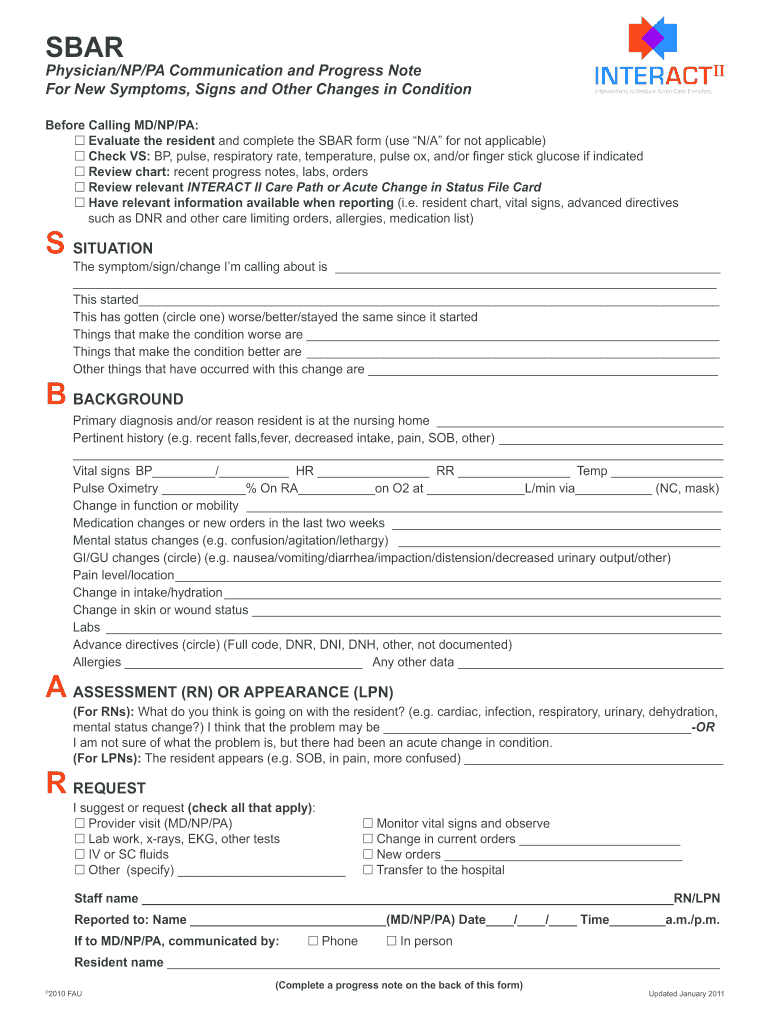
  1. Click ‘Get Form’ to open the blank SBAR in the editor.
  2. Begin with the 'SITUATION' section. Clearly describe the symptom or change in condition, including when it started and any factors that worsen or improve the situation.
  3. Move to the 'BACKGROUND' section. Provide relevant medical history, vital signs, and any recent changes in medication or function.
  4. In the 'ASSESSMENT' section, articulate your thoughts on what may be affecting the resident's health. If uncertain, note that there has been an acute change.
  5. Complete the 'REQUEST' section by checking all applicable options for further action needed, such as lab work or provider visits.
  6. Finally, fill in your name and report details at the bottom of the form before saving or sharing it directly from our platform.

Start using our platform today to streamline your SBAR completion process for free!

be ready to get more

Complete this form in 5 minutes or less

Get form

Got questions?

We have answers to the most popular questions from our customers. If you can't find an answer to your question, please contact us.
Contact us
The four SBAR headings allow you to frame conversations in a standardised was as follows: Situation. Concisely identify the current situation and give a description of the purpose for this communication. Background. Put the current situation into its context. Assessment. Recommendation.
SBAR Example Situation: The patient has been hospitalized with an upper respiratory infection. Background: The patient is a 72-year-old female with a history of congestive heart failure and chronic obstructive pulmonary disease. Assessment: Patients breathing has deteriorated in the last 30 minutes.
The components of SBAR are as follows, according to the Joint Commission: Situation: Clearly and briefly describe the current situation. Background: Provide clear, relevant background information on the patient. Assessment: State your professional conclusion, based on the situation and background.
SBAR Example Situation: The patient has been hospitalized with an upper respiratory infection. Respiration are labored and have increased to 28 breaths per minute within the past 30 minutes. Usual interventions are ineffective.
SBAR stands for Situation, Background, Assessment and Recommendation. According to Safer Healthcare, SBAR was originally developed by the U.S. Navy as a way to communicate information on nuclear submarines.

Security and compliance

At DocHub, your data security is our priority. We follow HIPAA, SOC2, GDPR, and other standards, so you can work on your documents with confidence.

Learn more
ccpa2
pci-dss
gdpr-compliance
hipaa
soc-compliance
be ready to get more

Complete this form in 5 minutes or less

Get form

People also ask

Background: He had her left hip replaced yesterday. He started complaining of chest pain about three hours ago. His pulse is 155, blood pressure 134 over 57, is restless and short of breath. Assessment: He may be having a pulmonary embolism, coronary artery disease, precordial chest pain, or a cardiac event.
SBAR, which stands for Situation, Background, Assessment, and Recommendation (or Request), is a structured communication framework that can help teams share information about the condition of a patient or team member or about another issue your team needs to address.

sbar format