
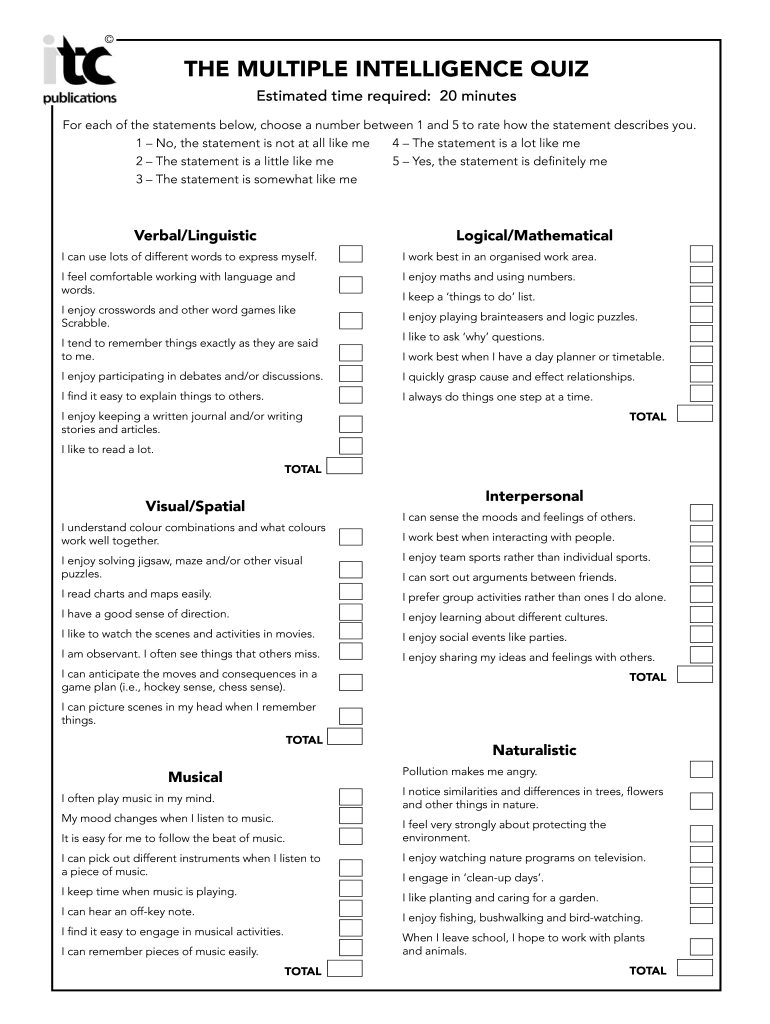







Understanding the Multiple Intelligence Test for Adults
The multiple intelligence test for adults is a self-assessment tool designed to evaluate individual strengths across various intelligence types as proposed by Howard Gardner. This quiz helps participants identify their dominant intelligences, enabling them to leverage these strengths for personal and professional development. The test categorizes intelligences into eight types: Verbal/Linguistic, Logical/Mathematical, Interpersonal, Visual/Spatial, Naturalistic, Musical, Body/Kinesthetic, and Intrapersonal.
Types of Multiple Intelligences
-
Verbal/Linguistic Intelligence: This intelligence encompasses the ability to use words effectively, both in writing and speaking. Individuals may excel in reading, writing, storytelling, or learning languages.
-
Logical/Mathematical Intelligence: Reflects the capacity for deductive and inductive reasoning, problem-solving, and understanding complex concepts. This intelligence is often found in mathematicians and scientists.
-
Interpersonal Intelligence: Involves the ability to understand and interact effectively with others. Skills in sensing others' moods, motivations, and feelings characterize this intelligence.
-
Visual/Spatial Intelligence: This type relates to understanding spatial relationships and visualizing concepts. Artists, architects, and engineers often thrive in this area.
-
Naturalistic Intelligence: The ability to recognize, categorize, and draw upon certain features of the environment. It is prevalent among biologists and environmentalists.
-
Musical Intelligence: Involves sensitivity to rhythm, pitch, tone, and quality of sound. Musicians and music critics typically exhibit high levels of this intelligence.
-
Body/Kinesthetic Intelligence: The capacity to use one’s body skillfully for expressive purposes or for goal-directed activities. This intelligence is seen in athletes and dancers.
-
Intrapersonal Intelligence: Involves self-awareness and the ability to understand one's own emotions, motivations, and inner states.
Utilization of the Multiple Intelligence Test
The multiple intelligence test can be utilized in various settings, including educational environments, corporate training, and personal development. To effectively use this test:
-
Self-Assessment: Individuals can start by taking the test, rating statements about their skills and preferences on a scale, usually one to five. This quantifies their intelligences and provides a clearer picture of their strengths.
-
Educational Guidance: Teachers and counselors can guide students or clients based on their intelligence profiles, recommending personalized learning strategies and activities that align with their natural abilities.
-
Career Development: Adults can use the findings from the test to make informed career choices or seek further training in areas where they exhibit strengths, improving job satisfaction and performance.
-
Team Dynamics: In a workplace context, understanding the diverse strengths of team members can enhance collaboration. Teams can be structured to balance different intelligences, leading to improved innovation and problem-solving.
Practical Applications of the Test Results
When individuals understand their multiple intelligences, they can engage in activities and learning that resonate with their strengths. Here are some practical activities based on different intelligences:
- Verbal/Linguistic: Participants might engage in writing workshops or join book clubs.
- Logical/Mathematical: Suitable activities include puzzles, coding, or engaging in mathematical games.
- Interpersonal: Opportunities for networking, team projects, or volunteering can foster this intelligence.
- Visual/Spatial: Activities beyond drawing or painting can extend to graphic design or architecture.
- Naturalistic: Gardening, hiking, or participating in ecology-focused initiatives can cultivate this intelligence.
- Musical: Attending concerts, learning an instrument, or composing music can be beneficial.
- Body/Kinesthetic: Sports, dance, or hands-on workshops align with this intelligence.
- Intrapersonal: Journaling or reflective practices can enhance personal growth and self-awareness.
Benefits of Taking the Test
Adopting the multiple intelligence test offers several benefits, such as:
- Personal Growth: Raises awareness of one’s own strengths and potential.
- Educational Enhancement: Informs teaching methods and learning strategies tailored to individual needs.
- Career Alignment: Assists in finding fulfilling career paths that align with natural skills and interests.
- Improved Relationships: Fosters better communication and understanding among peers by recognizing diverse strengths.
Where to Find Printable Versions
Several free resources offer printable versions of the multiple intelligence test for adults, including PDF formats. These resources can be accessed for personal use or educational purposes, making them a versatile tool for self-assessment.




