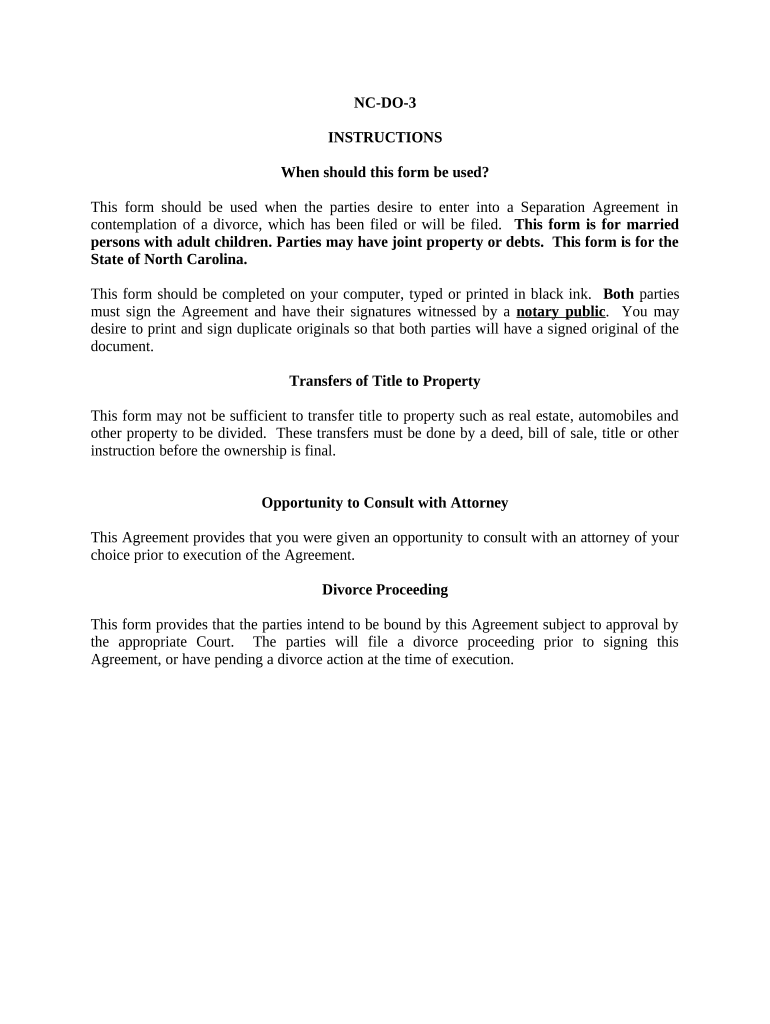
Marital Domestic Separation and Property Settlement Agreement Adult Children Parties May have Joint Property or Debts where Divorce Action Filed - North Carolina 2026

Get Form
Marital Domestic Separation and Property Settlement Agreement Adult Children Parties May have Joint Property or Debts where Divorce Action Filed - North Carolina Preview on Page 1

Here's how it works

01. Edit your form online
Type text, add images, blackout confidential details, add comments, highlights and more.
02. Sign it in a few clicks
Draw your signature, type it, upload its image, or use your mobile device as a signature pad.
03. Share your form with others
Send it via email, link, or fax. You can also download it, export it or print it out.

How to use or fill out Marital Domestic Separation and Property Settlement Agreement Adult Children Parties May have Joint Property or Debts where Divorce Action Filed - North Carolina

Form edit decoration
9.5
Ease of Setup
DocHub User Ratings on G2
9.0
Ease of Use
DocHub User Ratings on G2
  1. Click ‘Get Form’ to open it in the editor.
  2. Begin by entering the full legal names of both parties at the top of the form, ensuring accuracy for legal purposes.
  3. In Section 1, outline the separation details, including the date of separation and any relevant circumstances that led to this agreement.
  4. Proceed to Section 2 to disclose financial information. Each party should list their assets and liabilities honestly to ensure a fair settlement.
  5. In Sections 3 and 4, detail the division of assets and debts. Clearly describe each item and its current market value, ensuring both parties agree on ownership.
  6. Complete Sections regarding spousal support (if applicable) and future earnings, making sure all terms are clearly defined.
  7. Finally, both parties must sign the document in front of a notary public to validate the agreement legally.

Start using our platform today for free to streamline your document editing and signing process!

be ready to get more

Complete this form in 5 minutes or less

Get form

Got questions?

We have answers to the most popular questions from our customers. If you can't find an answer to your question, please contact us.
Contact us
A settlement agreement differs from a separation agreement as it sets the terms for the divorce, not the separation. A settlement agreement should address all central issues of the divorce. This can include things like division of marital assets and debts, child custody, and child support, as well as spousal support.
Making decisions like moving out without a separation agreement, misusing marital assets, making big life changes, and badmouthing your spouse can all complicate the divorce process.
Dont rush and make emotional decisions, turn down opportunities to spend time with your children, say bad things about your spouse, take on more debt, hide income and assets, get a new boyfriend or girlfriend, or say anything on social media about your situation.
In your affidavit, you need to prove that there has been a change in the marriage, gradual or sudden, showing you and your spouse have separated. You will need to explain any: change in sleeping arrangements. reduction in shared activities or family outings.
How can I get legally separated in North Carolina? A separation agreement or other written document is not required to be legally separated in North Carolina. To be considered separated from your spouse, you need to be living in different homes, and at least one of you needs to intend that the separation be permanent.

Security and compliance

At DocHub, your data security is our priority. We follow HIPAA, SOC2, GDPR, and other standards, so you can work on your documents with confidence.

Learn more
ccpa2
pci-dss
gdpr-compliance
hipaa
soc-compliance

People also ask

What is a spouse entitled to in a divorce in NC? A spouse is typically entitled to some amount of alimony or spousal support, depending on the decision of the NC divorce courts. A spouse may also be entitled to a 50/50 split of marital property if so decided by the courts.

Related links