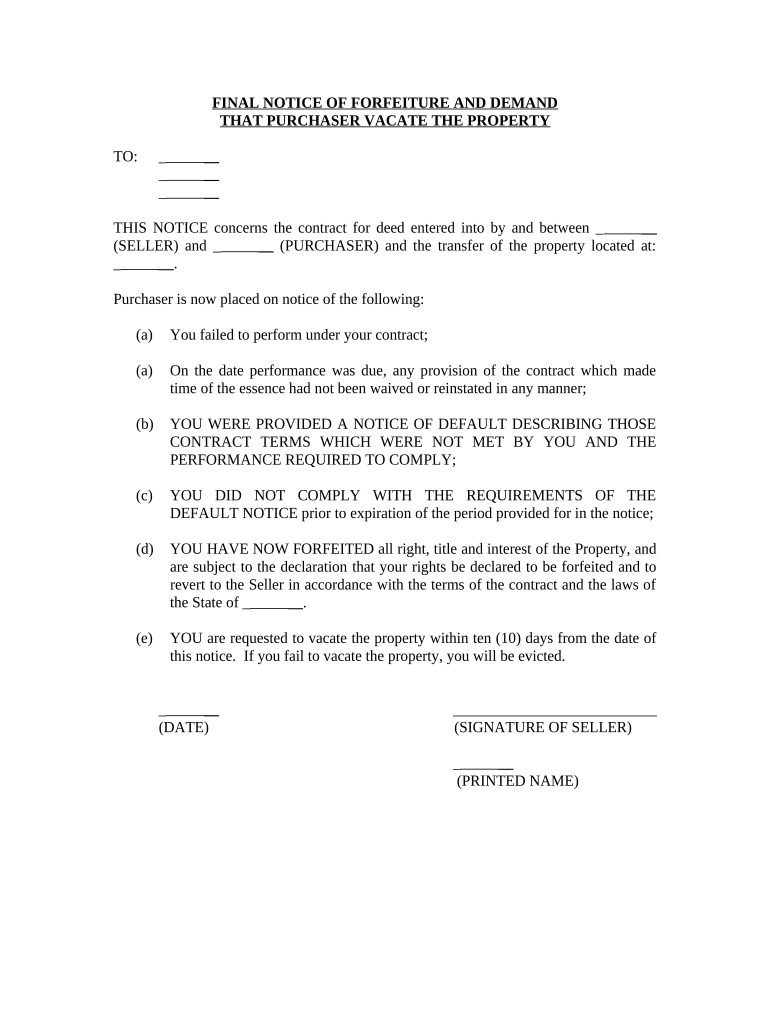
Final Notice of Forfeiture and Request to Vacate Property under Contract for Deed - North Carolina 2026

Get Form
Final Notice of Forfeiture and Request to Vacate Property under Contract for Deed - North Carolina Preview on Page 1

Here's how it works

01. Edit your form online
Type text, add images, blackout confidential details, add comments, highlights and more.
02. Sign it in a few clicks
Draw your signature, type it, upload its image, or use your mobile device as a signature pad.
03. Share your form with others
Send it via email, link, or fax. You can also download it, export it or print it out.

How to use or fill out Final Notice of Forfeiture and Request to Vacate Property under Contract for Deed - North Carolina

Form edit decoration
9.5
Ease of Setup
DocHub User Ratings on G2
9.0
Ease of Use
DocHub User Ratings on G2
  1. Click ‘Get Form’ to open it in the editor.
  2. Begin by entering the names and addresses of both the Seller and Purchaser in the designated fields. Ensure accuracy as this information is crucial for legal purposes.
  3. In the section detailing the property, input the complete address of the property involved in the contract for deed. This ensures clarity regarding which property is being referenced.
  4. Review each point listed under 'Purchaser is now placed on notice.' Confirm that all statements accurately reflect your situation, particularly regarding compliance with contract terms.
  5. Fill in the date at the bottom of the notice, ensuring it reflects when you are issuing this final notice.
  6. Finally, sign and print your name where indicated. This step formalizes your notice and makes it legally binding.

Start using our platform today to easily fill out your Final Notice of Forfeiture form for free!

be ready to get more

Complete this form in 5 minutes or less

Get form

Got questions?

We have answers to the most popular questions from our customers. If you can't find an answer to your question, please contact us.
Contact us
A contract for deed would be known as a real estate contract, and is a common method to document a sale. For a purchaser, with an increased possibility of a seller default based upon the owners present default, I do not recommend using a contract. The biggest risk is that the seller remains as the legal owner.
This file serves as a notice to inform you of a default in a contract for deed. It outlines the necessary steps required to remedy the default. Use this form to understand your rights and obligations regarding your property.
Other risks include: (1) the loan remains on a Sellers credit report, (2) Seller is still liable for the loan, (3) risk of non-payment by the buyer, and (4) the buyer never goes through a formal application process like with a regular mortgage.
Instead of going to a separate mortgage lender for a loan to pay the seller the full price of the property, the buyer agrees to pay the seller in monthly installments. The seller keeps the deed to the property until the contract is fulfilled. The deed represents legal ownership of the home.
Contracts for deed are loans where the seller keeps the legal title of a home until the borrower makes all the payments. Some contracts for deed can provide a path to homeownership, but most carry risks.

Security and compliance

At DocHub, your data security is our priority. We follow HIPAA, SOC2, GDPR, and other standards, so you can work on your documents with confidence.

Learn more
be ready to get more

Complete this form in 5 minutes or less

Get form

People also ask

Legal Recourse/Protections Some states provide specific protections for contract for deed buyers, and the contract itself can provide protections if properly drafted. In the event of missed payments, some states provide buyers and sellers rights similar to traditional foreclosure protections.

Related links