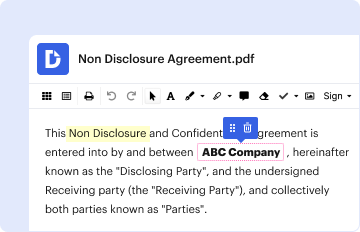
Type text, add images, blackout confidential details, add comments, highlights and more.
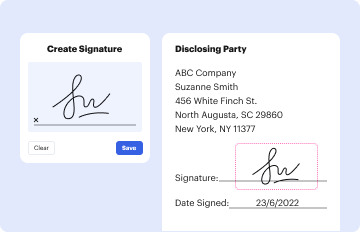
02. Sign it in a few clicks
Draw your signature, type it, upload its image, or use your mobile device as a signature pad.
03. Share your form with others
Send it via email, link, or fax. You can also download it, export it or print it out.
How to use or fill out Quitclaim Deed from Husband to Himself and Wife - Rhode Island with our platform
Ease of Setup
DocHub User Ratings on G2
Ease of Use
DocHub User Ratings on G2
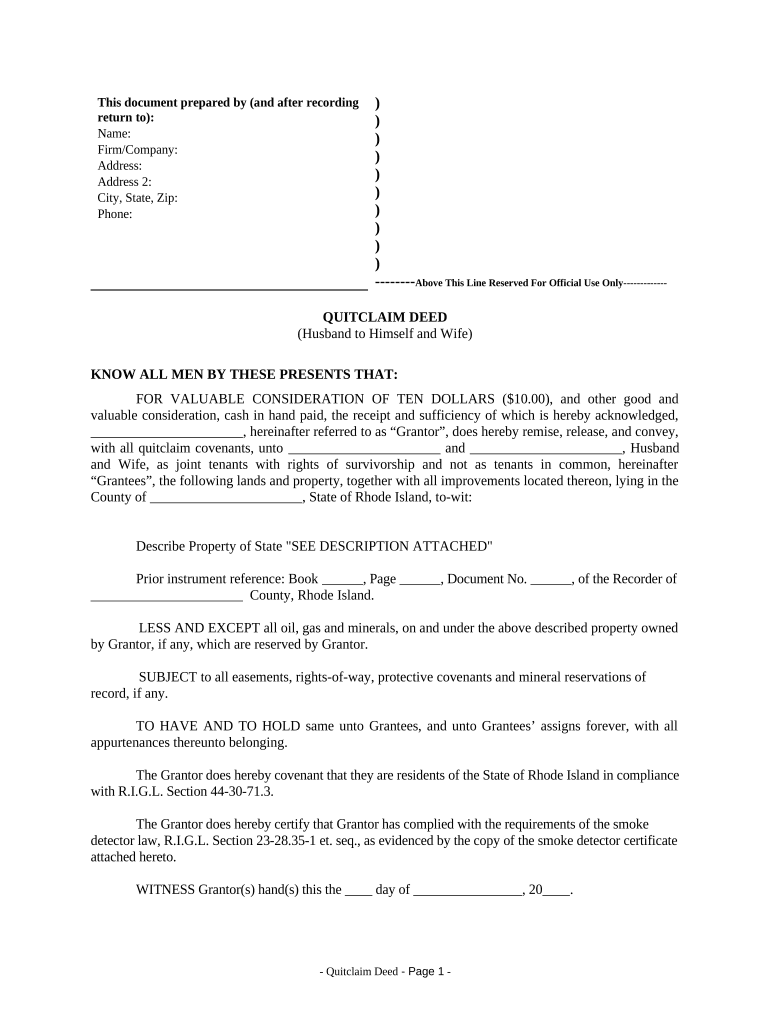
Click ‘Get Form’ to open the Quitclaim Deed in the editor.
Begin by entering the Grantor's name, firm/company, address, and contact information in the designated fields at the top of the form.
In the section labeled 'KNOW ALL MEN BY THESE PRESENTS THAT', fill in the Grantor's name again and specify the Grantees' names as 'Husband' and 'Wife'.
Describe the property being conveyed by filling in details about its location and any improvements. If there is a separate description attached, indicate that accordingly.
Complete any prior instrument references if applicable, including Book, Page, and Document numbers.
Ensure you check any exceptions or reservations regarding oil, gas, minerals, or easements that may apply to your property.
The Grantor must certify compliance with local laws regarding residency and smoke detector requirements by signing where indicated.
Finally, have a Notary Public witness your signatures and complete their section for notarization.
Start using our platform today to easily fill out your Quitclaim Deed for free!
Fill out Quitclaim Deed from Husband to Himself and Wife - Rhode Island online It's free
What is the difference between a quitclaim deed and an interspousal?
The difference between a Quit Claim Deed and an Interspousal Transfer Grant Deed is liability. The spouse who selects to give up their interest in the property can be held liable for taxes, liens and other debts associated with the property in a Quit Claim Deed but not in an Interspousal Transfer Grant Deed.
What is the most common circumstance in which someone will issue a quitclaim deed?
Quitclaim deeds can be used in a number of different situations, though they are most common when transferring property between family members or spouses. For example, after a divorce one spouse may sign a quitclaim deed to officially sign over ownership of the home.
Who benefits the most from a quitclaim deed?
The quitclaim deed simply transfers any interest they may have to the other party. Because of the lack of title guarantees, quitclaim deeds are most often used to transfer property between two parties who know and trust each other, such as family members.
What are the disadvantages of a quit claim deed?
A quitclaim deed is a straightforward document that transfers ownership, or the interest in a property, from one person to another.
Does a quitclaim deed give you ownership?
A quitclaim deed is a simple tool for transferring interest in a property without guaranteeing that the grantor has valid ownership. Its most commonly used in non-sale situations, such as transfers between family members, or to update or clarify ownership titles.
Related Searches
Legal risks to signing interspousal transfer deedLegal risks to signing interspousal transfer deed CaliforniaInterspousal transfer deed during marriageInterspousal Deed CaliforniaInterspousal transfer deed pdfInterspousal transfer deed formInterspousal Transfer Deed California instructionsInterspousal transfer deed vs quitclaim
Security and compliance
At DocHub, your data security is our priority. We follow HIPAA, SOC2, GDPR, and other standards, so you can work on your documents with confidence.
A deed substantially following the form entitled Quitclaim Deed shall, when duly executed, have the force and effect of a deed in fee simple to the grantee and his or her heirs and assigns, to his, her, and their own use, with covenants on the part of the grantor, for himself or herself and for his or her heirs,
Related links
Karen F. Carroll v. Lisa Rodriques, et al., C.A.
Sep 22, 2017 Carroll would deed the property from himself, to himself and his wife, as tenants by the entirety. Adverse Possession in Rhode Island In 1896,
Cookie consent notice
This site uses cookies to enhance site navigation and personalize your experience.
By using this site you agree to our use of cookies as described in our Privacy Notice.
You can modify your selections by visiting our Cookie and Advertising Notice.