




01. Edit your temporary guardianship without court florida pdf online
Type text, add images, blackout confidential details, add comments, highlights and more.

Type text, add images, blackout confidential details, add comments, highlights and more.

Draw your signature, type it, upload its image, or use your mobile device as a signature pad.

Send temporary guardianship without court florida via email, link, or fax. You can also download it, export it or print it out.
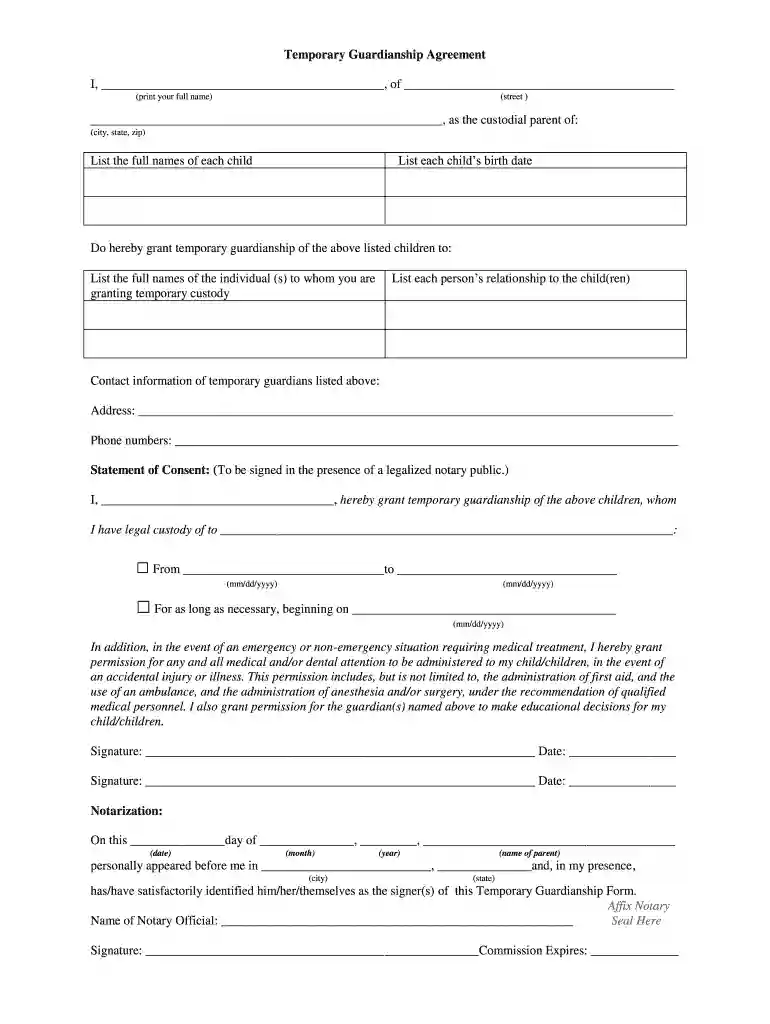
A temporary guardianship form in Florida is a legal document that allows a parent or legal guardian to designate another individual to care for their child or children for a limited period. This form is particularly useful in situations where the parent is unable to provide immediate care due to various circumstances, such as illness, travel, or other personal matters. The form outlines the responsibilities and authority granted to the temporary guardian, including the ability to make medical and educational decisions.
This document is vital for ensuring that proper care and decision-making can continue seamlessly during a parent's absence. Without it, a temporary guardian may face challenges in making critical decisions on behalf of the children.
Completing a temporary guardianship form in Florida involves several essential steps. Following these steps ensures that the form is filled out accurately and meets legal requirements.
Following these steps ensures that the temporary guardianship arrangement is legally sound and recognized by all necessary entities.
There are several key considerations when setting up a temporary guardianship in Florida to ensure that the agreement is effective and protects the rights of all parties involved.
Being aware of these considerations helps ensure that the temporary guardianship arrangement functions smoothly and effectively in the interest of the child.
In Florida, there are different types of temporary guardianship arrangements that cater to specific circumstances, including:
Understanding the different forms helps parents select the right arrangement based on their immediate needs and the specific context of guardianship.
Notarization plays a critical role in making a temporary guardianship form legally enforceable. The presence of a notary public serves to authenticate the identities of the parties involved, ensuring that the signatures on the document are legitimate.
The notarization step not only lends credibility to the guardianship arrangement but also helps prevent potential disputes regarding its validity.
There are various situations under which a temporary guardianship form may be utilized in Florida. Common scenarios include:
Each scenario illustrates the form's utility in ensuring that children's needs are met effectively and consistently, according to the stipulations of their custodial parent.
At DocHub, your data security is our priority. We follow HIPAA, SOC2, GDPR, and other standards, so you can work on your documents with confidence.




Guardianship is only warranted when no less restrictive alternatives, such as a durable power of attorney, a trust, a health care surrogate or proxy, or anotherRead more
This form is to be completed and signed by a parent who agrees to grant temporary custody of a minor child or child(ren) to an extended family member andRead more
Oct 1, 2017 DHTS is responsible for establishing goals to reduce motor vehicle crashes using performance measures based on assessments of the roadwayRead more


