Letter from Tenant to Landlord about Landlord using Unlawful Self-Help to Gain Possession - Oregon 2026

Get Form
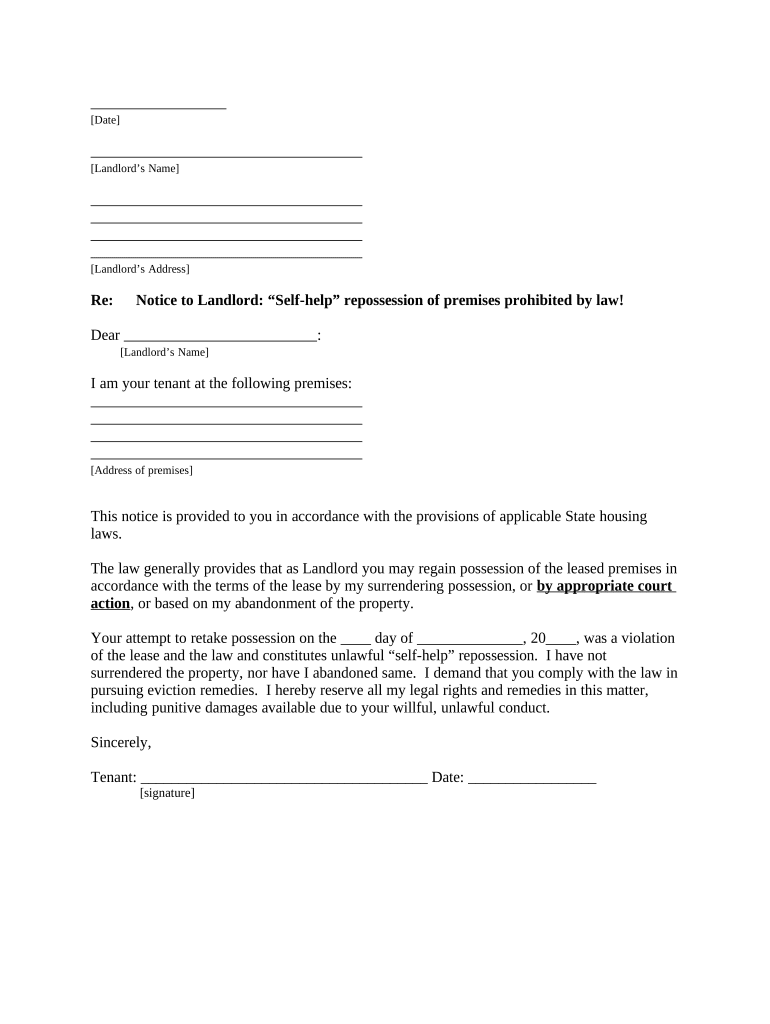
Letter from Tenant to Landlord about Landlord using Unlawful Self-Help to Gain Possession - Oregon Preview on Page 1

Here's how it works

01. Edit your form online
Type text, add images, blackout confidential details, add comments, highlights and more.
02. Sign it in a few clicks
Draw your signature, type it, upload its image, or use your mobile device as a signature pad.
03. Share your form with others
Send it via email, link, or fax. You can also download it, export it or print it out.

How to use or fill out Letter from Tenant to Landlord about Landlord using Unlawful Self-Help to Gain Possession - Oregon with our platform

Form edit decoration
9.5
Ease of Setup
DocHub User Ratings on G2
9.0
Ease of Use
DocHub User Ratings on G2
  1. Click ‘Get Form’ to open it in the editor.
  2. Begin by entering the date at the top of the letter. This is important for record-keeping and establishing a timeline.
  3. Fill in the landlord’s name and address in the designated fields. Ensure accuracy to avoid any miscommunication.
  4. In the body of the letter, clearly state your address as the tenant. This identifies you and connects you to the premises in question.
  5. Detail the unlawful self-help repossession incident by specifying the date it occurred. This strengthens your position by providing context.
  6. Sign and date at the bottom of the letter, ensuring that your signature matches any previous documents for consistency.
  7. Complete the Proof of Delivery section by selecting how you delivered this notice to your landlord, and sign again with the delivery date.

Start using our platform today for free to efficiently complete your tenant notice!

be ready to get more

Complete this form in 5 minutes or less

Get form

Got questions?

We have answers to the most popular questions from our customers. If you can't find an answer to your question, please contact us.
Contact us
Around 5% of cases were settled, and another 5% were dismissed without prejudice to be re-filed later. In most eviction cases, the landlord can secure a writ of possession and reclaim their property. There are, however, cases when the tenant is in the right and able to remain in the property for the foreseeable future.
Under a recently enacted law, HB 3522, which goes into effect in 2026, landlords can utilize the Forcible Entry and Detainer (FED) process to evict squatters. This marks a docHub shift in landlord-tenant law and provides property owners with a more streamlined method for reclaiming their property.
In California, landlords must be aware of the proper protocol for disposing of a tenants belongings after eviction. Its illegal for landlords to simply discard or throw them away and a landlord must notify you in writing of these rights.
No. Absolutely not. Your landlord cannot go through your things, nor can they remove any of your property unless you have been evicted by the courts and served by the Sheriff.

Security and compliance

At DocHub, your data security is our priority. We follow HIPAA, SOC2, GDPR, and other standards, so you can work on your documents with confidence.

Learn more
ccpa2
pci-dss
gdpr-compliance
hipaa
soc-compliance