Type text, add images, blackout confidential details, add comments, highlights and more.
02. Sign it in a few clicks
Draw your signature, type it, upload its image, or use your mobile device as a signature pad.
03. Share your form with others
Send it via email, link, or fax. You can also download it, export it or print it out.
How to use or fill out Release for Diverting Water in Favor of Governmental Agency with DocHub
Ease of Setup
DocHub User Ratings on G2
Ease of Use
DocHub User Ratings on G2
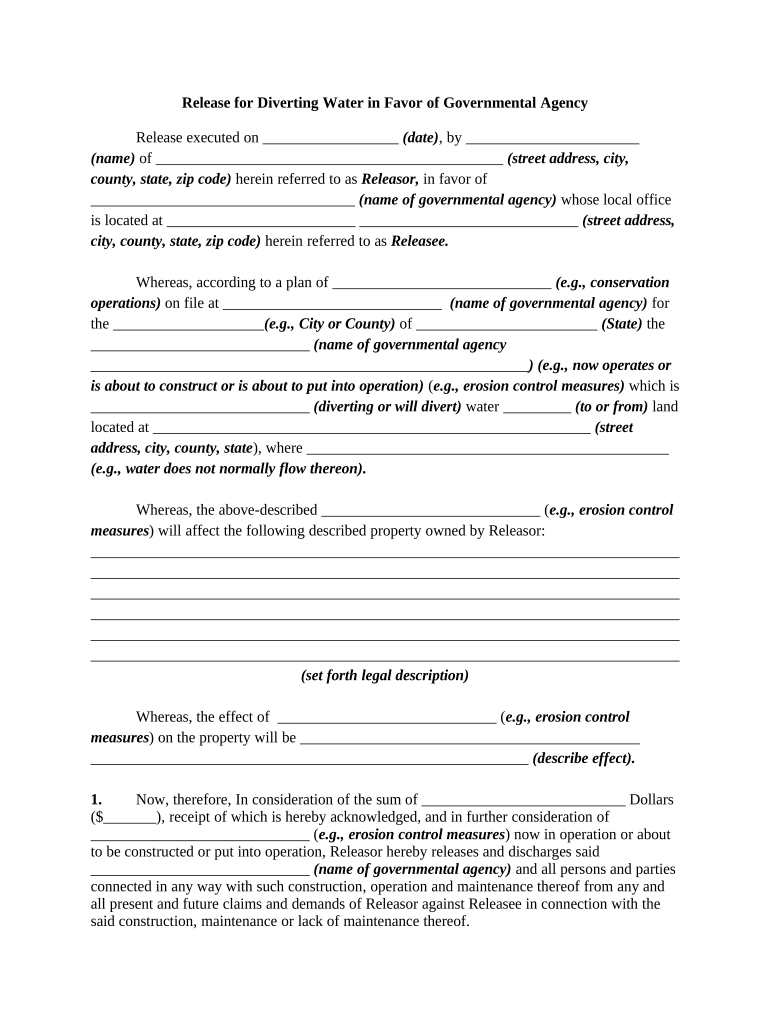
Click ‘Get Form’ to open the Release for Diverting Water in Favor of Governmental Agency in our editor.
Begin by entering the date of execution in the designated field. This is crucial as it marks the official start of the agreement.
Fill in your name and complete address as the Releasor. Ensure all details are accurate to avoid any legal complications.
Next, specify the name and address of the governmental agency that will benefit from this release. This identifies who you are releasing claims against.
Describe the plan related to water diversion, including its purpose and location. This section clarifies what operations are being conducted.
Provide a detailed legal description of your property affected by these operations. This ensures clarity on which property is involved.
Indicate any effects that these operations will have on your property, ensuring transparency about potential impacts.
Finally, acknowledge receipt of compensation and sign where indicated. Don’t forget to include a notary acknowledgment if required by your state.
Start using our platform today to easily fill out and manage your documents for free!
Fill out Release for Diverting Water in Favor of Governmental Agency online It's free
What is a State Water Resources Development System right-of-wayPrior appropriation water rights are best described asAppropriative water rightsMORE water ActWhat are prescriptive water rightsAppropriative water rights vs riparianWho was responsible for the creation of prior appropriation water rightsPrescriptive water rights are considered abandoned after
Security and compliance
At DocHub, your data security is our priority. We follow HIPAA, SOC2, GDPR, and other standards, so you can work on your documents with confidence.
Dec 1, 2025 In Colorado a water right authorizes the diversion of water for a legally recognized beneficial use [6]. Colorado law defines beneficial useRead more
Padilla Introduces Bills to Bolster Californias Water Supply
Feb 4, 2026 The program benefits water supply as well as the environment by reducing the need to divert water from rivers and the Delta. California alsoRead more
Cookie consent notice
This site uses cookies to enhance site navigation and personalize your experience.
By using this site you agree to our use of cookies as described in our Privacy Notice.
You can modify your selections by visiting our Cookie and Advertising Notice.