Corporate guaranty 2026

Get Form
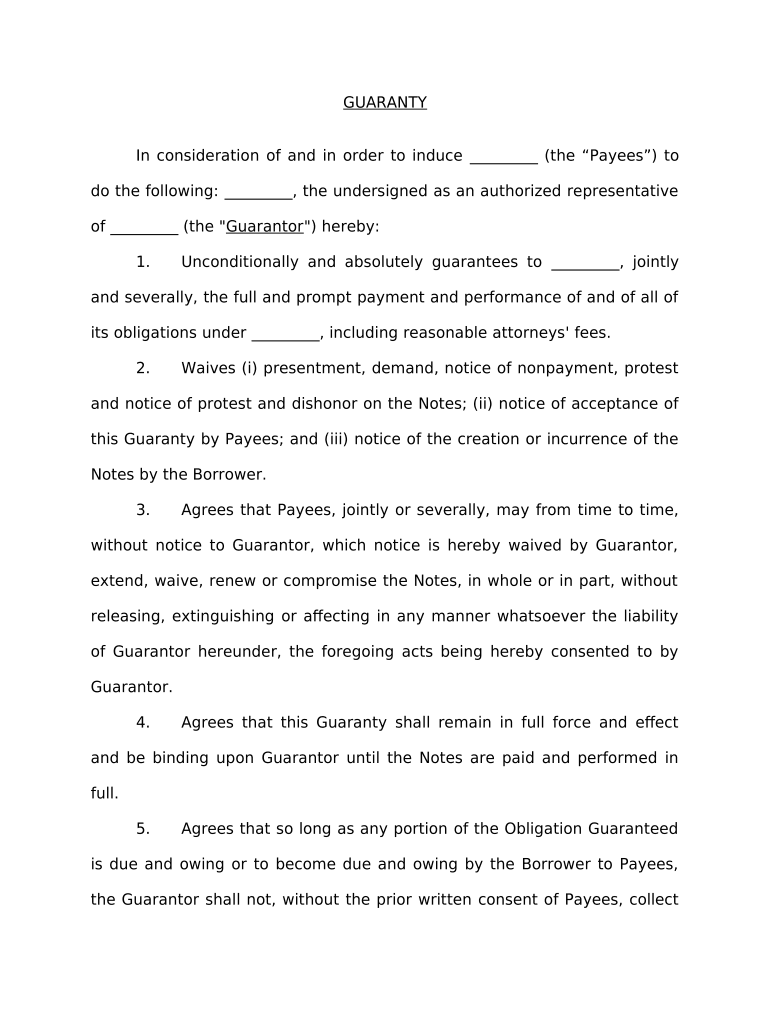
corporate guaranty Preview on Page 1

Here's how it works

01. Edit your form online
Type text, add images, blackout confidential details, add comments, highlights and more.
02. Sign it in a few clicks
Draw your signature, type it, upload its image, or use your mobile device as a signature pad.
03. Share your form with others
Send it via email, link, or fax. You can also download it, export it or print it out.

How to use or fill out corporate guaranty with our platform

Form edit decoration
9.5
Ease of Setup
DocHub User Ratings on G2
9.0
Ease of Use
DocHub User Ratings on G2
  1. Click ‘Get Form’ to open the corporate guaranty in the editor.
  2. In the first section, enter the name of the Payees and describe the obligations they are undertaking. This sets the context for the guarantee.
  3. Next, fill in the Guarantor's details, including their name and title. This identifies who is providing the guarantee.
  4. Proceed to section one where you will confirm your unconditional guarantee of payment and performance. Ensure all obligations are clearly stated.
  5. In section two, acknowledge waivers regarding presentment and notice requirements. This is crucial for understanding your rights.
  6. Continue through sections three to seven, ensuring you agree to terms regarding liability, possession of the instrument, and binding agreements on successors.
  7. Finally, date the document and sign as Guarantor. If required, have it notarized by filling in notary details at the end of the form.

Start using our platform today for free to streamline your corporate guaranty process!

be ready to get more

Complete this form in 5 minutes or less

Get form

Got questions?

We have answers to the most popular questions from our customers. If you can't find an answer to your question, please contact us.
Contact us
A corporate guarantee is a legal commitment by a company to cover the debt or obligations of another party if they default. There are various types of corporate guarantees, including absolute, conditional, performance, payment, and limited guarantees, each with unique implications.
Further, bank guarantees are commonly associated with financial transactions, while corporate guarantees serve a broader range of functions, including securing loans, facilitating business relationships, and supporting subsidiary operations.
The difference between corporate and personal guarantees is quite simple. A personal guarantee is when an individual agrees to take on the obligations of a debt for a debtor, whereas a corporate guarantee is when a guarantor is a corporation that takes on payment responsibilities.
A corporate guarantee is a contract between a corporate entity or individual and a debtor. In this contract, the guarantor agrees to take responsibility for the debtors obligations, such as repaying a debt.
However, the two are often considered different because of the different choice of words or pronunciations used. For example, collateral is commonly used to describe Unsecured Loans or KTA. On the other hand, the word guarantee is usually used to describe bank loans that require assets from the borrower as collateral.

Security and compliance

At DocHub, your data security is our priority. We follow HIPAA, SOC2, GDPR, and other standards, so you can work on your documents with confidence.

Learn more
ccpa2
pci-dss
gdpr-compliance
hipaa
soc-compliance
be ready to get more

Complete this form in 5 minutes or less

Get form

People also ask

Traditionally, a distinction is made between: Real guarantees relating to assets having an intrinsic value. Personal guarantees involving a debt obligation for one or more people. Moral guarantees that do not provide the lender with any real legal security.

Related links