Confidentiality and Nondisclosure Agreement - Evaluation Materials 2026

Get Form
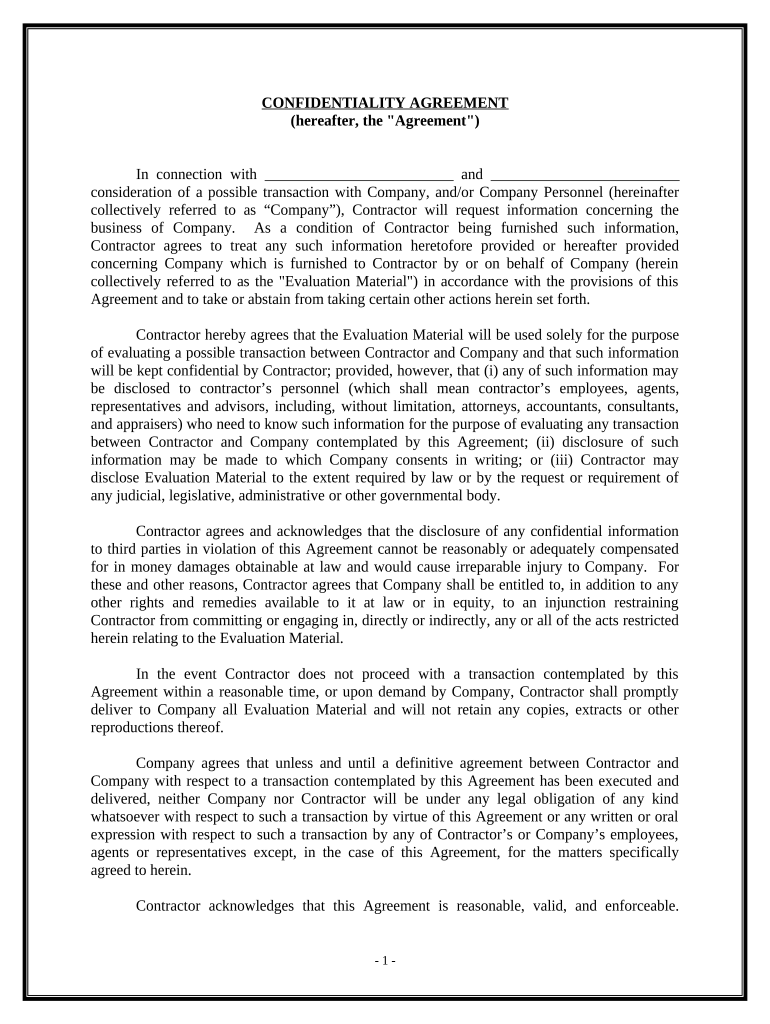
Confidentiality and Nondisclosure Agreement - Evaluation Materials Preview on Page 1

Here's how it works

01. Edit your form online
Type text, add images, blackout confidential details, add comments, highlights and more.
02. Sign it in a few clicks
Draw your signature, type it, upload its image, or use your mobile device as a signature pad.
03. Share your form with others
Send it via email, link, or fax. You can also download it, export it or print it out.

How to use or fill out Confidentiality and Nondisclosure Agreement - Evaluation Materials

Form edit decoration
9.5
Ease of Setup
DocHub User Ratings on G2
9.0
Ease of Use
DocHub User Ratings on G2
  1. Click ‘Get Form’ to open it in the editor.
  2. Begin by filling in the names of the parties involved in the agreement at the top of the document. This establishes who is bound by the terms.
  3. In the section regarding 'Evaluation Material', ensure you understand that this refers to any confidential information shared during your evaluation process. Review this section carefully.
  4. Fill out any specific details required, such as the state governing this agreement, ensuring accuracy for legal compliance.
  5. Sign and date the document at the bottom. Make sure both parties have signed before proceeding with any transactions.
  6. Once completed, save your changes and share or download your finalized document directly from our platform for easy distribution.

Start using our platform today to streamline your document editing and signing process for free!

be ready to get more

Complete this form in 5 minutes or less

Get form

Got questions?

We have answers to the most popular questions from our customers. If you can't find an answer to your question, please contact us.
Contact us
Expect to see the parts of an NDA listed above, including the identification of parties, definitions, obligations, scope, time frame, return of information, exclusions, and remedies. There may also be clauses about mutual non-disclosure or non-solicitation, as well as one stating the jurisdiction for handling disputes.
What is a nondisclosure agreement? Whereas confidentiality agreements are typically devised in employment or personal situations to protect sensitive information, NDAs are often used in business and legal settings to protect trade secrets, client lists, and financial data.
This Nondisclosure Agreement (the Agreement) is entered into by and between , with its principal offices at (Disclosing Party), and , with its principal offices at (Receiving Party), for the purpose of preventing unauthorized disclosure of Confidential
When reviewing an NDA, identify the exact information classified as confidential. Check if the agreement is mutual, protecting both parties information equally. Confirm that confidentiality obligations have a clear end date rather than lasting indefinitely.
The nondisclosure agreement should identify the parties to the agreement and which one is the disclosing party, or side sharing the information, and the recipient. Names and addresses of the parties should be included. The agreement should also identify other individuals who may be parties to the agreement.

Security and compliance

At DocHub, your data security is our priority. We follow HIPAA, SOC2, GDPR, and other standards, so you can work on your documents with confidence.

Learn more
be ready to get more

Complete this form in 5 minutes or less

Get form

People also ask

The key elements of Non-Disclosure Agreements: Identification of the parties. Definition of what is deemed to be confidential. The scope of the confidentiality obligation by the receiving party. The exclusions from confidential treatment. The term of the agreement.

Related links