Jury Instruction - Bribery Or Reward Of Bank Officer 2026

Get Form
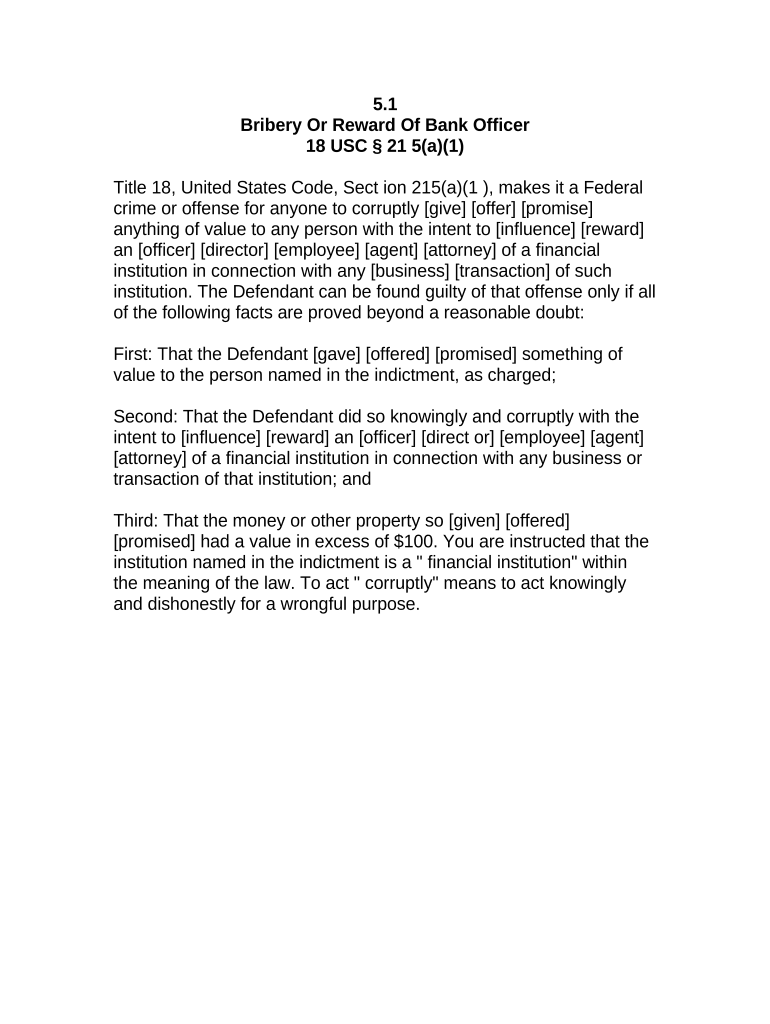
Jury Instruction - Bribery Or Reward Of Bank Officer Preview on Page 1

Here's how it works

01. Edit your form online
Type text, add images, blackout confidential details, add comments, highlights and more.
02. Sign it in a few clicks
Draw your signature, type it, upload its image, or use your mobile device as a signature pad.
03. Share your form with others
Send it via email, link, or fax. You can also download it, export it or print it out.

How to use or fill out Jury Instruction - Bribery Or Reward Of Bank Officer with our platform

Form edit decoration
9.5
Ease of Setup
DocHub User Ratings on G2
9.0
Ease of Use
DocHub User Ratings on G2
  1. Click ‘Get Form’ to open the Jury Instruction - Bribery Or Reward Of Bank Officer in the editor.
  2. Begin by reviewing the introductory section, which outlines the legal framework under Title 18, United States Code, Section 215(a)(1). This will help you understand the context of the instructions.
  3. Proceed to fill in the fields regarding the actions of the Defendant. You will need to select from options such as [gave], [offered], or [promised] something of value. Ensure that your selection aligns with the specifics of your case.
  4. Next, indicate whether the intent was to [influence] or [reward] an officer or employee of a financial institution. This is crucial for establishing intent.
  5. Complete the section regarding the value of what was given, ensuring it exceeds $100 as required by law. This detail is essential for proving guilt beyond a reasonable doubt.
  6. Finally, review all filled sections for accuracy and completeness before saving or exporting your document for further use.

Start using our platform today to efficiently complete your Jury Instruction forms online and for free!

be ready to get more

Complete this form in 5 minutes or less

Get form

Got questions?

We have answers to the most popular questions from our customers. If you can't find an answer to your question, please contact us.
Contact us
This jury instruction addresses the establishment of the two factual elements underlying the presumption of negligence. If they are not established, then a finding of negligence cannot be based on the alleged statutory violation. However, negligence can still be proven by other means. (See Nunneley v.
Jury instructions tell the jury what the laws are that govern a particular case. Each attorney gives the judge a set of proposed jury instructions. The judge considers each instruction and gives the one that properly states the law that applies to the case.
California Penal Code 93 PC is a closely related statute that states: All judicial officers, jurors, referees, arbitrators, or umpires that ask, receive, or agree to any bribe to influence their decision is facing up to four years in prison, and if no bribe was received, by restitution and a fine up to $10,000.
The judge will instruct the jury in each separate case as to the law of that case. For example, in each criminal case, the judge will tell the jury, among other things, that a defendant charged with a crime is presumed to be innocent and the burden of proving his guilt beyond a reasonable doubt is upon the Government.
Judges are the individuals responsible for delivering jury instructions in a trial. They guide jurors on the applicable laws and their duties during deliberations, ensuring fair decision-making. While attorneys present arguments, only judges provide these essential legal instructions to the jury.

Security and compliance

At DocHub, your data security is our priority. We follow HIPAA, SOC2, GDPR, and other standards, so you can work on your documents with confidence.

Learn more
ccpa2
pci-dss
gdpr-compliance
hipaa
soc-compliance
be ready to get more

Complete this form in 5 minutes or less

Get form

People also ask

Preliminary instructions occur at the beginning of a trial and typically inform the jury on the basics of reviewing evidence and other responsibilities. During the trial, courts may give limiting instructions that inform jurors how to evaluate specific evidence and curative instructions to correct evidentiary errors.

Related links